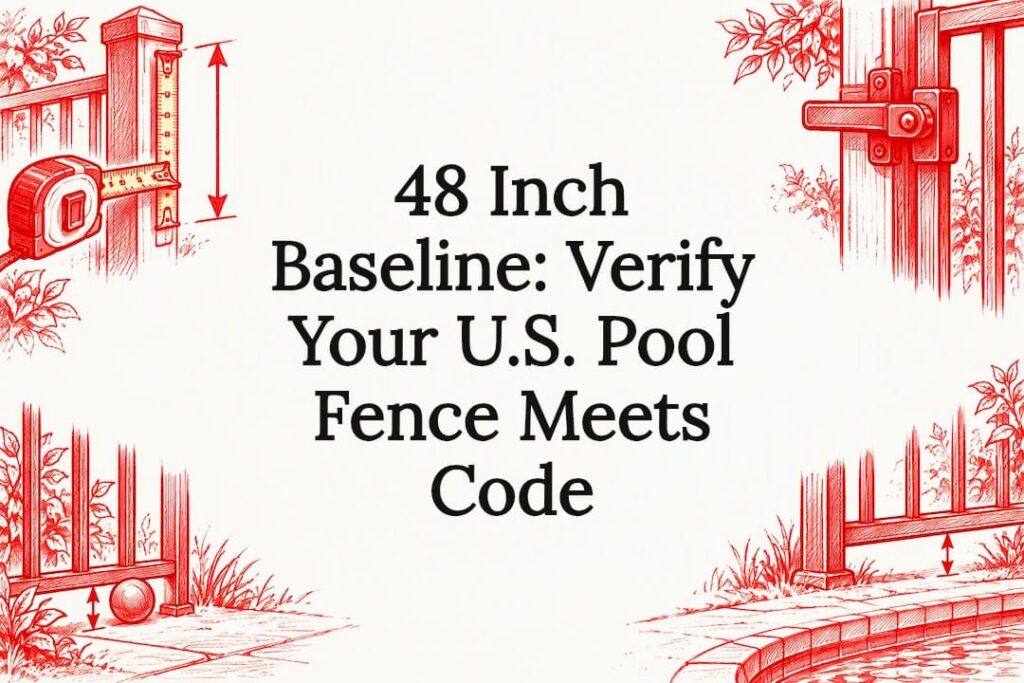
Most U.S. jurisdictions require a pool barrier of minimum code-compliant height, typically measured on the side facing away from the pool, with gates that open outward, close on their own, and latch out of a child’s reach. Some states and cities set higher barrier heights or add stricter gap and alarm rules, so verify the exact requirements with your local building or permit office before you build or buy fencing, and measure what you already have against the applicable baseline.
TL;DR:
- Most jurisdictions require a pool barrier at least 48 inches high, with some enforcing 60 inches or higher, so verify local height standards before building.
- Gates must open outward, be self-closing and self-latching, with latches at least 54 inches above the ground unless facing the pool side and set back from children’s reach.
- Bottom clearance should not exceed 4 inches for solid barriers and 2 inches for non-solid surfaces, with openings no larger than four inches for spheres.
- Above-ground pools can count as part of the barrier if their walls are at least 48 inches tall and securely anchored, and ladders must be removable or locked when unsupervised.
- Non-compliance typically blocks final permits, and failure to meet code can increase liability risk, impede sales, and result in fines or inspection failures.
Table of Contents
- The national baseline: ISPSC and CPSC rules behind local codes
- The exact measurements your fence has to meet
- Above-ground pools, spas, and construction fencing
- Using your house wall as part of the barrier
- Finding the exact rule that applies at your address
- A pre-inspection checklist and the mistakes that fail it
- What happens when a pool fence does not meet code
- Exceptions, private property, and temporary event fencing
- What installers see on the job that homeowners often miss
- Get a code-compliant pool fence built right the first time
- FAQ
- Sources
The national baseline: ISPSC and CPSC rules behind local codes
Two documents shape almost every pool fence rule in the country. The International Swimming Pool and Spa Code sets barrier height, clearance, and gate provisions that most states and counties adopt or adapt into their own building codes. The CPSC Safety Barrier Guidelines lay out the same core numbers from a safety-research angle rather than a legal one, covering barrier height, bottom clearance, opening size, and gate behavior in detail.
Neither document is law on its own. A city or county adopts a version of the ISPSC, often with local amendments, and that adopted version becomes the enforceable code. CPSC guidance fills the gaps and informs manufacturers, inspectors, and many state statutes, but it functions as a recommendation rather than a mandate for residential pools.
When you research your own requirements, watch for these reference points:
- ISPSC barrier provisions, which set the numeric minimums most codes are built on.
- CPSC Safety Barrier Guidelines, which explain the reasoning and add layered-protection advice.
- ASTM standards, including ASTM F1346 for power safety covers and ASTM F2286 for removable mesh fencing, often cited by name in local code.
The exact measurements your fence has to meet
Inspectors check specific numbers, not general impressions, so these are the figures to verify before you call a project finished.
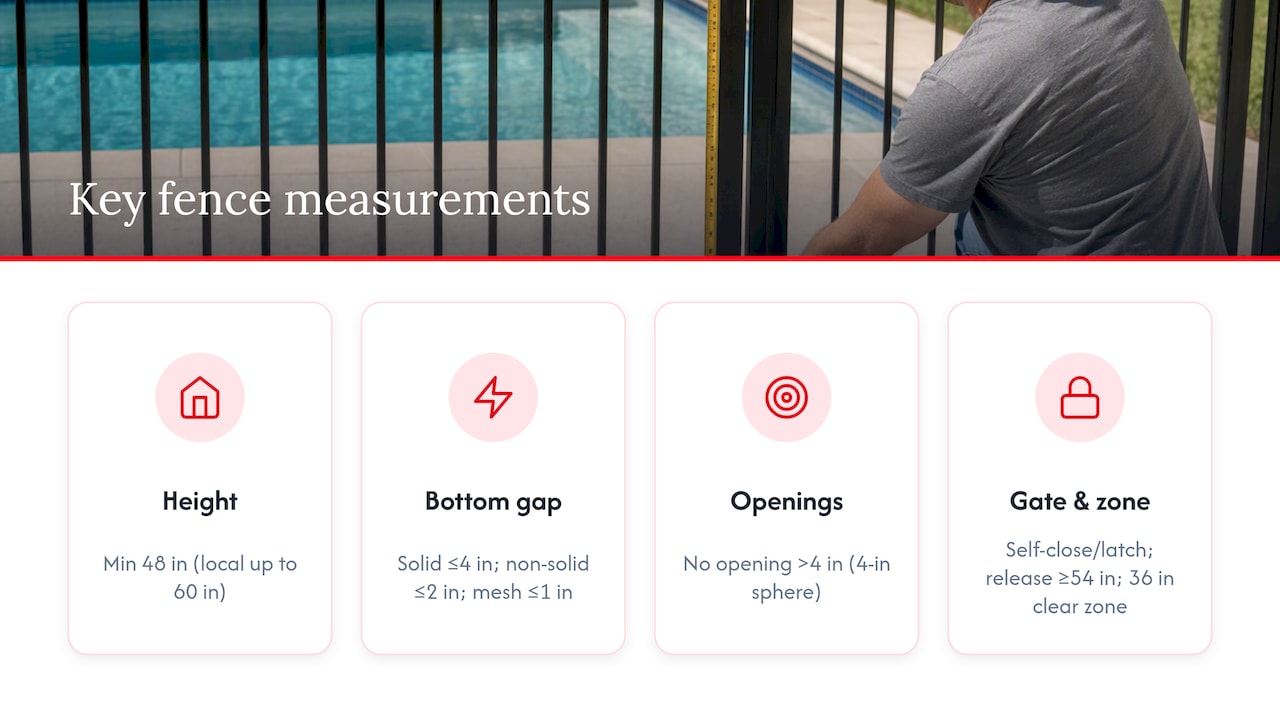
Height: the barrier must be at least 48 inches, measured from the side away from the pool according to the ISPSC and confirmed by CPSC guidance. Some states and municipalities push this to 60 inches, so confirm the local figure before ordering materials. Our guide on measuring fence height for code compliance covers how grade changes affect the measurement.
Bottom clearance: no more than 4 inches between the ground and the bottom of a solid barrier, 2 inches for non-solid surfaces, and 1 inch for removable mesh fencing, per the same CPSC guidelines. On sloped yards, check clearance at the lowest point along the fence line, not just at the posts.
Openings and spacing: no gap large enough for a 4-inch sphere to pass through, which generally limits vertical member spacing to roughly 1.75 inches and caps chain link and mesh openings at the same scale.
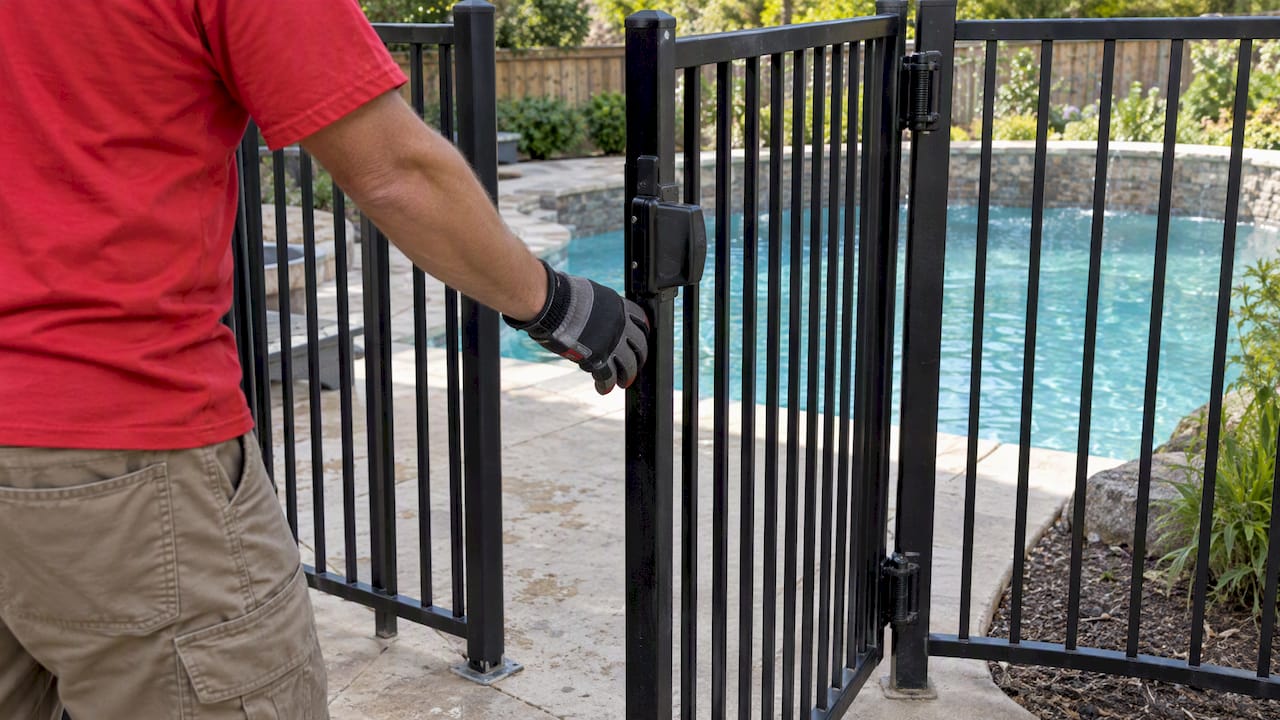
Gates: pedestrian gates open outward, away from the pool, and must be self-closing and self-latching. The release mechanism sits at least 54 inches from the ground, or lower only when it faces the pool side and is set back from any opening a child could reach through.
Materials: avoid horizontal rails that create footholds, keep decorative cutouts small enough to pass the sphere test, and limit diagonal member angles that a child could climb.
Pro Tip: Keep a 36-inch clear zone outside the barrier free of chairs, planters, or equipment that a child could use as a step.
Above-ground pools, spas, and construction fencing
Above-ground pools and hot tubs follow slightly different rules, and construction sites carry their own temporary requirements.
- The pool structure can count as part of the barrier when its wall is at least 48 inches tall and any mounted fencing on top is securely anchored to it rather than resting loose.
- Ladders and steps must be secured or removable so they cannot be used to climb into an above-ground pool when it is unsupervised, and removable mesh add-ons need locking posts set into the deck.
- Construction fencing is required from the day excavation starts until the permanent barrier is complete, with a minimum height around 4 feet under the ISPSC. Skipping this step is a common reason inspections stall.
Using your house wall as part of the barrier
When one side of the pool enclosure is the house itself, codes typically require extra protection on every door that opens onto the pool area.
- Door alarms that meet UL 2017 are a common requirement on doors forming part of the barrier, sounding when the door opens toward the pool.
- Power safety covers meeting ASTM F1346 can serve as an alternative to a full barrier section in some jurisdictions, but only when properly maintained and the controls are secured.
- Self-closing, self-latching doors are sometimes accepted in place of an alarm, depending on local code.
Manual pool covers rarely satisfy barrier rules on their own, since they depend on someone remembering to close them. Alarms and powered covers are preferred because they work without that step. Check alarm batteries and cover motors on a seasonal schedule, the same way you would check smoke detectors.
Finding the exact rule that applies at your address
National guidance sets the floor, but your enforceable rule lives in your state statute and local code.
- Check your county or city building division’s website first, since most post pool-barrier permit checklists directly.
- Search your state’s health and safety code for pool or barrier statutes. Texas, for example, publishes its own residential pool safety requirements that echo the national baseline with state-specific enforcement details.
- Call the permit office with your actual measurements in hand. A five-minute call can confirm whether your 48-inch fence meets local code or needs to go to 60 inches.
Local variation is common: some cities require a final inspection before a pool is filled, HOAs sometimes add height or material rules on top of the municipal code, and historic districts occasionally restrict fence style. Our permit checklist guide walks through what most offices ask for. Photograph your fence height, gate latch, and clearance measurements before any inspection so you have documentation ready if questions come up.
A pre-inspection checklist and the mistakes that fail it
Run through this list before you schedule any inspection.
- Measure height at three or four points along the fence, including the lowest point on sloped ground.
- Check bottom clearance at the same points, not just near a post.
- Open and release the gate several times to confirm it swings outward, closes on its own, and latches every time.
- Clear anything climbable within 36 inches of the barrier.
- Confirm above-ground pool ladders are locked, removed, or otherwise inaccessible when unsupervised.
- Test door alarms or power cover controls if the house wall forms part of the barrier.
Pro Tip: Most failed inspections trace back to one of three things: a gate latch mounted on the pool side within reach, horizontal rails that double as a ladder, or a removable mesh fence that was never locked into its anchors.
Check these points again each spring, since freeze-thaw cycles and ground settling can shift posts enough to open up clearance gaps that passed inspection the year before.
What happens when a pool fence does not meet code
Non-compliance carries real consequences beyond a failed inspection. A missing or inadequate barrier typically blocks final approval on a new pool build, which means the pool cannot legally be filled or used until the fence passes. For existing pools, many municipalities issue a notice of violation with a correction deadline, and some impose fines that accrue daily until the barrier is fixed.
Insurance exposure is a separate issue. If a drowning or near-drowning occurs at a pool that lacked a code-compliant barrier, the property owner can face civil liability, and a documented code violation often strengthens a negligence claim against the owner. Homeowners insurance policies sometimes reference pool safety compliance in their terms, so a known violation can also affect coverage after an incident.
Selling a home with a non-compliant pool fence can stall a transaction as well, since many jurisdictions require a compliance certificate or inspection sign-off before closing on a property with a pool. Buyers and their agents increasingly ask for this documentation upfront.
None of this means panic if your fence is slightly out of spec. It means treating a pool barrier the same way you would treat an electrical or structural issue: fix it promptly, keep records of the correction, and get a follow-up inspection if your jurisdiction offers one. The cost of bringing a fence into compliance is almost always smaller than the cost of a fine, a stalled sale, or a liability claim.
Exceptions, private property, and temporary event fencing
A few situations fall outside the standard barrier rules, though they are narrower than many owners assume. Some jurisdictions exempt pools on large rural or private parcels where the property itself is fenced and genuinely inaccessible to children from outside, but this exemption usually requires documentation and does not apply to most suburban or urban lots.
Temporary pools, inflatable pools under a certain depth, and some spas with lockable, code-compliant covers can also fall under different rules than permanent in-ground or above-ground pools; for secure fencing installation principles that include mesh installation and post techniques, see the Industrial Fencing Installation Guide for Secure Sites. The depth and duration thresholds vary enough by state that it is worth a direct call to your local building department rather than assuming your setup qualifies.
Events that bring a temporary pool or spa onto a property, such as a rental for a party, usually still require some form of barrier or constant adult supervision under local code, even when the installation is short-term. A temporary mesh fence that meets the standard height, clearance, and gate rules is often the fastest way to stay compliant for a weekend setup without triggering a full permit process. If you are unsure whether your situation qualifies for an exception, treat the standard baseline as the safer default and confirm any exemption in writing with your permit office before skipping a barrier.
What installers see on the job that homeowners often miss
In practice, the gap between a fence that looks fine and one that actually passes inspection usually comes down to small measurement details: a latch an inch too low, a gap a fraction too wide on uneven ground, a gate that swings the wrong way after a post shifts. Abraham and the team at Action Fence and Deck see these issues repeatedly on pool projects, which is why licensed, insured installation and permit guidance catch problems before they become a failed inspection or a liability gap.
— Abraham
Get a code-compliant pool fence built right the first time
A fence built to the wrong height or with a gate that swings the wrong way costs more to redo than to build correctly once. Professional companies handle custom fence and gate installation, permit coordination, and the measurement details inspectors check, typically backed by licensed and insured crews with transparent quotes.

- Custom fence and gate installation sized to your pool’s exact barrier requirements.
- Permit assistance so your paperwork matches what your local building office expects.
- Free, no-obligation quotes before any work begins.
Visit the services page to start a quote, or check the fence installation cost guide to budget your project first.
FAQ
What states have a pool fence law?
Most states require some form of pool barrier, either through a statewide statute or by adopting a version of the ISPSC at the state or local level. The exact height, gate, and clearance rules vary by state and sometimes by county, so check your state’s health and safety code or your local building department for the specific requirement that applies to you.
Do you need a fence around a pool in Pennsylvania?
Pennsylvania municipalities generally require a barrier around residential pools under locally adopted building codes, following the same baseline height and gate rules found in the ISPSC. Because enforcement happens at the municipal level, confirm the exact height and gate requirements with your local building department before installing or modifying a fence.
Does a 52 inch pool need a fence?
The height of the pool wall itself does not exempt you from barrier rules in most jurisdictions. A pool wall can sometimes count as part of the barrier when it meets the minimum height and has secured, non-climbable access, but most codes still require a compliant gate and clearance at any opening, so check your local rule before assuming the pool structure alone satisfies the requirement.
Can I put a pool up without a fence?
In most U.S. jurisdictions, no. Nearly every adopted code requires a barrier, whether that is a standalone fence, a securely mounted fence on the pool structure, or an approved alternative like a power safety cover, before the pool can legally be filled or used.
Sources
- Safety Barrier Guidelines for Residential Pools (CPSC)
- ISPSC 2024 — Chapter 3: General compliance (ICC Codes)
- Texas Health & Safety Code — Residential pool safety (example statutory source)