For reliable privacy, pair an immediate structure, such as a solid fence or prefab screen, with a layered living screen of evergreens, shrubs, and grasses that matures in front of it. The structure covers you now. The plants add depth, quiet, and beauty over the following seasons. Check local permit rules before you build, and plan on pruning and replacing the occasional plant.
TL;DR:
- For noise control, a single shrub row is inadequate; plan a layered planting about 20 feet wide, with 60% density at maturity.
- Running bamboo can spread 15 feet a year; choose clumping varieties or install a rhizome barrier at least 28 inches deep with seasonal edge checks.
- Fence rules vary by city and neighborhood, and permits often become more restrictive above roughly 6 to 7 feet; confirm requirements before building.
- Mixed screens resist pests and disease better than a row of one species; choose at least two evergreen types and space plants for mature width.
- Expect temporary screens to cover the first few years; fast growing vines, movable containers, or anchored panels can bridge gaps as plants mature.
Table of Contents
- 1. Use plants to build a living privacy screen
- 2. Add a fence, prefab screen, pergola, or gate for instant privacy
- 3. Layer your plantings like a designer
- 4. Use berms and planting to cut noise
- 5. Fill the gap with fast, temporary privacy
- 6. Choose the right species and keep bamboo contained
- 7. Plan your site, check permits, and budget for upkeep
- 8. Combine decks, retaining walls, and plantings
- 9. Know when to hire a pro and what to ask
- 10. Get privacy landscaping built right with Action Fence and Deck
- FAQ
- Sources
1. Use plants to build a living privacy screen
Plants do three jobs a fence cannot: they soften a hard edge, they add habitat, and they take the edge off noise. The trade-off is time. A planted screen takes time to reach full height, so choose species by the size they will reach, not the size they are at the nursery.
Design pros who write about small yards often advise considering plants before a fence, and they point to narrow upright evergreens such as arborvitae as a way to screen a boundary without eating up lateral space. That is the logic behind a formal hedge: a single clipped row of one narrow evergreen, planted at an even spacing, that reads as a green wall. It looks tidy and suits a straight property line. Its weakness is uniformity. If one plant fails, the gap shows, and a single pest or disease can move down the whole row.
An informal screen is a looser row of mixed shrubs and small trees with different textures and bloom times. It takes more width, usually a few feet more than a clipped hedge, but it hides gaps better and looks natural in a yard that is not strictly formal.
Evergreen or deciduous?
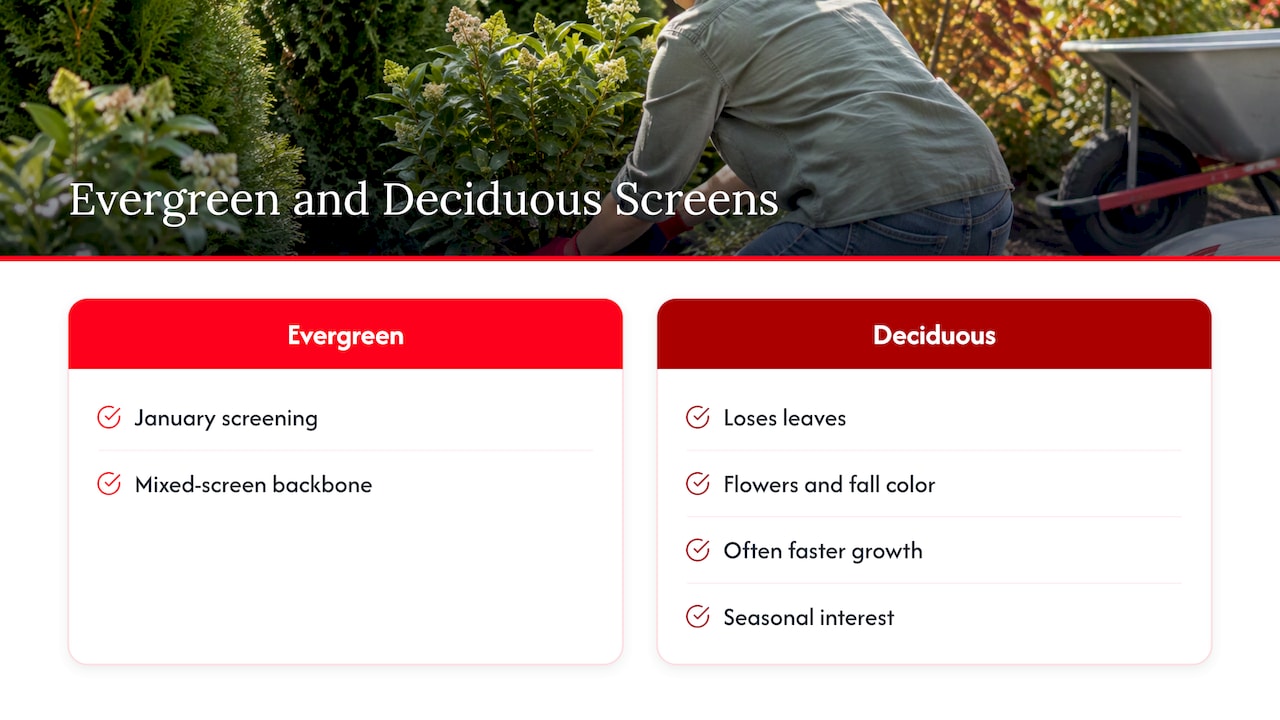
Evergreens give you screening in January, which matters if you want to keep neighbors out of your sightline during the months you spend indoors looking out. Deciduous shrubs and trees lose their leaves, but they offer flowers, fall color, and often faster growth. Many of the best screens use both: evergreens for the backbone, deciduous shrubs for seasonal interest.
Containers and vertical plantings for tight spaces
If you have a patio, terrace, or a narrow side yard, large containers can do real work. Tall planters with upright evergreens, ornamental grasses, or bamboo-style clumping plants create privacy exactly where you sit. Vertical options matter too: a trellis or wire panel with a climbing vine gives you a green wall that takes only inches of floor space.
Here is what to weigh when you pick the approach for your yard:
- Formal evergreen hedge: Best for straight boundaries and a clean look. Choose a narrow evergreen so it does not swallow the yard.
- Informal mixed shrub row: Best when you have room for width and want resilience and seasonal interest.
- Evergreen trees in a staggered group: Best for blocking a second-story view or a tall neighboring building.
- Large containers with upright plants: Best for patios, decks, and rentals where you cannot dig.
- Trellis with a climbing vine: Best for narrow spaces where you need height without width.
Space plants for their mature size
The most common mistake we see is planting too close together to get instant coverage. Crowded plants compete for light and water, and poor airflow raises disease risk. Clemson’s extension guidance on mixed screens tells homeowners to space plants by their mature size and to avoid overplanting for instant results, because overcrowding invites disease. Read the plant tag for mature width, then plant accordingly. If the gap looks bare while the plants establish, fill it with a temporary fix (more on that in a later section) rather than squeezing the permanent plants.
2. Add a fence, prefab screen, pergola, or gate for instant privacy
When you need privacy now rather than waiting for plants to mature, built structures win. A fence blocks sightlines the day it goes up, takes a predictable footprint, and also keeps pets and kids inside the yard. It is also the right call on a tight lot where a layered planting simply does not have room to grow.
Fence styles that block the view
Full sightline blocking comes from solid designs. A solid wood privacy fence has boards set tight against one another. Board-on-board takes that a step further by overlapping a second layer of boards over the gaps, so you do not see slivers of the yard as the wood shrinks and moves. If you want to compare the common styles and what they are like to live with, our overview of wood fence styles walks through them. For construction details that hold up over decades, see our notes on board-on-board fence specs and our privacy fence ideas that last.
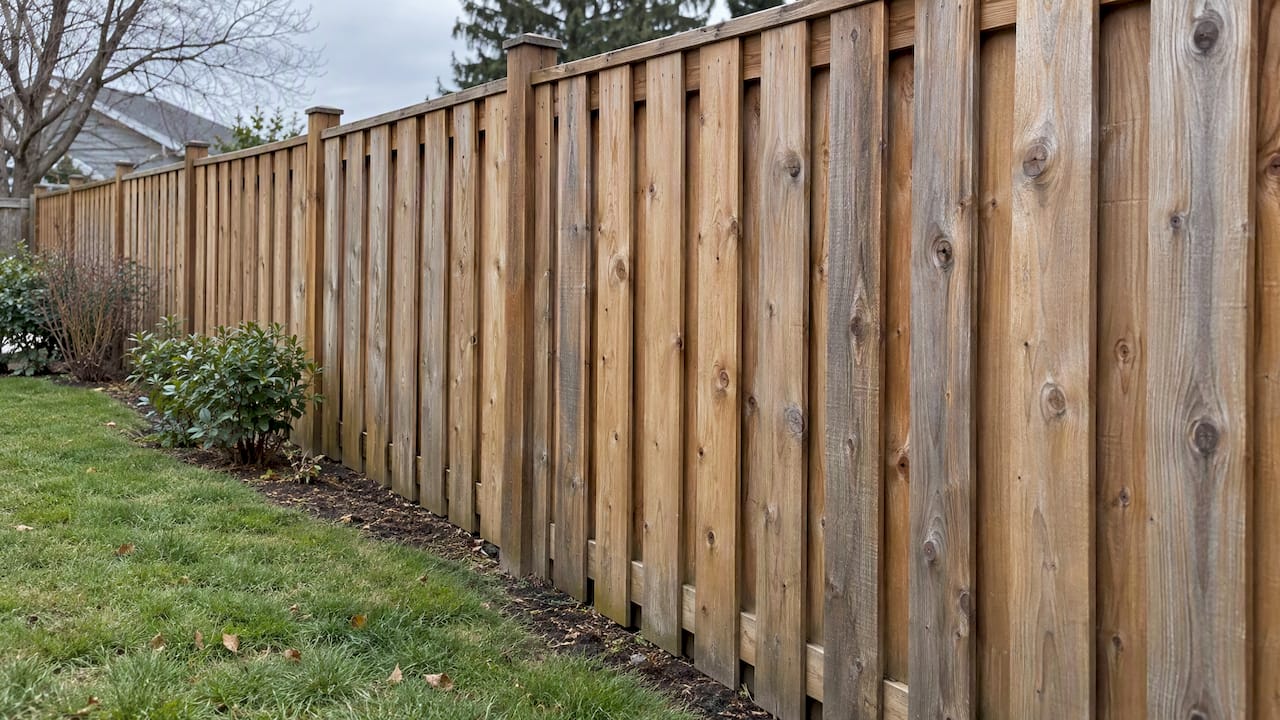
Height matters as much as style. A fence that is too short leaves a clear view from a deck or an upstairs window, and a fence that is too tall can trigger permit rules. We cover how to choose in how tall your privacy fence should be.
Prefab panels and freestanding screens
Prefab privacy panels and freestanding screens are the flexible option. You can place them along a deck rail, beside a hot tub, or in front of a window that faces the neighbors. They are easy to move if you rearrange the yard, and they cost less than a full fence run. The trade-off is durability and wind: a freestanding screen needs a solid base or posts set deep enough for your local gusts.
Pergolas, lattice, and privacy gates
Not every sightline needs a solid wall. A pergola over a seating area blocks the view from above, especially when you add slatted sides, lattice, or a vine. Lattice panels let some light and air through while still breaking up a direct view. A privacy gate makes sure your entry does not become the hole in an otherwise private yard, and the right design looks as good as it works. Our privacy gate ideas cover styles that hold up to daily use.
When to choose a built solution first
- Your lot is tight. If you have only a few feet between the house and the property line, plants cannot form a deep layered screen.
- You need privacy right now. A fence provides privacy as soon as it is installed, while a hedge takes time to mature.
- You have pets or children. A solid, secure perimeter does double duty.
- The sightline is high. Tall structures or a second-story window can overlook your yard; a fence plus a pergola or trees may be needed.
Even then, we rarely recommend a fence alone. Pairing it with plantings in front softens the wall, adds depth, and over time takes over part of the screening job. That pairing is the subject of the next section.
3. Layer your plantings like a designer
A single row of the same plant is a hedge. A layered screen is a small landscape, and it is far more forgiving. The pros who design privacy screens think in tiers, arranged from back to front.
Maryland Extension’s guidance on plants for mixed privacy screens makes the case directly: the most effective privacy designs combine structural elements with mixed-species plantings, and mixed screens resist pests and disease better than a monoculture, such as a single line of Leyland cypress. If one species struggles, the others carry on, and the screen never has a bare stretch for long.
Here is how to lay it out:
- Start at the back with tall evergreens. These form the backbone and the winter screen. Choose the height you need based on the sightline you are blocking.
- Add medium shrubs in the middle tier. Use a mix of evergreen and flowering deciduous shrubs. These fill the lower gaps that tall evergreens leave as they mature and lose their lower branches.
- Plant ornamental grasses and groundcovers in front. Grasses add movement and soften the edge, while groundcover fills the soil and suppresses weeds.
- Stagger the plants in a triangular pattern. Zigzagging the plants instead of lining them up creates depth and density, so your eye cannot find a straight line of sight through the screen.
- Cluster in odd numbers. Groups of three or five look natural and make it easier to blend species.
- Phase the planting around your structure. If you are building a fence, install it first, then plant in front so you are not trampling new plants during construction.
Mixing species also helps with timing. Fast growers fill in quickly while slower, longer-lived evergreens mature. Over time, you can thin the fast growers as the permanent plants take over.
Pro Tip: Plant the back row first and leave room to work. It is far easier to place tall evergreens before the mid-tier shrubs crowd the path, and a layout stake or garden hose laid on the ground will show you the zigzag before you dig.
Combine hardscape and plants from the start
A layered screen works best when the plants and the structure are designed together. A fence behind the tall tier gives instant coverage while the evergreens grow. Plant the shrubs far enough from the fence to leave room for maintenance and air movement. This is where a layered plan beats either piece alone: the fence handles today, and the plants take over more of the screening job as they mature.
4. Use berms and planting to cut noise
Privacy is not only visual. Many homeowners want to block the sound of a road or a loud neighbor as well. The Washington Post, summarizing expert advice, notes that audible privacy and psychological privacy matter as much as the visual barrier, and that a dense planting buffer about 20 feet wide is ideal for reducing traffic noise, with layering creating a strong sense of enclosure.
A berm, which is a low earthen mound, adds to that effect. The University of Tennessee’s publication on evergreen trees for screens and hedges reports that combining a moderate-height berm with strategic planting can reduce noise by 6–15 decibels, which people perceive as substantially quieter than without the buffer.
A berm plus plantings can reduce noise by 6–15 decibels, according to University of Tennessee extension guidance. In practice, that is the difference between a road you notice constantly and one you notice only occasionally.
Practical berm guidance
A berm can work for many residential yards, but its size should suit the site and the screening needs. Keep the slope gentle so the mound is stable, easy to mow or maintain, and does not erode in heavy rain. Then plant on top, using the layered approach from the previous section: evergreens on the crown, shrubs and grasses on the slopes. The combined height of the earth and the plants is what blocks the line of sight and scatters sound.
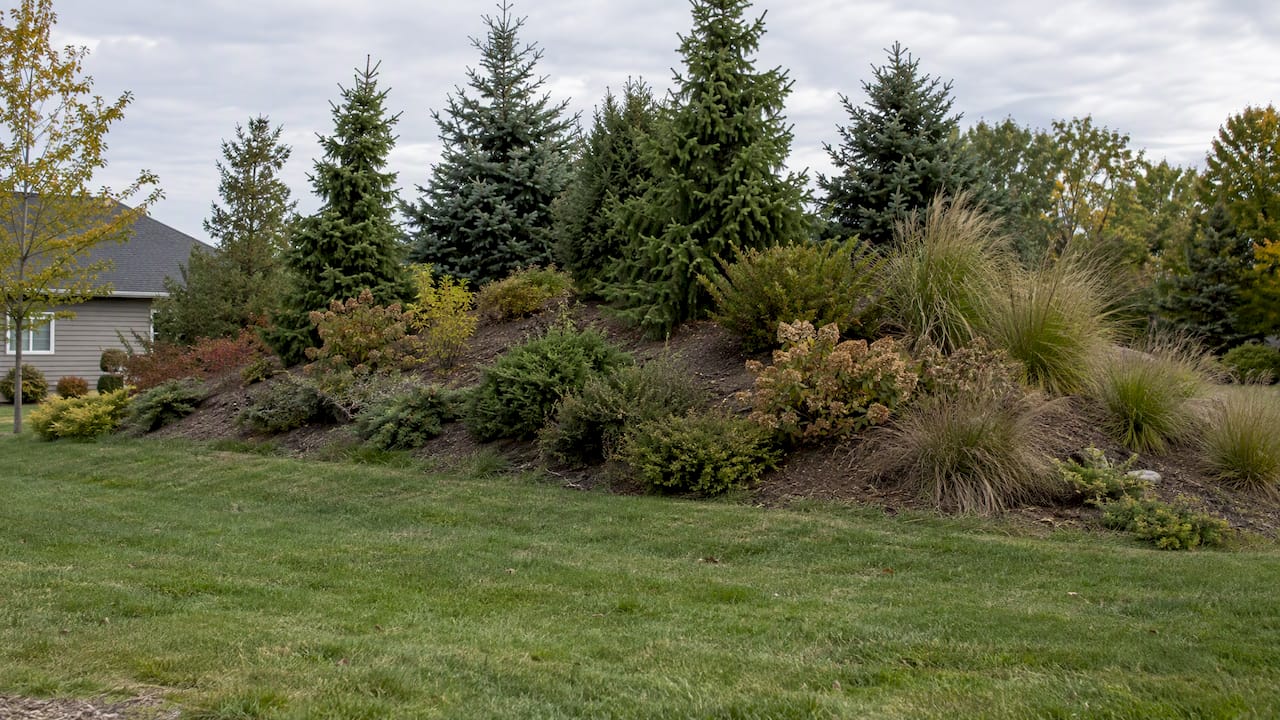
Width matters as much as height. Washington State University’s extension publication on screens and hedges recommends planning for at least 60 percent density at maturity and a planting width of about 20 feet for meaningful noise reduction. A single row of shrubs will not do much for sound, but a deep, dense planting will.
When a retaining wall helps
On a small lot, a berm can eat too much space. A low retaining wall can support a raised, planted bed that gains height in a smaller footprint. It also helps on a slope, where soil would otherwise slide. If you are planning a fence on top of a retaining wall, read our homeowner checklist for fences on retaining walls first, because the combination has to be engineered correctly.
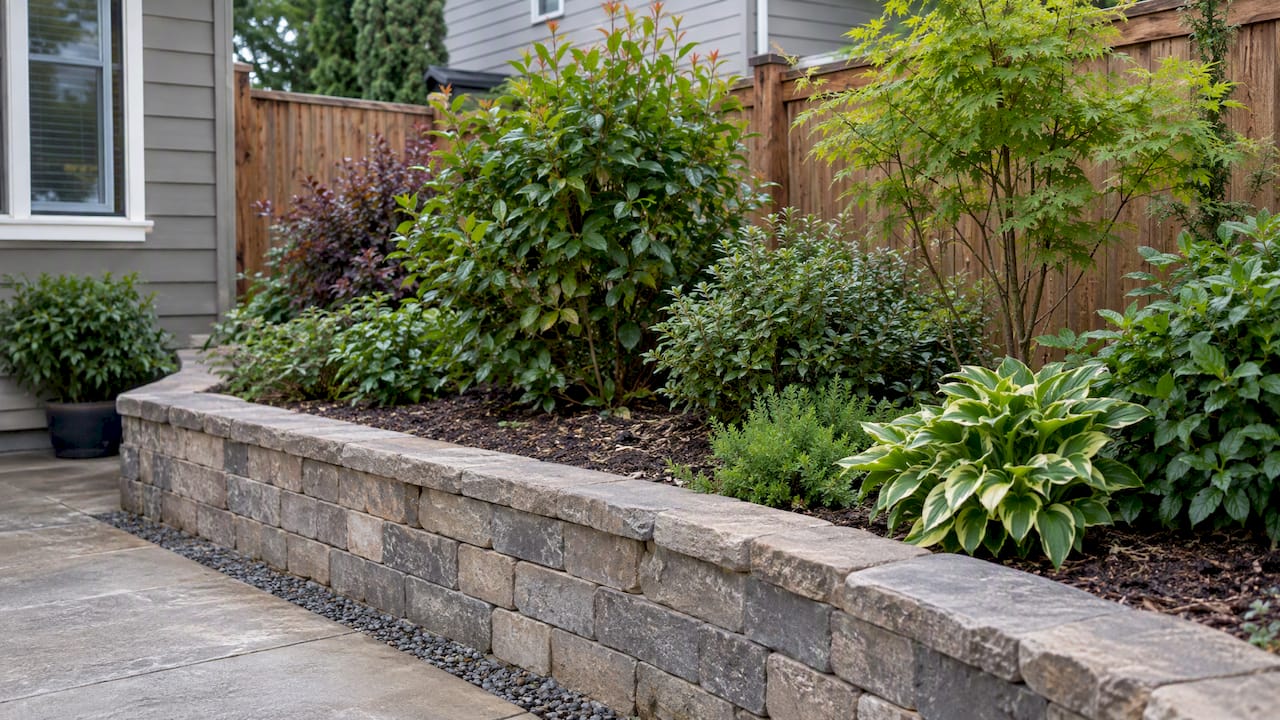
Earthworks like berms can involve heavy equipment and significant soil movement. If you are coordinating that work with other major exterior projects, a guide on how to protect landscaping during roof replacement is a useful reminder to sequence the trades so no one drives over your new plantings.
5. Fill the gap with fast, temporary privacy
Living screens take time. While they grow, you can close the gaps with fast fixes that cost little and come out easily later.
- Trellises with quick-growing annual vines. A trellis or wire panel with a fast climber covers in a single season and gives you a green wall with almost no footprint.
- Container screens. Large pots of tall grasses or upright shrubs can be moved into position today, and they can be rearranged or replanted in the ground later.
- Outdoor privacy curtains. Weather-resistant fabric panels hung from a pergola or deck frame give you privacy on a patio for the cost of a few yards of material. Take them down in storms and winter.
- Prefab fence panels and freestanding screens. These give solid coverage right away. Anchor them well, because a screen acts like a sail in the wind.
- Shade solutions over the deck. Overhead cover cuts sightlines from above and makes the space more comfortable. See our guide to deck shade solutions for ideas.
Set realistic expectations
Plan for a transition. Expect the temporary elements to carry the load for the first few years, then step back as the permanent plants reach height and density. Fast growers typically fill in sooner than slower evergreens, so use temporary elements while the permanent screen develops. When the living screen is thick enough, you can remove the temporary pieces or keep them as accents.
6. Choose the right species and keep bamboo contained
The best plant for privacy is the one that grows well on your site without becoming a problem. A few principles guide the choice.
Favor natives and mix your species
Native plants reduce maintenance once established and support local wildlife, and a varied planting lowers the risk of a pest outbreak, as Maryland Extension notes in its guide to plants for mixed privacy screens. Clemson’s guidance on mixed screens adds a practical rule: choose at least two types of evergreens, whether conifers or broadleaf evergreens, so a single problem cannot take out the whole screen. Look for native evergreen trees and shrubs that suit your region’s climate and soil, and ask a local nursery which ones stay healthy in your area.
Check deer pressure and site conditions
A great screening plant that deer eat down to stubs is not a screen. If deer are common where you live, ask your nursery for deer-resistant options. Also match each plant to your light, drainage, and soil, because a shade-tolerant shrub in full sun will struggle no matter how good its reputation.
Be careful with bamboo
Bamboo grows fast and looks great as a screen, which is why it is tempting. It is also one of the easiest ways to create a problem that outlasts your ownership of the house. NC State Extension warns that bamboo can be highly invasive and flammable, and that containing it requires a physical rhizome barrier sunk at least 28 inches deep, plus ongoing vigilance. A separate NC State piece notes that running varieties can spread up to 15 feet per year and recommends clumping varieties or deep barriers, and that even controlled bamboo needs long-term attention.
If bamboo is already spreading from a neighbor’s yard, the picture is harder. Maryland Extension explains that full removal is difficult without the neighbor’s cooperation, and that containment, ongoing cutting, and sometimes excavation equipment may be needed.
Use this checklist before you plant anything that spreads:
- Choose clumping over running. Clumping types stay put, while running types travel by underground rhizomes.
- Install the barrier first. Sink it to the recommended depth before the plants go in, not after they escape.
- Consider a container instead. A large, sturdy pot is the safest way to enjoy bamboo’s look.
- Inspect the edge every season. Cut any shoots that cross the barrier right away.
- Skip it if you rent or may move. A problem you leave behind can become a cost for the next owner.
Pro Tip: If you love the look of bamboo, ask a nursery for a clumping variety and still treat it as a plant that needs a barrier and a yearly edge check. Skipping either step is how a screen turns into a decade-long removal project.
7. Plan your site, check permits, and budget for upkeep
A privacy project goes smoothly when you do the unglamorous work first. Use this checklist.
- Measure the planting area. Mark the line on the ground with a hose or stakes, then measure its length and the depth you can spare. Remember that noise control needs width, so a 20-foot-wide band is a goal, not a requirement for every yard.
- Space plants by mature size. Use the plant tag’s mature width, not the nursery pot size. Washington State University’s screen and hedge guidance points to 60 percent density at maturity as the planning target for noise-control screens.
- Check your local permit triggers. Many U.S. cities regulate fence height, and rules often get stricter above roughly 6 to 7 feet, with different limits for masonry walls and for front yards versus back yards. These rules vary by city and neighborhood, so confirm with your local building department and your homeowners association before you build. Our overview of fence permits explains what to ask.
- Locate utilities before you dig. Call your local utility locating service before any digging, whether for posts, a berm, or a tree.
- Set a maintenance routine. Plan to prune on a schedule, replace plants that fail, water new plantings through their first seasons, and keep a layer of mulch around them.
- Know your timeline. Fast growers fill in sooner and slower evergreens take longer, so expect the screen to evolve over several years. Use temporary fixes for the gap, and judge progress by density at maturity, not by what you see in the first season.
Keep a short annual checklist
Once the screen is in, an annual walk-through catches small problems early. Look for dead or thinning plants and replace them in the right season. Trim anything crowding a neighbor or a structure. Check that mulch has not piled up against trunks. Watch fences for leaning posts and loose boards, which are far cheaper to fix early than late.
8. Combine decks, retaining walls, and plantings
The most effective privacy designs treat hardscape and plants as one system. A deck is a good example: it is often the place where you most want privacy, and it is also the place where neighbors and second-story windows see you most clearly.
Start by thinking about what each element contributes. A deck gives you a level, usable surface. A retaining wall holds the grade and can create planting beds at different heights. A fence or screen provides instant coverage. Plants soften every hard edge and carry the screening job over time.
A few combinations work especially well:
- Planter beds built into the deck edge. Raised beds along the rail hold evergreens, grasses, or climbers right where you need cover.
- A retaining wall with plantings on top. The wall adds height to a berm or a raised bed, so your screen starts higher and needs less time to reach privacy height.
- A fence with a pergola over the seating area. The fence blocks side views, while the pergola handles views from above.
- Shade structures and plants together. An overhead structure with a vine gives you shade and a green ceiling in one build.
Plan these elements together so footings, drainage, and plant spacing do not conflict. If you are sizing a deck at the same time, our guide to buildable deck designs covers sizing and code notes, and our overview of deck building permits explains when approvals are needed. For larger outdoor living plans, this design perspective on outdoor living shows how integrated planning pays off on bigger projects.
9. Know when to hire a pro and what to ask
Plenty of privacy projects are good weekend work: planting a hedge, adding a trellis, setting out containers. Others reward a professional hand, and the dividing line is usually structure, grade, and permits.
I have seen the same pattern many times. A fence goes up a few inches over the property line, or a berm pushes water toward a neighbor, or a retaining wall is built without proper drainage and bows out after a wet spring. None of those mistakes shows up on day one. They show up in year three, when they cost far more to fix. That is the case for professional installation on fences, berms, and retaining walls: correct siting, permit awareness, and footings that last.
If you hire out, ask a few questions. Is the builder licensed and insured? Can they show finished projects similar to yours? Will they handle permits and utility marking? How do they set posts and handle drainage? What does the written quote include? Look at their craftsmanship closely, because straight lines, tight joints, and clean post work tell you more than a brochure.
Material choices matter too. Sustainably sourced wood, long-lasting fasteners, and good finishing reduce replacement and maintenance, which is better for your budget and for the environment. A fence that lasts a long time can also be the greener choice. Our look at eco-friendly fencing explains the trade-offs we weigh.
My view is simple: plant what you can, build what you must, and do not let a plant do a structure’s job or the other way around. The best yards use both, each doing what it does best.
— Abraham
10. Get privacy landscaping built right with Action Fence and Deck
If you would rather have a licensed crew handle the build while you enjoy the result, we can help. We build the structural side of privacy projects and coordinate it with the planting side, so the pieces fit together instead of fighting each other.
Our services relevant to privacy projects include custom wood fencing, gate installation and repair, concrete work, masonry, and landscaping and hardscaping. We also build decks and retaining walls, so a berm, a raised planted bed, or a deck-side screen can be designed and built as one plan. Our builders are licensed and insured, we bring more than 20 years of experience to each job, and we favor eco-friendly materials and methods that hold up over time.

We tailor each design to your lot and your budget, and we give you a clear written quote before work starts. The next step is simple: contact us for a site assessment and a free quote, and we will walk the property with you and recommend the right mix of structure and planting for your yard.
FAQ
How can I get privacy in my yard quickly?
A solid fence or prefab privacy screen is the fastest option, because it blocks the view the day it goes in. Add plants in front so a living screen takes over over the following years. Temporary fixes like container plants and outdoor curtains can fill gaps meanwhile.
What is the best way to block noise in a yard?
Combine an earthen berm with a deep, dense planting. University of Tennessee extension guidance reports that a berm plus plantings can reduce noise by 6–15 decibels. A single row of shrubs does little for sound, so width and density matter.
Is bamboo a good plant for a privacy screen?
It can be, but only with care. Running bamboo spreads aggressively, and NC State Extension recommends a rhizome barrier sunk at least 28 inches deep plus ongoing monitoring. Clumping varieties or large containers are safer choices.
Do I need a permit to build a privacy fence?
Often yes, especially for taller fences, and the rules vary by city and neighborhood. Check with your local building department and any homeowners association before you build. Our guide to fence permits explains what to ask.
Why mix plant species instead of planting one hedge?
A mixed screen is more resilient. Maryland Extension notes that mixing species increases resistance to pests and disease compared with a single-species row. If one plant fails, the rest keep screening.
Sources
- Evergreen Trees for Screens and Hedges in the Landscape
- Extension
- Managing Bamboo in a Home Landscape – Gardening | NC State Extension
- Rex