

The best skirting for a raised deck is the one that hides the understructure, keeps animals out and still lets air move through. For most homes that means one of six choices: pressure-treated lattice, vinyl lattice, cedar slats, composite or PVC panels, aluminum, or stone veneer. Below you will find how each looks, what it costs, where it fails, and the details that matter more than the material: ventilation, ground clearance and pest-proofing.
TL;DR
- Vinyl lattice and pressure-treated lattice are the budget picks. Horizontal cedar slats, composite and aluminum cost more but look more modern and need less upkeep.
- Every skirting design needs airflow. A solid wall under a wood deck traps moisture, so choose slatted, gapped or vented designs.
- Keep skirting off the soil, and bury wire mesh 8 to 12 inches down if skunks or raccoons are a problem in your neighborhood.
- Material is only part of the bill. Labor often makes up 40 to 55% of a skirting project, and site prep is where cheap jobs go wrong.
- Dryer vents, access doors and gas or electrical lines under the deck need planning before anything gets closed in.
Table of Contents
- What deck skirting actually does
- Deck skirting ideas by material
- Lattice alternatives that don’t look like lattice
- Inexpensive deck skirting ideas
- The details that matter more than the material
- What skirting costs installed
- Should you do it yourself?
- Our perspective
- Let us build your deck skirting
- FAQ
- Sources
What deck skirting actually does
Skirting is the panel or screen that closes the gap between the bottom of a raised deck and the ground. It does three jobs: pest exclusion, moisture control and a finished appearance. It also blocks wind-blown leaves and hides whatever you store under there.
The look is what most people search for, but the function decides what lasts. A deck 12 inches off the ground and one 6 feet up need different solutions, as this skirting guide notes. A low deck can take a simple lattice panel. A tall deck usually needs framing, a mid-height rail or a door so you can reach the space beneath.
Deck skirting ideas by material
Pressure-treated lattice
The classic. Square or diagonal lattice in pressure-treated pine is the cheapest option you can find at a lumberyard, at roughly $4.50 per square foot in materials as of early 2026. Square lattice is about 55% open and diagonal about 60%, so airflow is excellent.
The trade-off is upkeep. Thin lattice strips split, cup and gray in Texas sun, and it needs staining or paint every couple of years to look good. If your deck is already stained, matching the lattice to the deck boards or to the house trim makes it look intentional rather than tacked on.
Vinyl lattice
Vinyl lattice costs about $5 per square foot and never needs paint. It will not rot or attract termites, and it closes off the space while still allowing airflow. White and tan are common, and some lines come in gray or brown.
The downside is stiffness. Vinyl can look flimsy up close, and in strong sun the panels can expand and ripple if they are nailed tight in the frame. Leave room for movement and use a proper frame with top and bottom rails, not loose panels pressed against the posts.
Horizontal cedar slats
This is the idea behind most modern deck skirting you see in photos. Cedar boards run horizontally with a gap of about half an inch to an inch between them, which gives a clean, architectural line. Cedar runs about $7.50 per square foot in materials.
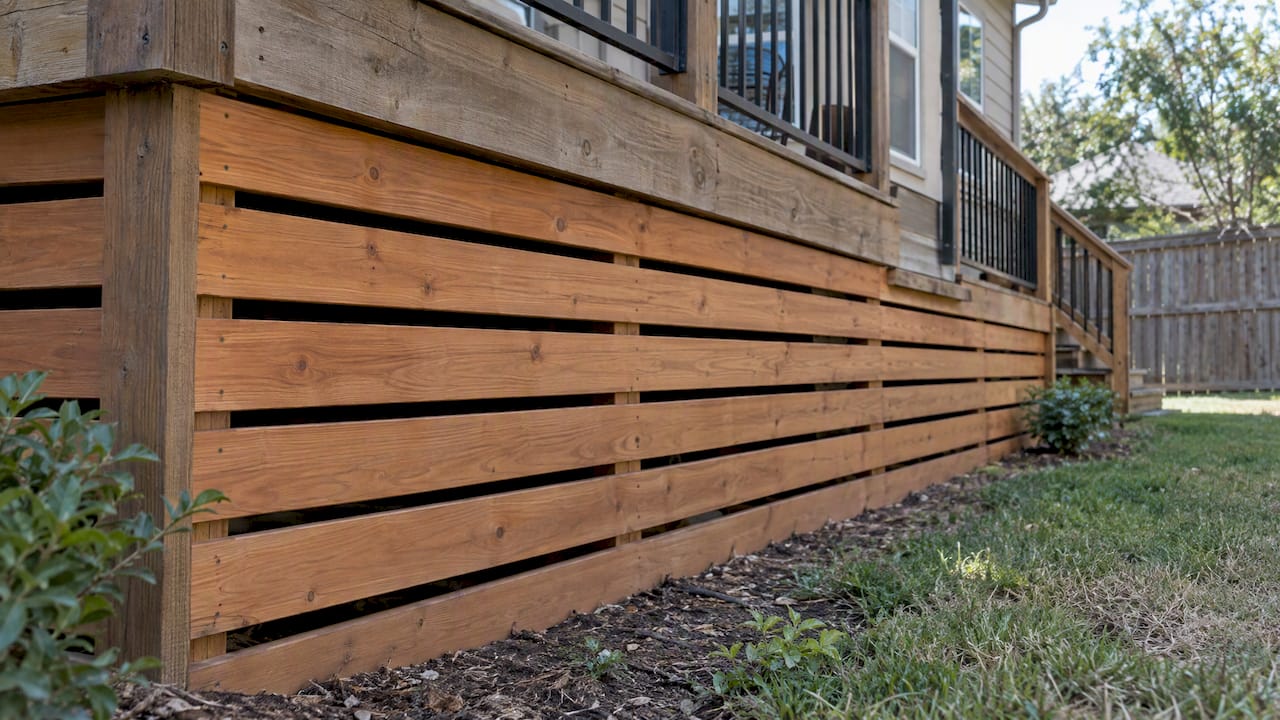
Gapped slats breathe well and look rich with a clear or semi-transparent finish. They do weather to silver gray if left alone, which many owners like. Vertical narrow slats give a similar look and hide the ground better when you view the deck from a distance.
Composite and PVC panels
If you built the deck with composite boards, matching skirting is the cleanest solution. Composite or PVC panels run about $11 per square foot and resist fading, staining and insects. Manufacturers also suggest contrasting fascia, PVC trim wraps and latticework panels as ways to finish the edge.
Solid composite panels need vents cut or built in, because the material does not breathe on its own. Slatted composite, with gaps between boards, solves that without extra work. For care once it is up, see our guide to composite deck maintenance.
Aluminum and metal grid panels
Aluminum costs about $9.50 per square foot. Powder-coated slats or perforated panels give a sharp, contemporary look and will not burn, rot or warp. Black or charcoal aluminum pairs well with black window frames and railings.
Metal is also a smart choice where wildfire embers are a concern. The Texas A&M Forest Service recommends non-combustible material such as gravel under the deck and metal screening with 1/8-inch openings on the underside. That is worth thinking about on the edges of Fort Worth and Tarrant County, where grass and brush meet houses.
Stone veneer and masonry
The premium end, at about $18 per square foot in materials. Stone or brick veneer on a concrete or block base looks permanent and matches a masonry home beautifully. It also needs a real footing and skilled masonry, so it is not a weekend project. On a low deck, a short masonry knee wall with vents and wood or composite above it gives the stone look at a lower cost.
Quick comparison
| Material | Materials cost (early 2026) | Look | Upkeep | Airflow |
|---|---|---|---|---|
| Pressure-treated lattice | about $4.50/sq ft | Traditional | Stain or paint every few years | Excellent |
| Vinyl lattice | about $5/sq ft | Traditional, uniform | Rinse occasionally | Excellent |
| Cedar slats | about $7.50/sq ft | Warm, modern | Refinish or let it gray | Very good if gapped |
| Aluminum | about $9.50/sq ft | Sleek, contemporary | Very low | Good if slatted |
| Composite or PVC | about $11/sq ft | Clean, matches deck | Very low | Needs vents unless slatted |
| Stone veneer | about $18/sq ft | Permanent, upscale | Very low | Needs vents |
Costs per square foot are from DeckMath’s skirting calculator. Local lumber prices move, so treat them as a starting point.
Lattice alternatives that don’t look like lattice
Many homeowners want to skip lattice because it looks dated. Here are the options readers ask about most:
- Horizontal or vertical slats. Cedar, composite or aluminum boards spaced apart. This is the most popular modern swap.
- Framed picket panels. Fence pickets set in a frame, painted to match the house. They give a cottage look and use cheap, available stock. Our team builds wood fencing daily, so this is an easy match for a fence on the same property.
- Board-on-board or shiplap panels. More solid, so you need vents. They suit decks you want to look like part of the house.
- Landscape screening. For a low deck, shrubs and ornamental grasses planted in front of an open frame can hide the gap with no solid wall at all. See our ideas for landscaping around decks.
- Gravel, edging and a recessed panel. A trimmed black panel set back a few inches from the deck edge creates shadow and makes the deck look like it floats.
Inexpensive deck skirting ideas
If budget decides, start here:
- Vinyl lattice in a wood frame. Lowest maintenance for the money.
- Pressure-treated lattice, stained to match. Cheapest material, but plan on refinishing.
- Cedar fence pickets, spaced. Fence pickets are often cheaper per square foot than finish-grade lumber and look good with gaps.
- Skirt only the visible sides. If one side faces a fence or a hedge, you can skip the panels there and add a pest barrier below grade.
What not to do is save money on the frame. Panels fastened straight to the posts without a rail sag within a season or two, and that is the repair we see most.
The details that matter more than the material
Ventilation
A wood deck stays healthy because air dries it from below. Closed-in skirting without vents holds moisture against joists and beams, which invites rot and mold. The best-known numeric rule comes from the federal manufactured-home standard: at least 1 square foot of vent opening per 150 square feet of area, or per 300 if a vapor retarder covers the ground. That rule is written for manufactured-home crawlspaces, not residential decks, so use it as a sensible benchmark. Your city’s adopted code and your permit office decide what applies to your deck.
Openings should be covered with perforated, corrosion-resistant screening to keep rodents out, according to that same section. Placing vents low to the ground helps sweep moisture away. Lattice and gapped slats meet this need without adding a single vent, which is why they are so common. If you are building or replacing, our deck building permits guide explains what to ask your city about.
Ground clearance
Skirting should never touch soil. Leave a small gap so the bottom edge does not wick moisture and rot. In North Texas, clay soil swells when wet and shrinks in drought, so a gap of an inch or two also keeps panels from binding as the ground moves.
Pest-proofing
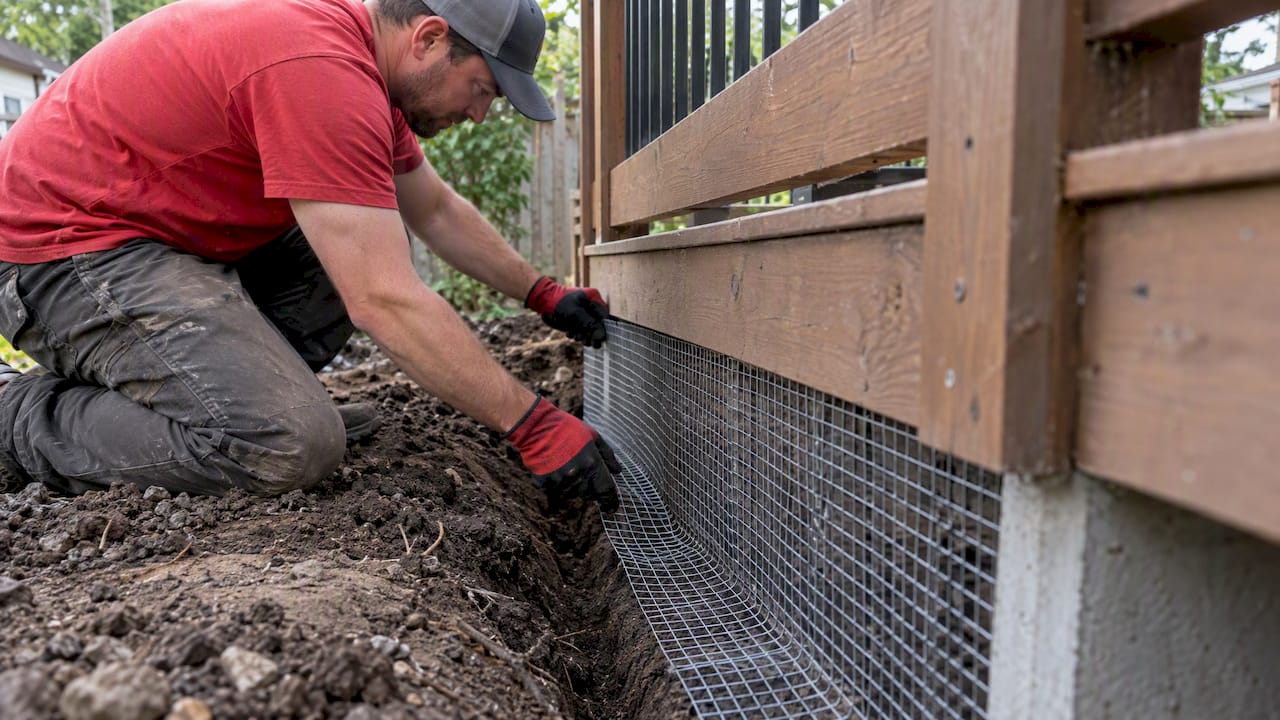
Skunks, raccoons and opossums dig under any gap. The most effective fix is deck trenching: wire mesh buried 8 to 12 inches below grade and flared outward, so animals that dig along the skirting hit metal. Do it before the panels go on. Retrofitting after the fact means digging around finished work.
Access and utilities
Plan a hinged or removable panel so you can reach the space. Dryer vents and combustion air inlets must terminate outside the skirting, not behind it, to avoid fire and carbon monoxide hazards. Gas lines, electrical junction boxes and hose bibs under the deck also need a plan. If you are unsure, have a licensed plumber, electrician or your gas utility look at it before closing in.
Drainage
Skirting hides a wet problem; it does not fix it. If water pools under the deck after storms, solve the grading first. Our guide to under deck drainage covers how to make that space dry and usable, and it should come before any panels go up. If moisture has already reached the siding or wall behind the deck, a contractor who handles water damage and exterior remodeling, such as this Southern California remodeling company, shows the kind of repair scope to ask about, though you will want a local North Texas pro for your own house.
What skirting costs installed
Material is only half the picture. DeckMath estimates a typical 90-square-foot project runs about $650 to $1,150 for vinyl lattice and $3,000 to $5,200 for stone veneer. The same source lists installed costs per linear foot of roughly $18 to $32 for pressure-treated lattice, $42 to $65 for composite or PVC panels and $85 to $145 for stone veneer.
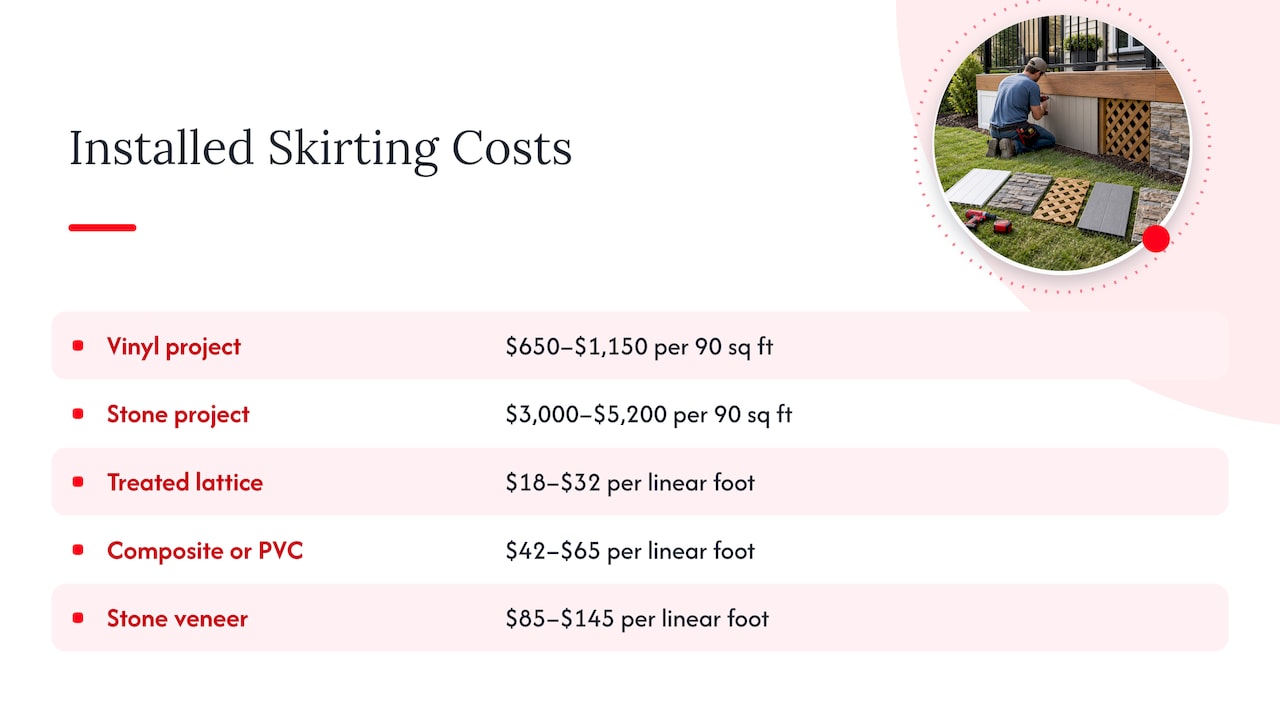
Those are national averages. Texas labor rates, deck height and access change the quote, and the more complicated the framing, the more labor weighs. Labor often makes up 40 to 55% of the total, because it includes grading, trenching and pest-proofing, not just hanging panels.
We do not publish set prices for skirting, because deck height, perimeter, material and site conditions vary too much. We offer free quotes so you can see the numbers for your own deck.
Should you do it yourself?
Vinyl lattice and basic wood panels are manageable for a handy homeowner with a saw, a level and a weekend. Stone veneer, complex composite framing and anything on a tall deck need skills most people do not have. A crooked frame or a gap at the corner shows on every side.
Ask yourself three questions. Is the deck more than about 3 feet off the ground? Do you need to trench for pests or regrade? Is the skirting going to be structural, such as a masonry wall? If you answered yes to any, hire a pro. Before you buy anything, also look at the deck itself: a bottom-up safety inspection of the ledger, joists and posts is far easier before skirting hides them.
Our perspective
We have built and repaired decks and fences in the Fort Worth area for over 20 years, and the pattern is consistent: people choose skirting by photo, then call us when it fails. The failures are rarely the material. They are panels without a frame, boards buried in soil, solid walls with no airflow and skunks that moved in because nobody trenched.
Our advice is to decide in this order. First, fix drainage and grade. Second, choose a design that breathes, whether lattice, gapped slats or vented panels. Third, pick the material that fits how much maintenance you want to do. A cedar-slat skirt on a well-drained deck will outlast a pricey solid panel on a wet one.
We also care about materials that last, since replacing things early is the least sustainable choice. If you are weighing materials for the deck itself, see our look at deck lifespan by material. A skirting design that matches the deck and the fence makes the whole yard read as one project, and that is where custom work pays off.
— Abraham
Let us build your deck skirting
Action Fence and Deck is a licensed and insured builder of decks, custom wood fencing, gates, concrete and landscaping. We can frame, trench and install skirting in the material that suits your deck and budget, and match it to your fence or railing. Request a free quote through our services page and we will look at your deck, your drainage and your options before anything is priced.
FAQ
What can I use instead of lattice for deck skirting?
Horizontal or vertical slats in cedar, composite or aluminum are the most common replacements. Fence-picket panels, board-on-board panels with vents and plantings in front of an open frame also work. Whatever you choose, keep airflow in mind so a wood deck can dry.
What is the cheapest way to skirt a deck?
Pressure-treated lattice and vinyl lattice have the lowest material costs, at about $4.50 and $5 per square foot. Spaced fence pickets in a frame are another budget-friendly option. Skimping on the frame or ground prep tends to cost more in repairs later.
Does deck skirting need ventilation?
Yes, for a wood deck. Enclosed space without airflow holds moisture and can lead to rot and mold. Lattice and gapped slats provide it naturally, while solid panels need screened vents. Ask your local building department which ventilation rules apply to your deck.
How do I keep animals out from under my deck?
Bury wire mesh 8 to 12 inches below grade and flare it outward before installing the skirting. Screen any vent openings with corrosion-resistant mesh. Texas A&M Forest Service also advises 1/8-inch metal screening where embers are a concern.
Sources
- DeckMath: Deck Skirting Calculator
- eCFR: 24 CFR 3285.505, Crawlspace ventilation
- Texas A&M Forest Service: Fire Resistant Construction
- Deck Skirting: Ideas, Materials & Installation Guide
- Vinyl Lattice Under Deck: Install, Cost, Tips
- DG Floors
- TimberTech: 13 Deck Skirting Ideas
- Home Remodeling in San Diego