A good neighbor fence is a fence that looks finished from both sides. Standard wood fences show smooth boards to one yard and bare rails and posts to the other. A good neighbor design hides the framing or alternates the boards so both properties get the same face. It is a style choice, not a legal category. In Texas, nothing makes you build one, but your HOA might, and your neighbor will probably thank you for it.
Below: the main designs, how they differ from a plain privacy fence, who pays, what to check before a post goes in the ground, and what a good quote should say.
TL;DR
- A good neighbor fence presents a finished look on both sides. Shadowbox, board-on-board with a double-sided build, and framed PVC or composite systems all qualify.
- Shadowbox gives airflow and a lighter look but not full privacy. Board-on-board gives more privacy. Framed systems cost more up front and need the least upkeep.
- No nationwide law requires this style. City rules, HOA covenants, easements and your survey decide what you can build and where.
- Texas has no California-style cost-sharing notice rule that we work from, so put any cost-sharing agreement with your neighbor in writing.
- Get a site-specific quote. Online per-foot prices ignore your terrain, gates, removal and permits.
Table of Contents
- What a good neighbor fence actually is
- Good neighbor fence vs. privacy fence
- Which design fits your yard
- Who pays, and who owns it
- Before the first post: line, permit and HOA
- Build details that decide how long it lasts
- What the quote should say
- Our view: build it for the fence line, not just for your side
- Planning a fence along a shared line?
- FAQ
- Sources
What a good neighbor fence actually is
The name comes from etiquette. The person who pays for the fence usually puts the “bad side” (rails, post faces, fasteners) toward the neighbor, or the other way around. Either way, someone looks at the framing. A good neighbor fence removes that argument.
There are three common ways to do it:
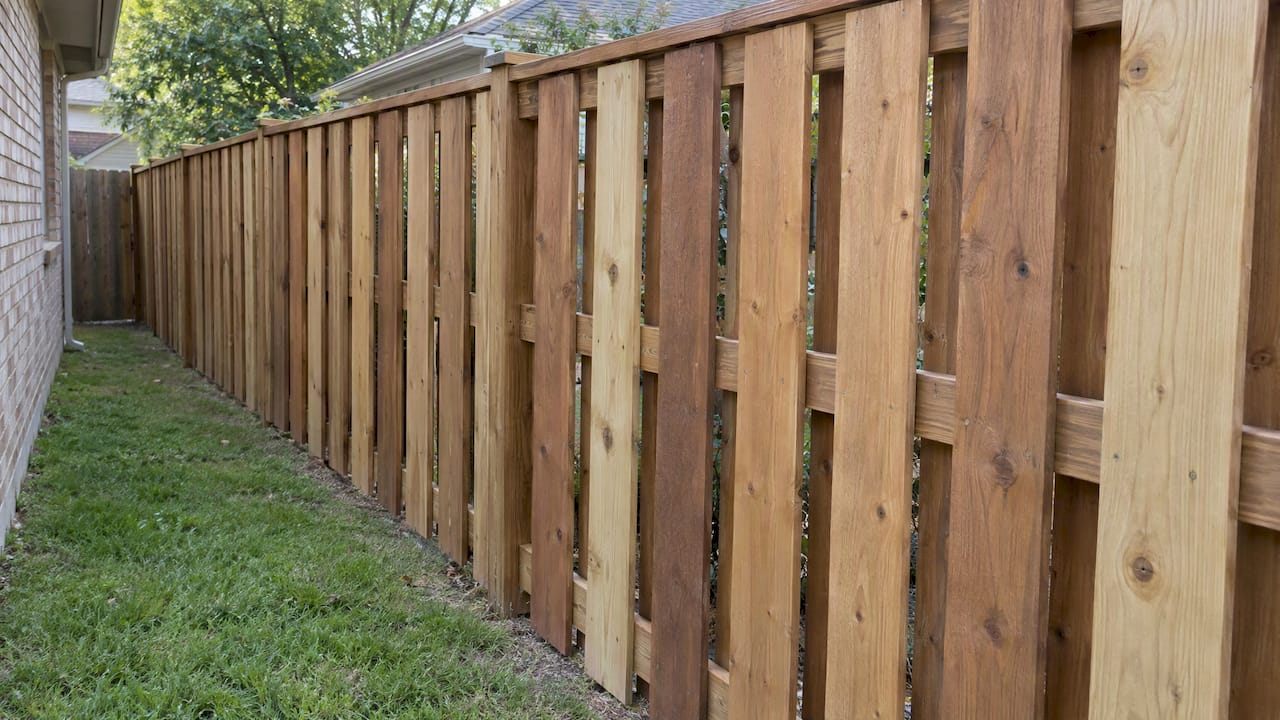
- Shadowbox: pickets are fastened alternately on each side of the rails. From any angle you see boards, with small gaps. The structure sits in the middle.
- Board-on-board: overlapping boards give denser coverage. To make it truly two-sided, the picket count roughly doubles, with boards on both faces of the rails.
- Framed systems: boards or panels sit inside a frame or channels, so posts and rails are hidden. Materials include wood, composite and PVC.
FenceTrac’s guide describes these same three families. Many people use “good neighbor” and “shadowbox” as if they were the same thing. They are not: shadowbox is one way of getting there.
Good neighbor fence vs. privacy fence
Privacy describes what a fence does: it blocks views. Good neighbor describes how it looks: the same from both sides. A fence can be one, the other, or both.
| Solid privacy fence (one-sided) | Shadowbox | Board-on-board, two-sided | Framed PVC or composite | |
|---|---|---|---|---|
| Same look both sides | No | Yes | Yes, if built with boards on both faces | Yes |
| Privacy | High | Partial | High | High |
| Airflow | Low | Better | Moderate | Depends on design |
| Wind load | Highest | Lower | Higher | Depends on design |
| Upkeep | Stain or seal periodically | Stain or seal periodically | Stain or seal periodically | Lowest |
| Material cost | Lowest | Moderate | Highest of the wood options | Highest overall |
The trade-off is physical, not just visual. NDSU Extension notes that solid stockade fencing is more private but more wind-resistant and less favorable for airflow, while alternating-board designs look good from both sides and moderate wind. North Texas gets strong spring storm winds, so this matters. If wind is your concern, read our wind resistant fence specs before you choose boards.
Which design fits your yard
Choose shadowbox when
You want a lighter look, you have a long run, or you are planting along the line and want air moving through. Expect to see a sliver of your neighbor’s yard from some angles. If you have a dog that watches the street, or a pool, shadowbox may not give enough screening.
Choose two-sided board-on-board when
Privacy is the first job. You get dense coverage and a finished face to both yards. You pay for it in lumber and labor, and in wind load. Posts and rails may need to be heavier.
Choose a framed system when
You want the least maintenance and a consistent look for decades. A New Jersey DOT and FHWA research report evaluated PVC and thin precast-concrete privacy fencing that looked the same from both sides, with expected lives of 25 to 50 years in that application. That study used 2004 public-project prices, so ignore its dollar figures for a home quote. The point is only that two-sided, low-upkeep options exist if you do not want to restain wood.
For more style ideas, see our guides to wood fence styles and privacy fence ideas that last.
A note on noise
A privacy fence is a visual screen. The same NJDOT and FHWA study treats it that way, not as a replacement for an engineered noise barrier. A tall fence along a busy road like a Fort Worth arterial will hide the cars. It will not make them quiet.
Who pays, and who owns it
Homeowners search “good neighbor fence” partly because of a California law of that nickname. California Civil Code section 841 creates a presumption that adjoining owners share boundary fence costs equally, unless a written agreement or court decision says otherwise. The owner planning the work generally has to give neighbors 30 days’ written notice with the estimated cost. It is a presumption, not an automatic bill-split, and hardship, unequal benefit and prior agreements can change the result.
That is California. Texas works differently. One Fort Worth permit guide states that the city has no ordinance requiring neighbors to share fence costs or notify each other before building. The city only enforces height, location and material standards. Treat that as a general summary and confirm with the city, because Texas property disputes can turn on deeds and recorded agreements.
Practical consequences for a Fort Worth or DFW homeowner:
- Do not invoice your neighbor for half of a design they never agreed to. Silence is not consent.
- If you do want to split the cost, write it down: the design, the price, who owns the fence, and who repairs it.
- If you pay alone, a good neighbor design is cheap goodwill. It also avoids the awkward conversation about which side faces out.
Our property line fence rules guide goes deeper on ownership, and the shared fence etiquette guide covers the conversation with the neighbor.
Before the first post: line, permit and HOA
Most fence disputes start with placement, not style. Check these in order.
- Confirm the boundary. Find your survey or existing markers. Seattle surveyor Robert Winters told The Seattle Times that fence placement is often guessed unless a licensed surveyor has identified the property, and that even a small error can create a long dispute. Resolve doubt before materials are ordered, not after posts are set.
- Learn whether the fence must sit inside your parcel. Some cities require it. Saint Paul, for example, requires fences and supporting structures to stay inside the property line and says it will not settle private boundary disputes. Fort Worth rules are different, so ask the city.
- Check height, permit and corner-lot limits. Requirements vary widely: Scottsdale requires permits for new walls and fences taller than 3 feet, for instance. Fort Worth’s own thresholds for height, front yards, pools and flood zones are set by the city, so confirm them with its development staff. Our fence permit guide and privacy fence height guide explain what to ask.
- Find easements and utilities. A utility easement along a back lot line can limit or forbid a fence. Underground lines must be located before digging.
- Read your HOA documents. HOAs often set height, color and material, and some require a two-sided look. If you are buying or selling in California, this walkthrough of HOA document timing shows how much paperwork can sit behind a community’s rules. In Texas, ask your HOA or management company for the current covenants and architectural request form.
Build details that decide how long it lasts
Two-sided does not mean well built. Look past the style to the construction. NDSU Extension’s guidance gives a useful checklist:
- Posts: preservative-treated posts rated for ground contact, with drainage around them. Concrete under the bottom of a wood post can trap water and speed up rot.
- Hardware: stainless, aluminum-alloy or hot-dip-galvanized fasteners, so rust does not streak the boards.
- Rails: for a solid fence 6 feet or taller, three horizontal supports.
- Gates: 6-by-6 gate posts set in concrete, screw-fastened construction, at least three hinges, and an opening of at least 3 feet, with 4 feet preferred if you move equipment through. Gates take the most wear on any fence.
A good neighbor build has one more consideration. If rails are hidden or boards alternate, check that the framing is still strong enough. Hiding the structure should never mean thinning it. If your fence sits on top of a retaining wall, extra rules apply, covered in our fence on a retaining wall checklist.
What the quote should say
No honest contractor can give you a reliable per-foot price for every yard, and we do not publish one. Cost depends on material, height, length, terrain, gates, removal of the old fence and permits. A written quote for a good neighbor fence should identify:
- Wood species, or the composite or PVC product
- Post size, spacing and depth
- Number of rails
- Fastener type and corrosion rating
- Gate hardware and gate posts
- Finish or stain, and who applies it
- Drainage, cleanup and haul-away
- Who pulls permits and calls for utility locates
- Warranty terms
If two quotes differ a lot, the differences are almost always in this list. Our fence installation cost guide explains the main price drivers.
Our view: build it for the fence line, not just for your side
We build custom wood fences across Fort Worth and Dallas-Fort Worth, and we have been doing this work for over 20 years. Our experience with shared lines is simple: the cost difference between a one-sided fence and a good neighbor fence is usually smaller than the cost of one tense conversation over a back fence.
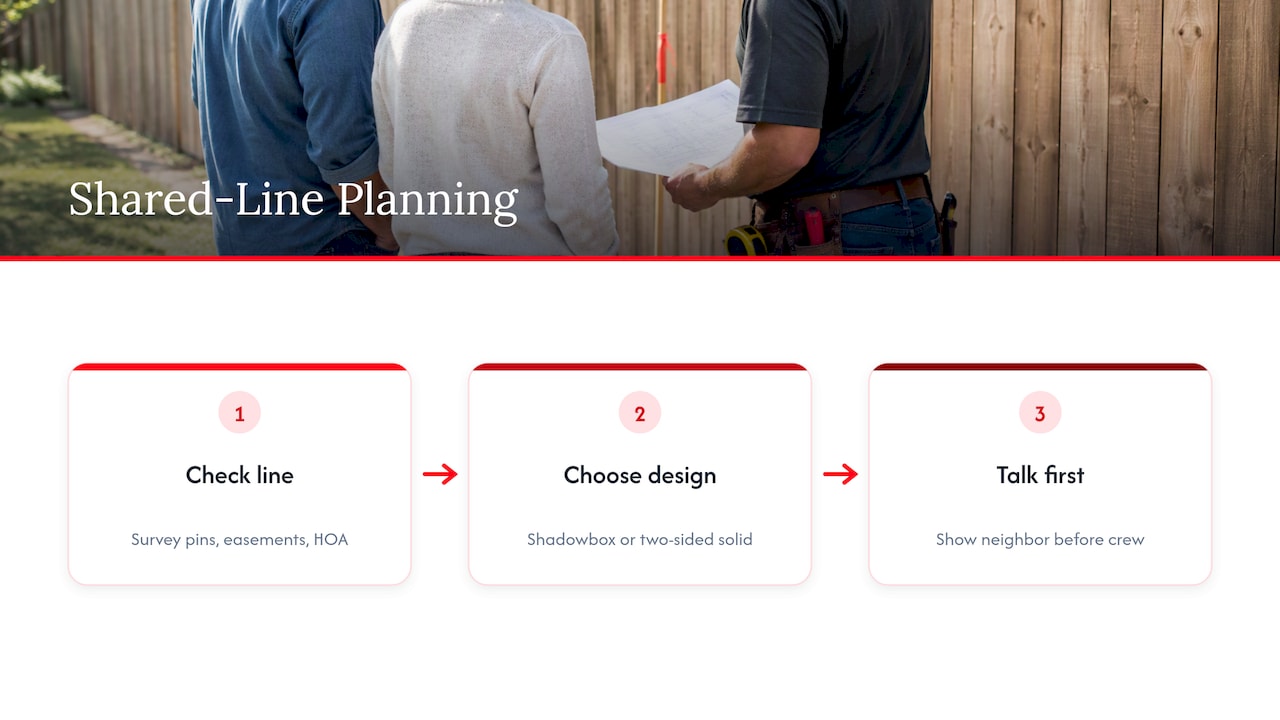
We start with the line. Before we talk boards, we want to know where the survey pins are, whether there is an easement, and what the HOA says. We would rather lose a day to that than rebuild a fence. Then we match the design to the yard: shadowbox where wind and airflow matter, a two-sided solid build where privacy is the job. We also care about materials and how long they last, which is part of why we lean toward sustainable choices where they make sense. A fence that lasts is less waste.
One piece of advice we repeat: tell your neighbor before the crew shows up. Show them the design and ask whether they have any concerns. Most do not. The few who do have usually been looking at a bare rail for years.
— Abraham
Planning a fence along a shared line?
We are licensed and insured, and we offer free quotes for custom wood fencing and gate installation and repair in the Fort Worth area. Tell us where the line is, what your neighbor has, and what your HOA requires, and we will recommend a design and write up every item listed above. See our fencing and gate services or start from the Action Fence and Deck home page.
FAQ
Why is it called a good neighbor fence?
Because it treats the neighbor as well as the owner. The finished face is not reserved for the person who paid, and nobody has to look at exposed rails. The name describes courtesy and appearance, not a legal status.
Is a good neighbor fence required in Texas?
There is no nationwide requirement, and we are not aware of a statewide Texas one. Requirements come from your city, your HOA, easements and your lot. Some HOAs do require a two-sided look, so check your covenants before you design anything.
What is the difference between a privacy fence and a good neighbor fence?
Privacy is about blocking sight lines. Good neighbor is about looking the same from both sides. A solid board-on-board fence with boards on both faces does both. A shadowbox is good neighbor but only partly private.
Can I make my neighbor pay for half?
Not automatically in Texas. California has a presumption of equal sharing with a notice process, but that is California law. In Texas, get a written agreement before you build if you want a cost split, and confirm anything unusual with a real estate attorney.
How much does a good neighbor fence cost?
It costs more than a one-sided fence of the same height because it uses more boards or a framed system. The exact amount depends on length, height, terrain, gates, removal and permits, so we price each job after seeing the site. Our free quote lists every line item.
Sources
- What Is a Good Neighbor Fence? (FenceTrac)
- NDSU Extension fence construction guidance
- Good Neighbor Privacy Fence (NJDOT and FHWA research report)
- Notice of Intent to Alter Shared Boundary Fence (firsttuesday Journal)
- Fort Worth, TX Building Permits Guide (CityRuleLookup)
- Building a fence that connects to your home, but doesn’t divide neighbors (The Seattle Times)
- Fence Plan Review, Permit and Inspections (Saint Paul)
- General Information for Walls/Fences (Scottsdale)