Choose stamped concrete when upfront cost and a seamless look matter most, since it typically runs $10 to $18 per square foot installed and lasts 20 to 30 years. Choose pavers when long-term repairability and freeze-thaw resilience matter more, since they run $15 to $30 per square foot but often last 30 to 50 years or more. Base preparation and joint planning decide which one actually holds up.
TL;DR:
- For a 400 square foot patio, stamped concrete typically costs $4,000 to $7,200 installed, compared with $6,000 to $12,000 for pavers, before site specific charges.
- Stamped concrete needs resealing every 2 to 3 years, while paver joints need periodic sand checks and refills; polymeric sand lasts longer between refills.
- Poor compaction or drainage can damage either surface, so require written details on base depth, slope, joints or sand, and warranty terms.
- Concrete patches rarely match stamped texture or color, while paver sections can be reset; keep spare units from the original order for future repairs.
Table of Contents
- Stamped concrete vs pavers at a glance
- What does it cost per square foot and for a full patio?
- How long does each surface last and what happens when it cracks?
- Which look fits your patio: seamless stone or modular pattern?
- What does installation actually involve and how long does it take?
- What does ongoing maintenance and 20-year cost actually look like?
- How do you choose between stamped concrete and pavers?
- What a 20-year contractor has learned about patio failures
- Get a free quote for your stamped concrete or paver patio
- FAQ
- Sources
Stamped concrete vs pavers at a glance
Before you call a contractor, it helps to see where each material pulls ahead and where it falls short.
- Cost: stamped concrete costs less upfront; pavers cost more but spread expense differently over time.
- Lifespan: stamped concrete lasts 20 to 30 years; pavers often reach 30 to 50 years or more with proper installation.
- Repairability: pavers can be lifted and reset one unit at a time; a cracked slab usually needs patching or full replacement.
- Maintenance: stamped concrete needs resealing every few years; pavers need joint sand checked and topped off periodically.
- Appearance: stamped concrete gives a continuous, stone-like surface; pavers give modular color and pattern flexibility.
- Installation: stamped concrete pours faster but cures longer before heavy use; pavers take longer to place but can be ready for foot traffic relatively quickly.
- Climate: pavers generally handle freeze-thaw cycles and ground movement better than a single slab.
For a 400 square foot patio, that gap in approach shows up directly in your quote and in what you’ll spend over 20 years.
What does it cost per square foot and for a full patio?
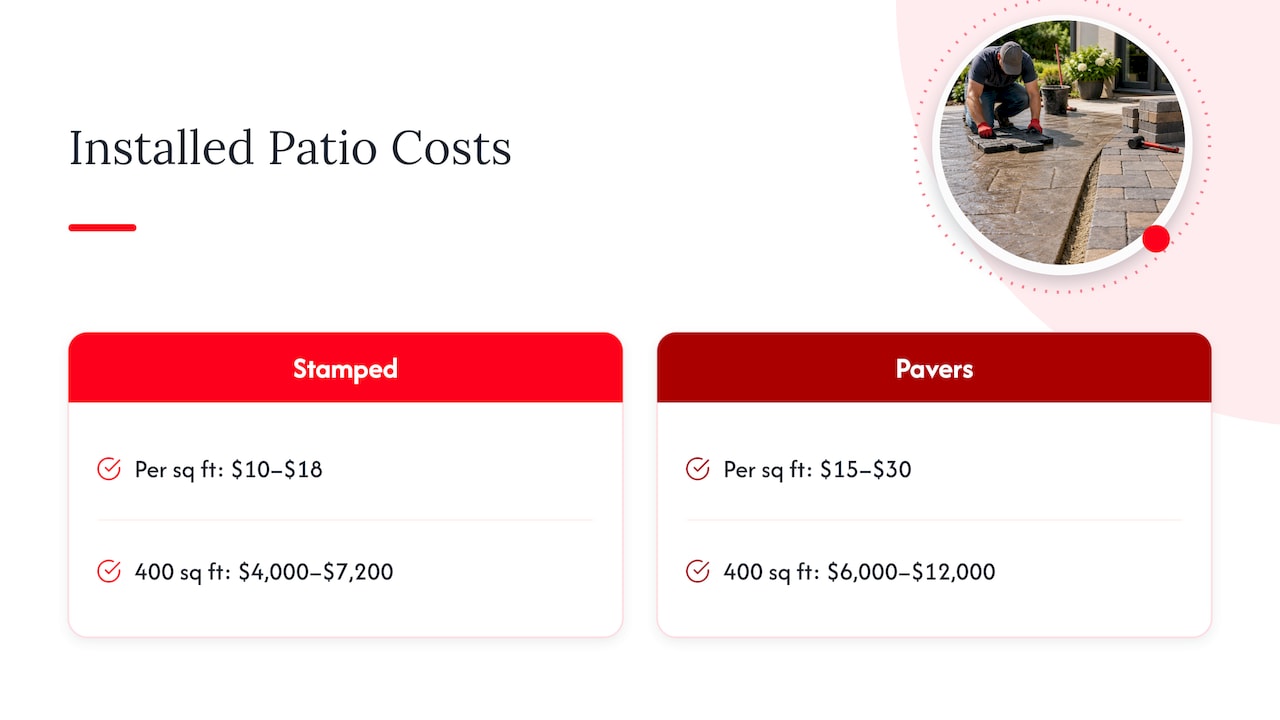
Stamped concrete typically installs for $10 to $18 per square foot, while pavers run $15 to $30 per square foot. On a 400 square foot patio, that puts stamped concrete around $4,000 to $7,200 and pavers around $6,000 to $12,000 installed. Those are starting points, not fixed quotes: site access, pattern complexity, and whether an old surface needs demolition all move the number.
A simple rectangular pour with easy truck access sits at the low end of either range. Intricate stamped patterns with multiple color hardeners, or paver layouts with borders and curved cuts, push labor time up. Excavating a deeper base for poor-draining soil adds cost to both options, and tearing out an old slab or patio before starting fresh adds a demolition line item that many homeowners forget to budget for. If you want a deeper local breakdown before you request bids, our concrete patio cost guide walks through the line items contractors typically quote.
How long does each surface last and what happens when it cracks?
Stamped concrete is a single poured slab, which means it moves as one piece. Subbase settling, tree roots, or freeze-thaw cycling can crack that slab, and once it cracks, the repair shows: patched concrete rarely matches the stamped texture and color exactly. Correctly spaced contraction joints reduce random cracking by giving the slab planned places to flex, but they don’t eliminate the risk entirely.
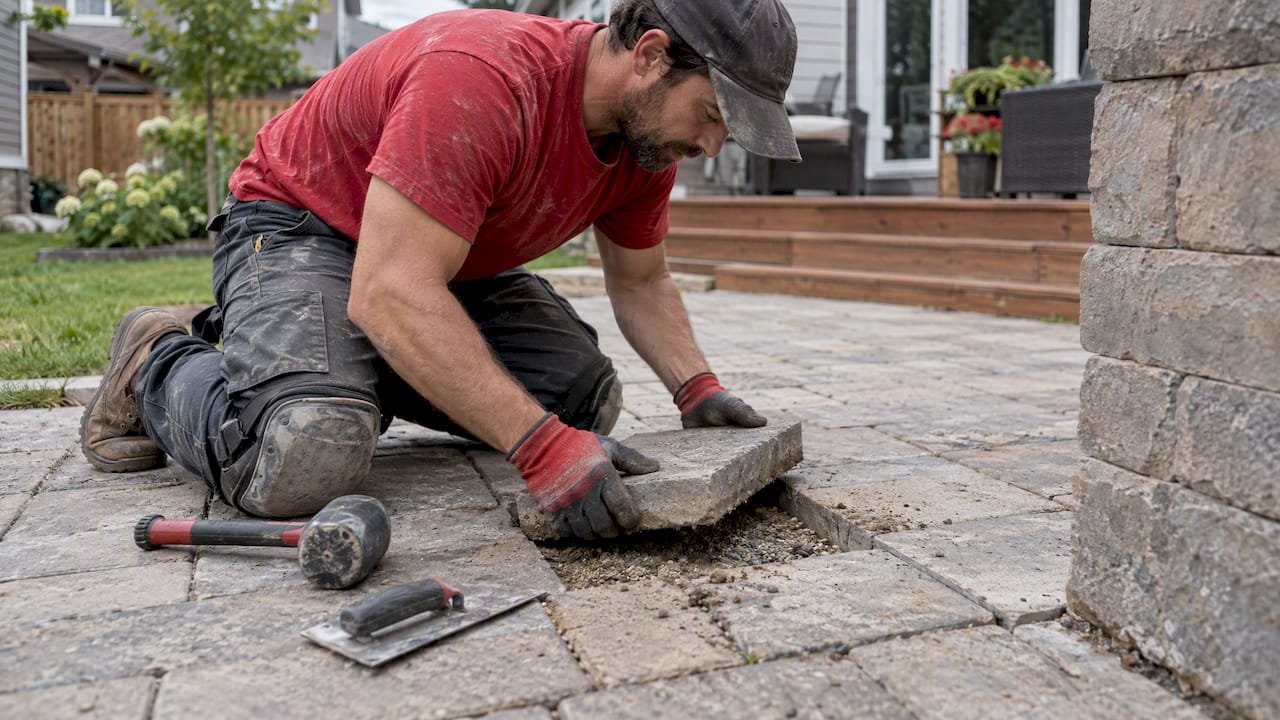
Pavers are modular, so a damaged or settled section can usually be lifted, releveled, and reset without touching the rest of the patio. Manufactured pavers also test stronger in compression. Belgard reports poured concrete in the range of 3,000 to 4,000 PSI compared with 8,000 PSI or greater for its pavers, though exact numbers vary by product.
Expect stamped concrete to last 20 to 30 years and well-installed pavers to last 30 to 50 years or more, with pavers holding up better where winters bring repeated freezing and thawing. If you’re already seeing a crack in an existing slab, our guide on triaging concrete patio cracks covers what to check before calling anyone out.
Which look fits your patio: seamless stone or modular pattern?
Stamped concrete can be pressed, scored, or rolled to mimic stone, brick, tile, or wood, and color hardeners plus antiquing washes create depth without a single paver joint interrupting the surface. It’s a strong choice when you want one continuous plane that reads like natural stone.
Pavers work differently: you choose from individual units in varying colors, sizes, and shapes, then mix them into borders, bands, or herringbone fields. Pavers offer a different appearance and maintenance profile from stamped concrete. In both cases, sealing protects the look. Skip it and stamped concrete dulls and stains faster, while pavers may need periodic joint-sand maintenance. If your existing slab has lost its shine, our piece on resurfacing a concrete patio explains when resurfacing makes sense versus starting over.
What does installation actually involve and how long does it take?
Both systems depend on the same groundwork: compacted base material, proper drainage slope, and solid edge restraint. Skip any of these and the surface fails early, regardless of what’s on top.
- Stamped concrete: poured, stamped while still workable, then cured, usually ready for foot traffic within a few days and vehicle traffic later.
- Pavers: placed unit by unit on a compacted base, often ready for foot traffic the same day, with polymeric sand needing water activation to set properly.
Before signing a contract, ask any contractor for the planned joint layout, the slope direction for drainage, and the curing or sand-activation timeline in writing.
What does ongoing maintenance and 20-year cost actually look like?
Stamped concrete needs resealing roughly every 2 to 3 years to protect color and surface integrity, and skipping it accelerates fading and surface wear. Pavers need joint sand inspected and replenished on a similar 2 to 3 year cycle unless polymeric sand was used, which binds when activated with water and holds up longer between refills. A 2026 comparison notes that while stamped concrete costs less to install, pavers tend to carry lower long-term maintenance costs, and the gap widens in frost-prone climates.
Over 20 years, factor in several reseal cycles for stamped concrete plus the risk of a crack repair that never quite matches the original finish. For pavers, factor in periodic sand top-offs and occasional unit resets, which are generally cheaper and less visible than a concrete patch. Keep a handful of spare pavers from your original order for exact-match repairs, and make sure water drains away from the patio rather than pooling against the house. Our patio drainage guide covers warning signs worth catching early, and homeowners weighing paver upkeep specifically can also check this patio paver cleaning cost guide for pressure-washing pricing.
How do you choose between stamped concrete and pavers?
Run through this before requesting bids:
- Set your budget ceiling and decide if you’re optimizing for lowest install cost or lowest 20-year cost.
- Check your climate: frequent freeze-thaw cycles favor pavers’ modular tolerance for ground movement.
- Weigh repair tolerance: if a future crack bothers you, pavers offer a cleaner fix.
- Match the application: patios and pool decks both work with either material, but pool-deck material choices should account for surface heat and slip resistance.
- Get two estimates, one for stamped concrete and one for pavers, and request the base depth, joint or sand plan, timeline, and warranty terms in writing.
Budget-focused homeowners with stable soil often lean toward stamped concrete. Homeowners in harsh winter climates or anyone who prioritizes easy repairs tends to lean toward pavers. Many projects land in between, using one material for the main field and the other as a border or accent.
What a 20-year contractor has learned about patio failures
After building outdoor structures, the most common failure we see isn’t the material itself: it’s a shortcut in the base. Poor compaction, missing or misplaced contraction joints, and inadequate drainage can contribute to cracking and settling. A solid proposal should spell out base depth, joint or sand layout, edge restraint, and a written warranty before any concrete gets poured or any paver gets set.
Pro Tip: Pairing a stamped concrete field with a paver border often cuts material cost while keeping a clean repair option at the edges, and setting aside a few extra pavers at installation makes future color-matched repairs painless.
— Abraham
Get a free quote for your stamped concrete or paver patio
We build concrete patios, pavers, and masonry work as part of our concrete pouring, paving, and finishing services, alongside fencing, decks, and landscaping for the same property. A free quote from our team helps you compare our proposal directly against any other bid you’ve collected.

- We walk your site and assess soil, slope, and drainage before quoting a base depth.
- We lay out the joint plan or paver pattern so you see it before work starts.
- We bring licensed, insured crews to our projects.
If a deck or outdoor living upgrade is also on your list, our deck services page covers that side of the project too. Reach out for a free quote and we’ll walk your specific patio plans with you.
FAQ
How much does a 20×20 stamped concrete patio cost?
A 20×20 patio is 400 square feet, which puts stamped concrete around $4,000 to $7,200 installed based on typical per-square-foot rates. The final number depends on pattern complexity, site access, and whether an old surface needs removal first.
Which is better, pavers or stamped concrete?
Neither wins outright: stamped concrete costs less upfront and gives a seamless look, while pavers cost more initially but offer easier spot repairs and better freeze-thaw tolerance. The better choice depends on your climate, budget, and how much you value easy repairs over a continuous surface.
How often does stamped concrete need resealing?
Stamped concrete typically needs resealing every 2 to 3 years to protect its color and surface from wear. Skipping resealing accelerates fading and makes the surface more prone to staining.
Can a cracked stamped concrete patio be repaired without replacing it?
Small cracks can sometimes be patched, but matching the original stamped texture and color exactly is difficult. For patios with significant cracking, our guide on diagnosing concrete cracks walks through which cracks are cosmetic and which signal a deeper base problem.
Are pavers or stamped concrete better for a pool deck?
Both work around pools, but material choice affects surface heat and slip resistance near water, which matters more for pool decks than standard patios. This pool deck material guide breaks down those safety and heat trade-offs in more detail.
Sources
- Stamped Concrete vs. Pavers – What’s Best? What Costs Less? – Concrete Network
- Finishing Concrete with Color and Texture
- Stamped Concrete vs Pavers: Cost, Durability & When to Choose (2026)