Wood fence styles fall into three groups: full-privacy, semi-private, and open or decorative. For maximum privacy, board-on-board or solid stockade are common choices. For a good-neighbor look that shares the finished side, pick shadowbox. For a modern architectural statement, horizontal slats deliver it at a higher price. If budget rules everything, post-and-rail or picket often cost less and are among the faster styles to install.
TL;DR:
- Proper installation, including setting posts below the frost line and using weather-compatible fasteners, can significantly extend a fence’s lifespan.
- Horizontal slat fences require internal reinforcement and are best suited for modern homes with precise, high-quality craftsmanship.
- The most sustainable wood fences last longer without replacement, with cedar and redwood sourced responsibly offering natural durability and environmental benefits.
- Common mistakes like shallow post setting, mismatched fasteners, or HOA non-compliance often lead to costly repairs or reinstallation, especially with complex styles or slopes.
- A professional installer is highly recommended for high-wind sites, sloped lots, or precision styles to avoid redos that outweigh the initial cost.
Table of Contents
- Wood Fence Styles: How to Choose the Right One for Your Yard
- Board-On-Board: The Professional Standard for Full Privacy
- Solid Stockade: Budget-Friendly Full Privacy
- Shadowbox: The Good-Neighbor Fence for Shared Lines
- Horizontal Slat: The Modern Look That Costs More to Get Right
- Picket and Post-and-Rail: Open Styles for Curb Appeal and Boundaries
- Board-and-Batten and Lattice-Top: Polish and Extra Height
- Louver and Basketweave: Specialty Styles With a Learning Curve
- Other Variations Homeowners Use to Solve Site Problems
- Choosing Cedar, Redwood, or Pressure-Treated Pine
- How to Keep Any Wood Fence Style Looking Good for Decades
- Environmental and Sustainability Considerations of Wood Fence Styles
- What We See in the Field: Common Mistakes and When to Call a Pro
- Get a Free Quote From Action Fence and Deck
- Sources
- FAQ
Wood Fence Styles: How to Choose the Right One for Your Yard
Before you pick a style, answer a few questions that actually drive the decision.
- How much privacy do you need? A backyard pool deserves full closure; a front yard usually just needs curb appeal.
- What’s your wind exposure? Solid panels catch wind like a sail. Open styles like shadowbox or louver let it pass through.
- What’s your budget vs. how long you want it to last? Cheaper styles often mean more maintenance down the road.
- Are you doing this yourself or hiring a pro? Horizontal slats and basketweave punish DIY mistakes; picket fences are more forgiving to DIY mistakes.
- What do your local rules say? Many municipalities cap front-yard fence height to a few feet and require a permit for taller or more opaque backyard fences. Check your HOA and height limits before you order lumber.
Answer those five questions honestly and you’ll eliminate half the options before you even start comparing wood species.
Board-On-Board: The Professional Standard for Full Privacy
Board-on-board overlaps two rows of pickets so no gap lines up on either side, which kills sightlines completely. That overlap also lets air move between boards, reducing the cupping and warping that plague single-layer panels. Installed costs run toward the higher end of the $25 to $55 per linear foot range for full-privacy fencing, since you’re buying roughly 30% more lumber. DIY difficulty is moderate to manageable. Doable if you’re patient with a level, but many homeowners hire it out to keep the overlap consistent across a long run.
Solid Stockade: Budget-Friendly Full Privacy
The stockade fence is what most people picture when they say “privacy fence”: pickets butted edge to edge in a single layer, no overlap. It sits at the affordable end of the full-privacy range, which makes it a cost-conscious choice for total closure. The trade-off is cupping. Single boards dry unevenly and can bow over time, especially with lower-grade lumber. It’s a solid choice when budget matters more than a flawless, finished look on both faces.
Shadowbox: The Good-Neighbor Fence for Shared Lines
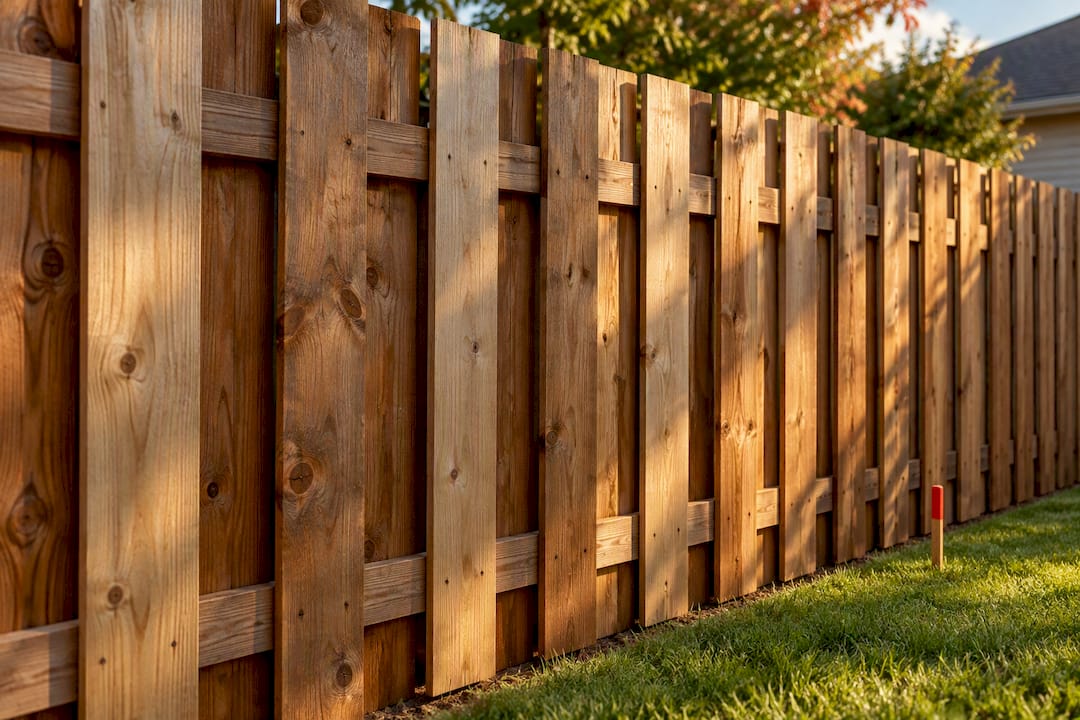
Shadowbox alternates pickets on opposite sides of the rail, so both neighbors see a finished face instead of a raw frame. That gapped pattern also cuts wind load compared to a solid panel, which is why it’s sometimes called the “good neighbor” fence. Privacy sits in the medium range. You get visual screening without complete closure, since the offset pattern leaves narrow sightlines. Cost is generally comparable to stockade, and DIY installation is manageable if you can keep picket spacing consistent on both sides. It’s the natural pick for a shared property line or a yard that catches steady wind.
Horizontal Slat: The Modern Look That Costs More to Get Right
Horizontal slats have become the default look for contemporary homes, but the style fights gravity in a way vertical fences don’t. Long boards need internal blocking or steel tensioning to resist sagging over a run, which pushes installed costs toward $35 to $60 per linear foot, the top of the wood fence spectrum. DIY difficulty is high; uneven gaps or a single sagging board ruins the clean line that makes this style worth choosing in the first place. Reserve it for homes where the architecture calls for it, or check our privacy fence idea gallery for examples of horizontal builds done right.
Picket and Post-and-Rail: Open Styles for Curb Appeal and Boundaries
Picket fences top out around 3 to 4 feet and exist for looks, not privacy. They mark a front yard boundary and let the whole yard stay visible from the street. Post-and-rail (or split-rail) goes even further toward open: two or three horizontal rails between posts, built to define a property line or pen in livestock rather than block a view. Both sit at the low end of the cost spectrum, $12 to $30 per linear foot installed, and both are among the easiest wood fence styles to DIY since post-setting and rail attachment don’t demand precision fitting.
Board-and-Batten and Lattice-Top: Polish and Extra Height
Board-and-batten covers the seams between boards with a second narrow strip, which gives a cleaner, more finished look than a plain stockade and often reads as more upscale. Lattice-top adds a foot or two of open lattice above a solid privacy section. Some municipalities count lattice differently than solid fencing for height limits, so it can be a workaround where a full 8-foot solid wall isn’t allowed. Board-and-batten typically costs somewhat more than stockade for the extra material; lattice-top adds a modest premium for the topper itself. Both are DIY-friendly for anyone comfortable with a stockade build already.
Louver and Basketweave: Specialty Styles With a Learning Curve
Louver fencing angles the boards so you get airflow and a blocked direct sightline at the same time, which makes it one of the better choices for high-wind sites where a solid panel would take a beating. Basketweave, sometimes called herringbone, weaves thin strips in a criss-cross pattern purely for visual effect. Both sit at the upper end of prices due to labor intensity and detail because of the labor involved in precise angle cuts or repeated weaving. Choose louver when wind is your real problem and choose basketweave when you want a fence that functions as a design feature, not just a barrier.
Other Variations Homeowners Use to Solve Site Problems
Plenty of yards need something between the standard styles listed above, and hybrids often solve problems a single style can’t.
- Mixed-height designs combine a taller privacy section in back with a shorter, decorative front section for curb appeal without sacrificing backyard seclusion.
- Masonry or composite posts paired with wood infill cut down on rot at ground level and can match a home’s brick or stone exterior.
- On sloped lots, stepped panels keep each section level while racked (raked) panels follow the grade in one continuous line. Which approach you use depends on how steep the slope is and how much of a stair-step look you’re willing to accept.
Choosing Cedar, Redwood, or Pressure-Treated Pine
Species choice affects lifespan and cost as much as the style itself. Cedar and redwood carry natural oils that resist decay and insects, and either one typically lasts 15 to 25 years above ground with reasonable care. Pressure-treated pine is generally less expensive upfront and is commonly used for posts due to its ground contact durability, often combined with cedar pickets above ground.
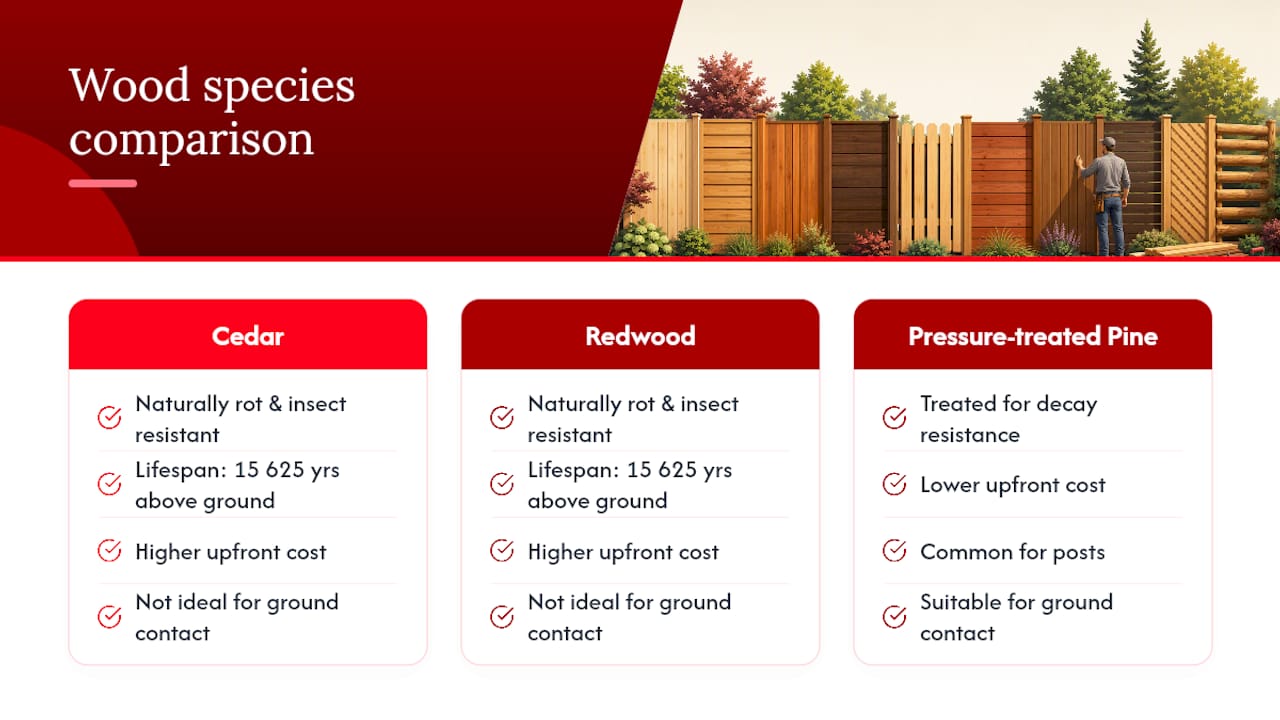
Modern pressure-treated lumber uses formulations like micronized copper azole, and that copper content is exactly why fastener choice matters. Clemson’s HGIC extension guidance recommends stainless steel or hot-dipped galvanized fasteners with treated wood, since standard steel corrodes quickly against the copper. University research on outdoor lumber selection echoes the same point: preservative type and fastener compatibility matter as much as species when you’re estimating how long a fence will actually last.
How to Keep Any Wood Fence Style Looking Good for Decades
Lifespan comes down to a handful of habits more than the style you picked.
- Walk the fence line once a year and check for loose pickets, leaning posts, and soil buildup against the wood.
- Reseal or restain every 1 to 3 years depending on sun and rain exposure. South-facing runs need it more often than shaded ones.
- Clear vegetation and mulch away from the base so wood doesn’t sit in constant moisture.
Installation details matter as much as upkeep. Posts set below the frost line, backfilled with gravel instead of packed soil, and protected with post sleeves at grade all add years to a fence’s working life.
Pro Tip: If you’re mixing pressure-treated posts with cedar pickets, use stainless or hot-dipped galvanized screws throughout the whole fence, not just at the posts. Mismatched fasteners corrode unevenly and it’s one of the most common callback issues installers see.
Environmental and Sustainability Considerations of Wood Fence Styles
Wood is a renewable material, but not every wood fence is equally sustainable. Cedar and redwood sourced from well-managed forests decompose naturally at the end of their service life, unlike vinyl or composite alternatives that persist in landfills for generations. That said, sourcing matters: lumber certified by programs like the Forest Stewardship Council comes from operations that replant and manage harvests responsibly, while uncertified tropical hardwoods sometimes carry a heavier environmental cost tied to deforestation.
Style choice also affects material efficiency. Post-and-rail and picket styles sit at the other end, using the least material for the same length of fence line.
Pressure-treated lumber raises its own trade-off. The chemical preservatives that extend service life to decades also mean the wood shouldn’t be burned or used in gardens where treated runoff could reach edible plants. Untreated cedar and redwood avoid that concern entirely, though they cost more upfront.
The most sustainable fence, in practical terms, is usually the one that lasts the longest without replacement. A fence rebuilt every eight years because it was under built consumes more total lumber over 25 years than one solid installation that holds up the whole time. Longevity is itself an environmental decision, not just a financial one.
What We See in the Field: Common Mistakes and When to Call a Pro
Most homeowners get the style right and get the build wrong. The recurring issues: posts set too shallow for the region’s frost line, mismatched fasteners that streak the wood with rust within a year, and HOA rejections discovered after materials were already purchased. Horizontal slat designs, sloped lots, and high-wind sites are where hiring a professional saves the most money. Not because DIY is impossible, but because a redo costs more than doing it once, correctly.
— Abraham
Get a Free Quote From Action Fence and Deck
Picking the right wood fence style is only half the job. The build quality is what determines whether it lasts 10 years or 25. Professional installers can handle the full range covered here, from straightforward stockade runs to horizontal slat designs that demand precise blocking, and take care of parts homeowners tend to underestimate: post depth for local frost lines, permit checks before digging, and fastener choices that won’t rust against treated lumber.

If your site has a slope, a shared property line, a windy exposure, or an HOA with opinions about height, that’s exactly when a professional install pays for itself in avoided redos. Sustainable material sourcing options are available, detailed in our eco-friendly fencing overview, for homeowners who want a longer-lasting fence with a lighter footprint. For site prep on overgrown property lines, partnering with specialized services like Property Lines fence clearing can prepare a lot before the first post goes in.
Get a free quote on our services page and we’ll walk your yard, talk through style trade-offs, and give you transparent pricing before any lumber is ordered.
Sources
- Wood Fence Designs: 10 Styles Compared by Cost & Privacy
- Treated wood in the landscape (HGIC, Clemson)
- Selecting lumber and lumber substitutes for outdoor exposures (UC ANR)
- Get a fence permit | City of Philadelphia
FAQ
What are the different types of wooden fences?
The main categories are full-privacy styles like board-on-board and stockade, semi-private styles like shadowbox and louver, and open or decorative styles like picket, post-and-rail, and lattice-top. Each balances privacy, cost, and wind resistance differently, and installed costs range from about $12 to $60 per linear foot depending on style and materials.
Which side of the fence should face the neighbor?
The finished side, meaning the smooth face without visible rails and posts, traditionally faces the neighbor’s property while the framing faces your own yard. Shadowbox fences avoid this dilemma entirely since alternating pickets give both sides a finished appearance.
What are the two types of fences?
At the broadest level, fences split into privacy fences, which fully block sightlines, and open fences, which mark boundaries or add curb appeal without blocking the view. Most wood fence styles fall clearly into one category or the other, though shadowbox and louver designs sit in a semi-private middle ground.
How much does a wood privacy fence cost per linear foot installed?
Full-privacy wood fences typically run $25 to $55 per linear foot installed, while open styles like picket or post-and-rail run lower and horizontal slat designs run higher. Actual pricing depends on wood species, site conditions, and local labor rates, so a personalized quote from a local installer gives the most accurate number for your yard.
Do I need a permit for a wood fence?
Many municipalities require a permit for fences above a certain height, commonly around 3 to 4 feet in front yards, with more flexibility in backyards. Philadelphia’s fence permit guidance is one example of how these rules work, but requirements vary by city, so checking with your local building department or HOA before construction is worth the ten minutes it takes.