
Swing gates usually work best on flat driveways with some space available on either side; sliding and cantilever gates are preferred where slopes or tight lot lines limit swing clearance; telescopic gates address wide openings without side yard space for a panel. Bi-fold, vertical pivot, and barrier gates cover the remaining edge cases. Whatever you pick, the automation and safety hardware need to be specified alongside the gate itself, not bolted on as an afterthought.
TL;DR:
- Sliding and cantilever gates are more suited than swing gates for sloped driveways or tight lot lines, especially with frequent daily use.
- Telescopic gates provide wide openings without side yard space but involve more complex mechanics and higher repair costs.
- Automated gate safety requires proper sensors, obstruction reversal, manual release, and backup power, with compliance to UL 325 standards being essential.
- Site assessment should precede style selection; measuring the driveway width, slope, drainage, and clearance is critical before choosing materials or automation.
- Cost factors include opening width, material choice, civil work needs, and automation setup; a full site evaluation and licensed professional quote are recommended.
Table of Contents
- Driveway Gate Types Explained: Swing, Sliding, Telescopic, and More
- Driveway Gate Materials, Finishes, and What They Cost You Long Term
- What Safety Standards Should Your Automated Gate Meet?
- How to Choose a Driveway Gate: A Site-First Checklist
- Installing and Maintaining a Driveway Gate: Timeline and Cost Drivers
- Why We Push Site Assessment Before Style Choices
- Get a Free Quote on Your Driveway Gate Installation
- Sources
- FAQ
Driveway Gate Types Explained: Swing, Sliding, Telescopic, and More
Every gate on the market is a variation on six operating mechanics, and matching the mechanic to your driveway matters more than any style decision you’ll make later.
Single and dual swing gates hinge on posts and open like a door, either as one wide panel or two meeting in the middle. They need clear space on the side they swing into, roughly the width of the gate itself, and they struggle on driveways with more than a gentle grade because the panel can drag or bind. Dual swing gates halve the footprint each leaf needs to clear, which helps on narrower lots. They’re the simplest mechanically, which usually means fewer service calls down the road.
Sliding gates run along a track (ground mounted) or cantilever on rollers with no ground track at all. Both need side run off space roughly equal to the gate’s width unless you go telescopic, and both handle slopes and frequent daily cycles better than a swing gate does, according to synthesized guidance from multiple installation resources. Cantilever versions skip the ground track, which means no debris jamming and no ice buildup in the rail, but the counterbalance framework costs more upfront and needs a longer, sturdier fence run to mount against.
Telescopic gates stack two or more panels that slide behind each other, solving the problem neither swing nor standard sliding gates can touch: a wide opening with no side yard to park a full-width panel in. The trade off is mechanical complexity. More panels mean more rollers, more alignment points, and a higher repair bill if something goes out of adjustment.
Bi-fold gates fold in half as they open, cutting the swing arc roughly in half, useful when you have some side clearance but not enough for a full swing gate. Vertical pivot or lift gates rise straight up, which fits driveways boxed in on both sides with no room to swing or slide at all, though they demand a taller structure and careful counterweight engineering. Barrier gates (the arm style you see at parking garages) are built for controlled-access commercial sites more than residential driveways, but they occasionally make sense for shared drives with heavy daily traffic.
On the aesthetic end, ornamental gates with wide picket spacing prioritize visibility and curb appeal, solid privacy panels block sightlines entirely, and chain link utility gates handle back lots, storage yards, or secondary access points where looks aren’t the point.
Driveway Gate Materials, Finishes, and What They Cost You Long Term
Material choice drives three things: how heavy the gate is (which determines operator sizing), how often you’ll maintain it, and how long it lasts in your climate.
- Steel is stiff and strong for its price, making it a common pick for automated gates that need to stay rigid over a wide span, but bare steel rusts fast without a protective finish.
- Wrought iron delivers the ornamental look people associate with estate entrances. It’s heavy, which means you need a properly rated operator, and it needs repainting or recoating on a regular cycle.
- Aluminum weighs a fraction of steel or iron and resists corrosion naturally, which makes it a favorite for coastal properties, though it flexes more and isn’t the first choice for very wide, heavy panels.
- Wood gives you the warmest look and pairs naturally with privacy fencing, but it demands the most upkeep of any material: sealing, staining, and periodic hardware checks to stop sagging.
- Vinyl and composite options trade some structural stiffness for near zero maintenance, a reasonable swap if you’re not running heavy automation.
Powder coating is the corrosion protection most metal gates rely on today, applied as a dry finish that’s baked on for a durable, weather-resistant shell. Galvanizing works underneath the finish coat on steel that will see real weather. If you’re near the coast, salt spray accelerates corrosion on anything not properly coated; in freeze-thaw climates, moisture trapped in a poorly sealed post or footing is what actually cracks concrete, not the cold itself. If privacy is the goal alongside security, these privacy gate ideas show how panel spacing and material choice work together, and a primer on exterior finish types is worth a look before you commit to a coating.
What Safety Standards Should Your Automated Gate Meet?
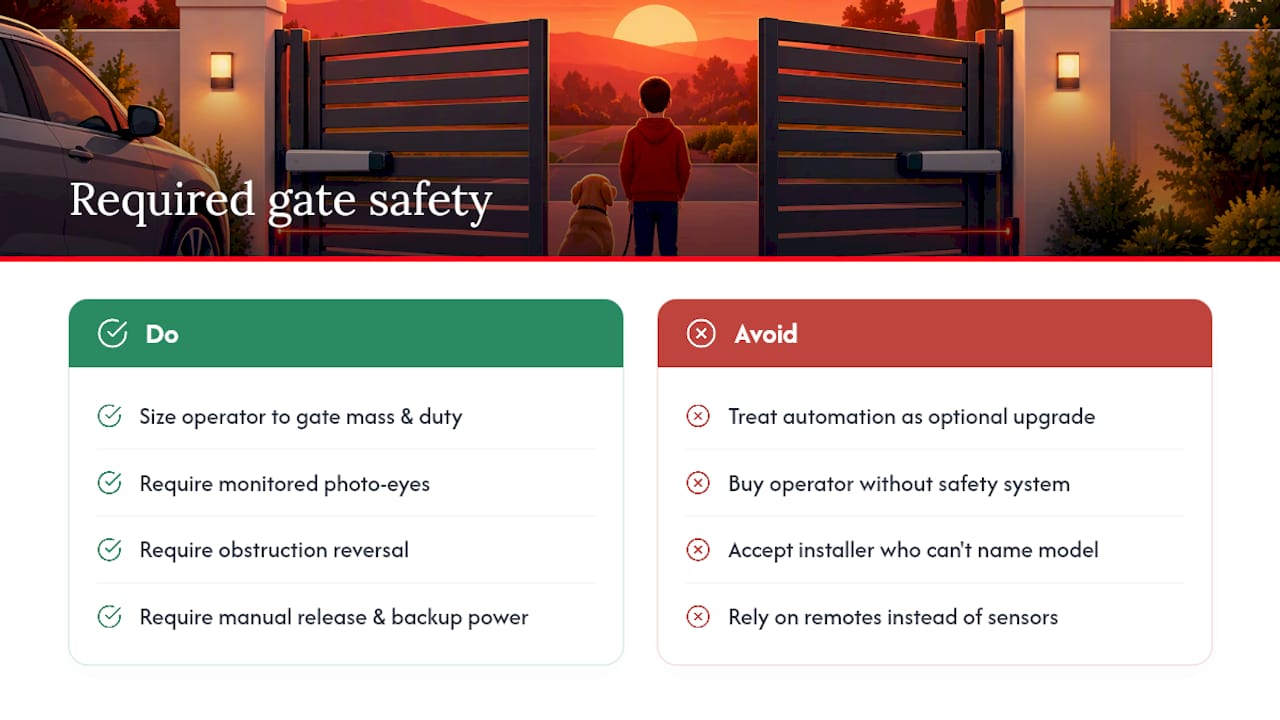
Automation is a safety engineering decision, not a convenience upgrade you tack on after the gate is built. The gate’s mass, geometry, and how often it cycles all determine what operator duty rating you actually need, and CPSC guidance on gate operators treats the operator and the safety devices around it as one system, not two separate purchases.
Automation should be selected with the gate type, mass, geometry, traffic level, and safety system together. Installers should provide monitored photo eyes, obstruction reversal, emergency or manual release, vehicle detection, warning devices, and backup power.
That list isn’t optional extras. Monitored photo eyes and obstruction reversal are what stop a gate from closing on a car, a pet, or a kid who darts through at the wrong moment. Manual release matters when the power goes out and you need to get a vehicle in or out anyway. UL 325 revisions, detailed in CPSC’s commentary, tightened entrapment protection and sensor testing requirements, which is exactly why the operator model matters as much as the gate itself. A home automation overview covering remotes, keypads, and smartphone apps is a fair read for control options, but none of those replace the physical safety hardware.
Pro Tip: Ask any installer to write the exact operator model, its UL/ANSI compliance, and the full list of safety devices directly into your quote. If they can’t name the model, that’s a sign the automation wasn’t sized to your gate.
How to Choose a Driveway Gate: A Site-First Checklist
Skipping ahead to style before you’ve measured your site is how homeowners end up with a gate that doesn’t fit their driveway’s actual constraints.
- Measure the clear vehicle opening. This is the number every quote, every operator spec, and every material decision hangs on.
- Map the swing or slide path. Walk the exact arc a swing gate would need, or the exact run a sliding gate would occupy, and check for trees, slopes, or utility boxes in the way.
- Confirm slope, drainage, and side storage. A driveway that pitches even slightly can rule out ground track sliders and favor cantilever or swing instead.
- Decide privacy versus visibility. This shapes both material and panel spacing before you shop finishes.
- Choose material and finish based on climate exposure and how much upkeep you’re willing to take on.
- Specify posts, foundations, operator, controls, and safety devices as one package, not separate line items added later.
Before anyone breaks ground, run the boring but critical checks: utility locating, confirming property lines and easements, sight distance at the street, and whatever permit or HOA approval your municipality or association requires. This full sequence follows the Access Board’s own guidance on entrance and gate planning, which also flags a detail a lot of homeowners miss: if people will regularly walk through on foot, that pedestrian route needs its own planning and clear width, separate from the vehicle opening.
A written quote should list the clear opening dimensions, material and finish, post and footing specs, track or cantilever details, the operator’s model and duty rating, control types, every safety device, who’s doing electrical or solar work, permits, warranty terms, and who owns maintenance responsibilities going forward. A price that’s missing half of that list is a price that’s missing half the job.
Installing and Maintaining a Driveway Gate: Timeline and Cost Drivers
Installation runs through a fairly predictable sequence: site prep and layout, digging and setting footings or posts, fitting and aligning the gate itself, wiring the operator and controls, then testing every safety device before anyone calls it finished. A straightforward swing gate on flat ground moves through that faster than a cantilever slider that needs a longer counterbalance run poured into concrete.
Costs shift with a handful of variables: how wide the opening is, what material you picked, whether the site needs real civil work (grading, drainage, a longer footing run), and whether you’re adding automation with electrical or solar power. A basic manual swing gate on an easy site costs far less than an automated cantilever slider requiring new electrical service, so treat any single number you see online as a rough starting point, not a quote.
Ongoing upkeep is short but non negotiable:
- Check sensors and controls visually every month for anything blocked, misaligned, or dirty.
- Have the operator serviced annually by someone who knows the model.
- Lubricate hinges or rollers and clear debris out of ground tracks on a regular cycle.
- Recheck sensor alignment any time the gate gets bumped or the ground shifts.
If your gate starts sagging or the opener starts hesitating, these troubleshooting checks and this sagging gate fix guide cover what to try before calling anyone out. And always confirm permit and HOA rules before you order materials. It’s a lot cheaper to find out the height limit is six feet before the gate arrives than after.
Why We Push Site Assessment Before Style Choices
Homeowners tend to shop gate styles first and site conditions second, which is backwards. Over 20 years building outdoor structures, we’ve found the driveway itself, its slope, its width, its drainage, decides which gate types are even viable long before material or finish enters the conversation. The order is favored deliberately, with eco-friendly materials and solutions built around each site rather than a catalog default. Run the selection checklist above, then request a free site assessment from a licensed installer before you commit to anything.
— Abraham
Get a Free Quote on Your Driveway Gate Installation
If you’ve made it through the swing versus sliding versus telescopic decision and you’re ready to move from research to actual hardware, that’s exactly where a licensed crew earns its keep. Licensed crews install and repair custom wood and metal gates, build the posts and foundation work that heavier automated gates require, and can integrate access control hardware into the final build, with eco-friendly material options.

Free quotes are provided, and crews are typically licensed and insured, helping to avoid scope gaps or surprise charges once the job starts. Head to the services page to request a free site visit and get a written quote that covers your gate, your posts, and your automation as one package instead of three separate guesses. If you’re also weighing fencing options for the rest of the property, the eco-friendly fencing overview is worth a look while you’re there.
Sources
- CPSC — Voluntary Standards topics: Garage Door Operators / Gate Operators
- U.S. Access Board — Guide: Chapter 4 entrances, doors and gates
- Powder Coating Institute — What is powder coating?
FAQ
What are the best gates for a driveway?
The best gate depends on your site, not a single “best” style. Swing gates fit flat driveways with clearance on either side, sliding and cantilever gates handle slopes and tight side yards, and telescopic gates solve wide openings where no side storage space exists at all.
What is the average cost of installing a driveway gate?
Cost swings widely based on opening width, material, whether civil work like grading or new footings is needed, and whether you’re adding automation with electrical or solar power. Because those variables change so much from property to property, a written quote covering the full scope, not just the gate panel, is the only reliable number. Action Fence and Deck provides free, no-obligation quotes after a site visit.
Do I need a permit to put a gate on my driveway?
Many municipalities and HOAs require a permit or design approval for driveway gates, especially automated ones or gates above a certain height. Always confirm local requirements and HOA rules before ordering materials, since retrofitting a gate to meet code after installation gets expensive fast.
What are the different types of gates?
The main operating types are single or dual swing, sliding (ground track or cantilever), telescopic, bi-fold, vertical pivot or lift, and barrier gates for controlled-access sites. Within those mechanics, material choices like steel, wrought iron, aluminum, wood, and vinyl or composite determine weight, maintenance, and style.