Pour 4 inches of concrete for most residential patios. That covers standard foot traffic, patio furniture, and grills. Bump it to a thicker slab for hot tubs, outdoor kitchen islands, occasional vehicle parking, or soft, unstable soil. Everything else that determines how long the slab lasts comes down to base prep, reinforcement, and joint spacing, which the rest of this guide covers.
TL;DR:
- Thicker slabs of 5 to 8 inches are necessary mainly for hot tubs, heavy vehicles, or outdoor kitchens, while standard foot traffic patios perform well at 4 inches.
- Proper base preparation with 4 to 6 inches of compacted gravel is more critical for durability than simply increasing concrete thickness, especially in freeze-thaw regions.
- Reinforcement such as wire mesh, rebar, or fiber helps control cracking and allows for slightly thinner slabs if properly placed and supported.
- Control joints should be cut every 8 to 10 feet at one-quarter of the slab’s depth, with adequate curing and edge support preventing early cracking.
- Increasing thickness from 4 to 6 inches raises material costs proportionally and typically offers less benefit than investing in better base prep or reinforcement.
Table of Contents
- Concrete Patio Thickness: The Standard and the Minimum
- When You Need More Than 4 Inches
- Base Prep Matters More Than an Extra Inch of Concrete
- Reinforcement: Wire Mesh, Rebar, or Fiber
- Joints, Curing, and Finishing That Prevent Cracks
- What Extra Thickness Actually Costs You
- Pre-Pour Checklist and When to Call a Pro
- A Publisher’s Note on Field Decisions
- Get a Free Quote on Your Concrete Patio Project
- Sources
- FAQ
Concrete Patio Thickness: The Standard and the Minimum
Four inches is the number contractors default to, and for good reason. It handles the loads a typical backyard sees, from a dining set to a couple of adults doing yard work on top of it. In tight budget situations, some crews will use slightly less than the standard thickness, but that’s the minimum, not a target, and it leaves almost no margin for a weak base or an unexpected load.
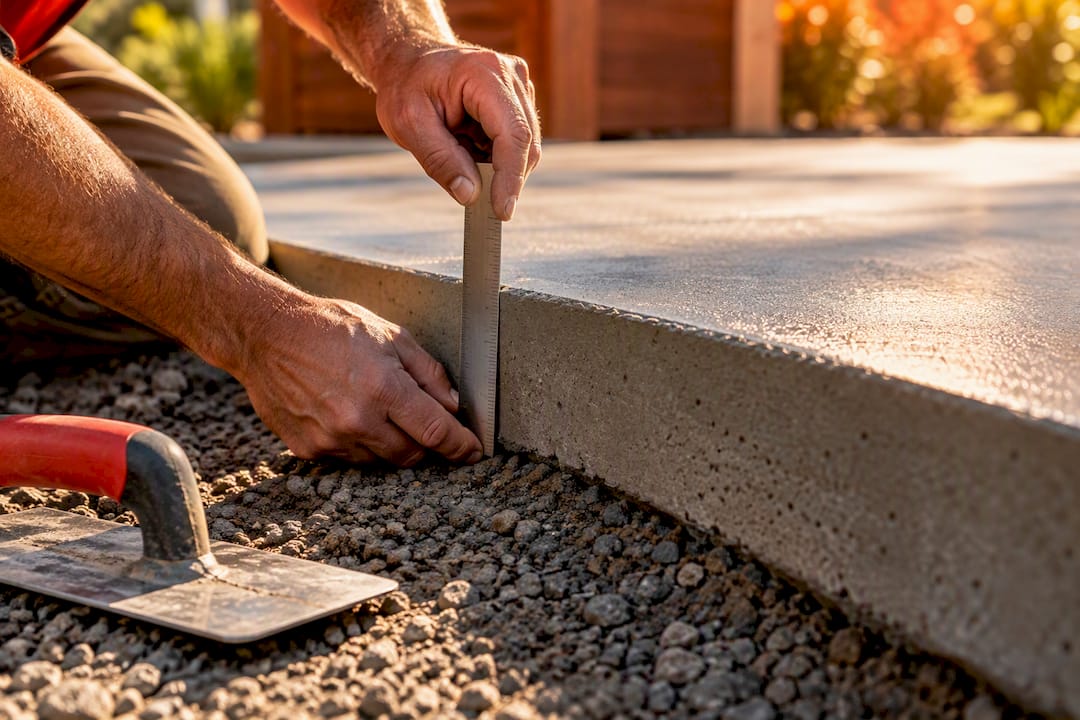
Residential slabs generally get poured at 3,000 to 4,000 psi, with 3,500 psi being the common middle ground for patios exposed to freeze-thaw cycles. Going above 4,000 psi rarely buys much for a patio unless you’re also dealing with heavy point loads.
Common thickness options break down like this:
- 4 inches: Standard patios, walkways, foot traffic only
- 5 to 6 inches: Occasional car or light truck parking
- 6 to 8 inches: RVs, heavy equipment, or repeated heavy vehicle loads
Lowe’s recommends 4 inches as generally sufficient for slabs on grade carrying foot traffic, which lines up with what most trade guides call the baseline.
When You Need More Than 4 Inches
Concentrated loads change the math fast. A hot tub full of water and people can weigh 4,000 to 6,000 pounds sitting on a footprint of maybe 7 by 7 feet. That’s a lot of pressure concentrated in one spot, not spread across the whole patio the way a dining table’s weight is.
- Hot tubs: Pour a dedicated pad at 5 to 6 inches, reinforced, sized to the tub’s footprint plus a few inches of margin.
- Outdoor kitchen islands: Thicken the slab under the island footprint to 5 inches or add a footing, since cabinets and countertops concentrate weight along narrow lines.
- Occasional vehicle parking: Go to 5 to 6 inches across the whole area a car might sit on, not just the tire paths.
- RVs or heavy trucks: Plan for 6 to 8 inches, and treat this as pavement design territory rather than a standard patio pour.
You don’t need an engineer to eyeball most of these. If an object’s weight divided by its footprint feels like it’s concentrated on a few square feet rather than spread out, that’s your signal to either thicken that section or pour a separate pad instead of upsizing the entire patio. A separate reinforced pad under a hot tub, tied into but slightly isolated from the main patio slab, often outperforms a uniformly thicker pour at a lower material cost.
Base Prep Matters More Than an Extra Inch of Concrete
Trade guides agree on this point: a well-prepared base under a standard 4-inch slab beats a thicker slab poured on a poor base every time, as explained in detail by gravel driveway repair and installation experts in Cincinnati, OH. Industry consolidation of patio specs points to 4 to 6 inches of compacted gravel as the standard sub-base for residential patios.
Here’s what that prep actually looks like:
- Excavate to a depth equal to your slab thickness plus your gravel base, plus a couple inches of buffer for settling.
- Compact the gravel base to roughly 95 percent density, in lifts rather than one dumped pile.
- Slope the finished grade 1/8 to 1/4 inch per foot away from the house for drainage.
- Add a vapor barrier under the slab in damp climates or where the patio sits near a foundation.
- In freeze-thaw regions, make sure the base extends below the frost line or uses a well-draining aggregate to reduce frost heave risk.
A ConcreteCalc Pro breakdown makes the same point: a properly based 4-inch slab with good joints regularly outperforms an unsupported thicker one. If drainage around your existing patio already looks like a problem, it’s worth diagnosing that separately before you commit to a thickness plan.
Pro Tip: Uneven compaction, not undersized thickness, causes most of the cracking and settling homeowners see in the first two years. Spend your prep budget on the base before you spend it on extra concrete.
Reinforcement: Wire Mesh, Rebar, or Fiber
Reinforcement doesn’t make concrete thicker, but it changes how much thickness you can get away with and how well the slab resists cracking over time.
- Welded wire fabric (6×6 W1.4xW1.4): Fine for standard 4-inch residential patios with foot traffic and light furniture loads.
- #3 rebar on an 18-inch grid: Better for anything carrying vehicles, hot tubs, or slabs poured over marginal soil.
- Fiber reinforcement: Mixed directly into the concrete at roughly 1 to 1.5 pounds per cubic yard, mainly to control surface shrinkage cracking rather than replace structural steel.
- Placement: Keep mesh or rebar suspended on chairs at mid-depth or slightly above center, with at least 2 inches of concrete cover, and overlap mesh sheets by one full square.
Mesh that ends up sitting on the ground during the pour, which happens constantly on DIY jobs, does almost nothing. If it’s not held up during placement, skip it and rely on fiber instead.
Joints, Curing, and Finishing That Prevent Cracks
Concrete cracks. The goal with control joints isn’t to prevent cracking, it’s to decide where the cracks happen.
- Cut control joints every 8 to 10 feet for a 4-inch slab, following the general patio-building guidance trade sources use.
- Cut joints to roughly one-quarter of the slab’s depth, so a 1-inch cut on a 4-inch slab.
- Moist cure for 7 days minimum, keeping the surface damp or covered rather than letting it dry out fast in the sun.
- Expect roughly 70 percent of design strength at 7 days, with full 28-day strength as the standard benchmark contractors use for load calculations.
- Support slab edges properly during forming so they don’t chip or slump before the concrete sets.
Skipping the moist cure is probably the single most common mistake on DIY pours. A slab that dries too fast on the surface while the interior is still curing ends up with a network of fine surface cracks that show up within the first summer.
What Extra Thickness Actually Costs You
Going from 4 inches to 6 inches doesn’t double your concrete cost, but it’s not free either. Regional cost estimates suggest each additional inch across a patio adds material cost on top of your base 4-inch price, plus a bit more in labor and finishing time.
- 10×10 patio (100 square feet): Going from 4 to 6 inches adds roughly 50 percent more concrete volume, a modest dollar increase for a small project.
- 20×20 patio (400 square feet): The same 2-inch increase multiplies across four times the area, so the added cost is proportionally larger and worth planning for early.
- Better use of that budget: In most cases, spending the same money on a deeper gravel base, proper compaction, or upgraded reinforcement returns more durability than pouring 2 extra inches of unreinforced concrete.
If you’re weighing a full renovation against a patch job, detailed cost breakdowns for concrete patios can help you see where thickness ranks against other line items.
Pre-Pour Checklist and When to Call a Pro
Before any concrete truck shows up, walk the site with this list:
- Excavation depth confirmed for slab plus base
- Gravel base compacted in lifts, not dumped and left loose
- Forms set to the exact target height, checked at multiple points
- Reinforcement laid out and elevated on chairs, not resting on the ground
- Control joint locations marked and spacing confirmed
- Finish plan decided (broom, stamped, exposed aggregate) before the pour, not during it
Small pads, like a single stepping-stone slab, are reasonable DIY territory. But permits, heavy equipment access, poor or expansive soils, and anything supporting a hot tub or vehicle load are where hiring a licensed contractor pays off. A DIY-built 10×10 recycled concrete patio shows what’s achievable at a small scale, but that same project scaled up to a full backyard patio with drainage challenges is a different job entirely.
A Publisher’s Note on Field Decisions
Most patio failures we see trace back to a rushed base, not a thin slab. Homeowners fixate on whether to pour 4 or 5 inches, when a poorly compacted sub-base or a missed drainage slope will crack any slab regardless of thickness. When in doubt, spend the extra budget on base prep first. A free inspection or quote catches these issues before concrete ever gets ordered.
— Abraham
Get a Free Quote on Your Concrete Patio Project
The full job includes site excavation, base compaction, reinforcement layout, jointing, and finish work on patios and custom pads, performed by experienced crews.

If you’re staring at conflicting advice on thickness, base depth, and reinforcement and just want someone to walk your yard and tell you what it actually needs, that’s exactly what a free quote is for. Here’s what’s covered:
- Site evaluation for soil conditions, drainage, and load requirements
- Concrete pouring, paving, and finishing tailored to your patio’s actual use
- Reinforcement and joint planning built into the estimate, not added later as a surprise
Request a free quote on concrete pouring, paving, and finishing services and get a straight answer on thickness, base depth, and cost before you commit to a design.
Sources
For engineering-level thickness math, see TxDOT’s rigid pavement design guidance. For trade-standard patio specs and jointing, see the Estimation QS technical guide and the ConcreteCalc Pro slab thickness guide.
- How to build a concrete pad — Lowe’s
- Concrete Patio Thickness: How Thick Should Your Patio Be? Technical Guide – Estimation QS
- Concrete Slab Thickness Guide | ConcreteCalc Pro
FAQ
How Much Does a 20×20 Concrete Patio Cost?
Cost depends heavily on region, base prep, and finish choice, and a 400-square-foot patio at 4 inches thick uses substantially more material and labor than a small pad. For a full cost breakdown by square footage and finish type, see Actionfenceanddeck’s concrete patio cost guide or request a free quote for exact pricing on your project.
Is a 2-Inch Concrete Slab Enough for a Patio?
No. Two inches is far below the accepted minimum for a residential patio and won’t hold up to normal foot traffic or furniture weight without cracking early. Most guidance sets 4 inches as the standard minimum for durability, with 4 inches as the typical residential patio thickness recommended by Lowes.
What Is the 90-Minute Rule for Concrete?
Ready-mix concrete generally needs to be placed and finished within a limited timeframe after batching, after which the mix starts losing workability and strength potential. This matters most on hot days or long-distance deliveries, where crews sometimes add retarding admixtures to extend that window.
Is 4-Inch Concrete Good for a Patio?
Yes. Four inches is the standard thickness for most residential patios handling foot traffic, furniture, and grills, and it’s what Lowe’s and most trade guides recommend as sufficient for typical backyard use. Only heavier loads like hot tubs or vehicles call for going thicker.