
Service your automatic gate regularly—about once a year for typical use and more frequently for heavy daily traffic—and run three quick checks yourself every month: the safety sensors, the track and rollers, and the backup battery or power connection. Most breakdowns trace back to one of those three spots. Anything involving wiring, force settings, or safety-device calibration is a job for a licensed technician, not a Saturday afternoon project.
TL;DR:
- Regularly inspect wiring connections, sensors, and backup batteries monthly to identify intermittent faults caused by corrosion, water intrusion, or aging components.
- Seasonal maintenance should focus on cleaning and lubricating track and hinges, checking weather seals, and avoiding snow or ice buildup that can damage or stall the gate.
- Weekly gate trials, quarterly lubrication, and battery testing can prevent most common failures and extend the system’s lifespan, but professional servicing is recommended at least once a year.
- Most problems stem from dirt, friction, or wiring issues, while safety sensor misalignment or dirt buildup are frequent nuisances that trigger shutdowns or reversals.
- Costs for routine professional maintenance typically range from $150 to $300 annually, with higher expenses only for major repairs like motor rebuilds or component replacements.
Table of Contents
- What Causes Most Automatic Gate Problems?
- What Should You Do Each Season to Maintain an Automatic Gate?
- How Do You DIY Maintain and Troubleshoot an Automatic Gate?
- How Often Should a Professional Service Your Automatic Gate?
- What Safety Checks and Records Should Owners Keep?
- What Action Fence and Deck Sees on Most Service Calls
- Why Most Gate Maintenance Advice Misses the Point
- Get a Free Quote for Gate Maintenance or Repair
- Sources
- FAQ
What Causes Most Automatic Gate Problems?
A gate that won’t open or close usually has one of four culprits: a power interruption, a dead remote or keypad battery, a blocked photocell sensor, or a physical obstruction sitting in the gate’s path. Before assuming the worst, check the obvious stuff first. A branch resting against the track or a spider web across a sensor lens causes more service calls than any motor failure.
Slow or jerky movement almost always points to friction. Dirt packed into the track, rollers that have worn flat on one side, or hinges that haven’t seen lubricant in a year will all make a gate hesitate or grind partway through its cycle. Grinding, squealing, or knocking noises during operation usually mean loose mounting bolts, a bearing starting to fail, or debris caught somewhere in the moving parts.
Intermittent faults, where the gate works fine one day and refuses the next, are the trickiest to diagnose and the ones most owners get wrong. The most common causes worth checking before calling a technician include:
- Corroded or loose wiring connections at the control board
- Water that has gotten into a junction box or sensor housing
- A backup battery that’s aging out and can no longer hold a charge under load
- A control board reset that got triggered by a power surge
Safety sensor issues deserve their own mention because they’re both the most common nuisance and the most safety critical. Dirty lenses, sun glare, or a sensor pair that’s drifted slightly out of alignment will cause a gate to stop, reverse, or refuse to close at all. That’s the system doing its job. A gate that ignores a blocked sensor and closes anyway is a bigger problem than one that’s overly cautious.
What Should You Do Each Season to Maintain an Automatic Gate?
Weather swings are hard on moving hardware, and a gate that sits outside 365 days a year takes the brunt of it. Building a seasonal rhythm catches small issues before they turn into stuck gates or motor burnout.
- Spring: Deep clean the track and roller channels once the winter grit has had a chance to build up. Inspect hinges, hardware, and the gate frame for rust or corrosion that formed over the cold months. Test the safety sensors and the manual emergency release now, before you need them in an emergency.
- Summer: Check that the motor housing has clear ventilation. Heat is hard on gate operators, and a motor working inside a dust-caked enclosure runs hotter than it should. Tighten any hardware that’s worked loose from vibration, clear out wasp nests or bird nests that tend to form in housings, and wipe down solar panels if your system runs on one.
- Fall: Clear leaves and debris from the track before they get packed down by rain. Check weather seals and drainage points around the gate posts and control box. Walk the gate slowly and look for fasteners that have started to back out.
- Winter: Switch to a low-temperature lubricant on hinges and rollers if you’re in a freezing climate, since standard grease can stiffen up and drag in cold weather. Keep de-icing salt away from metal gate components. It accelerates corrosion fast. Test the manual release and backup battery before the first snowfall, and clear snow or ice from the track manually rather than forcing the gate to push through it.
That last point matters more than people think. A gate motor is not built to shove through a snowdrift, and doing it repeatedly is one of the fastest ways to burn out a drive system that would otherwise last a decade.
How Do You DIY Maintain and Troubleshoot an Automatic Gate?
Most of what keeps a gate running smoothly is well within an owner’s ability. The Standard Gate Co maintenance checklist breaks the work into a rhythm that prevents the majority of common failures, and a structured monthly and quarterly routine is the backbone of it.
- Weekly: Watch and listen to one full open/close cycle. Unusual sounds or hesitation are early warning signs, and catching them here is cheaper than catching them after a full stop.
- Quarterly: Lubricate hinges and rollers, tighten any hardware that’s loosened, and clean the track of dirt buildup. On sliding gates, never grease the drive rack itself. Grease attracts grit and speeds up wear rather than preventing it. Use dry silicone or PTFE lubricant on bearings instead, which is the standard recommendation from gate maintenance guides.
- Test the backup battery and remote batteries. Run the gate on battery power alone for one cycle to see if it completes it at normal speed. A gate that moves noticeably slower on battery is telling you the battery is near the end of its life.
- Check the manual release. Trigger it with the gate in a safe, closed position and confirm the gate disengages and moves freely by hand. If it sticks or resists, that’s a sign the release mechanism needs professional attention.
- Note anything electrical, but don’t touch it. Corroded connectors, a control box with water inside, or exposed wiring are all reasons to stop and call a professional. Never open or work on mains wiring or the control board yourself.
Pro Tip: Keep a small notebook or phone note with the date of every check you run. When something eventually goes wrong, being able to tell a technician “the battery test was fine three weeks ago” saves diagnostic time and often saves money.
How Often Should a Professional Service Your Automatic Gate?
Gate Safe recommends servicing automatic gates at least every six months when a trained installer handles the inspection, and most manufacturer guidance lines up with that for higher-use gates. CAME’s maintenance guidance puts it at once a year for typical residential use and twice a year for gates that see heavy or commercial-level traffic.
A professional visit covers ground a homeowner shouldn’t attempt alone:
- Calibrating safety devices and testing the force settings that determine how hard the gate pushes against an obstruction
- Inspecting the electrical control board for corrosion, loose terminals, or moisture damage
- Checking bearings, the gearbox, and drive components for wear that isn’t visible from outside
- Updating firmware or control settings where the operator supports it
Costs vary by region and gate type, but routine annual service typically falls in a modest range, often $150 to $300. Repairs run higher and depend heavily on what failed. A battery swap or roller replacement costs far less than a motor rebuild, and a full motor replacement is the most expensive outcome on the list. Scheduled maintenance exists precisely to keep you out of that last category. Skipping it long enough tends to turn a $50 part into a $500 repair.
Keeping service records also matters beyond your own peace of mind. If a gate ever causes an injury or property damage, a documented maintenance history is often the difference between a manageable insurance claim and a serious liability problem.
What Safety Checks and Records Should Owners Keep?
Photocells and the safety reversal function need testing regularly, not just during an annual visit. Walk into the gate’s path while it’s closing and confirm it stops or reverses. If it doesn’t, stop using the gate until a technician resets the safety settings.
- Test photocells and reversal sensors monthly, not just once a year
- Keep a written or digital maintenance log with dates, tasks performed, and any parts replaced
- Save professional service reports rather than discarding them after the visit
- Recognize that commercial or shared-site gates often carry stricter legal maintenance obligations than a private residential driveway gate, and typically require a competent, trained installer for any adjustment
- Leave force settings and control-board changes to a qualified professional every time
What Action Fence and Deck Sees on Most Service Calls
Gate maintenance and repair is one of the services our crews handle alongside fencing and decking, and the patterns repeat across nearly every property we visit. A typical professional visit covers a full inspection, lubrication at the right points, hardware tightening, safety-device testing, and a battery check. It rarely takes long, and it’s rarely dramatic.
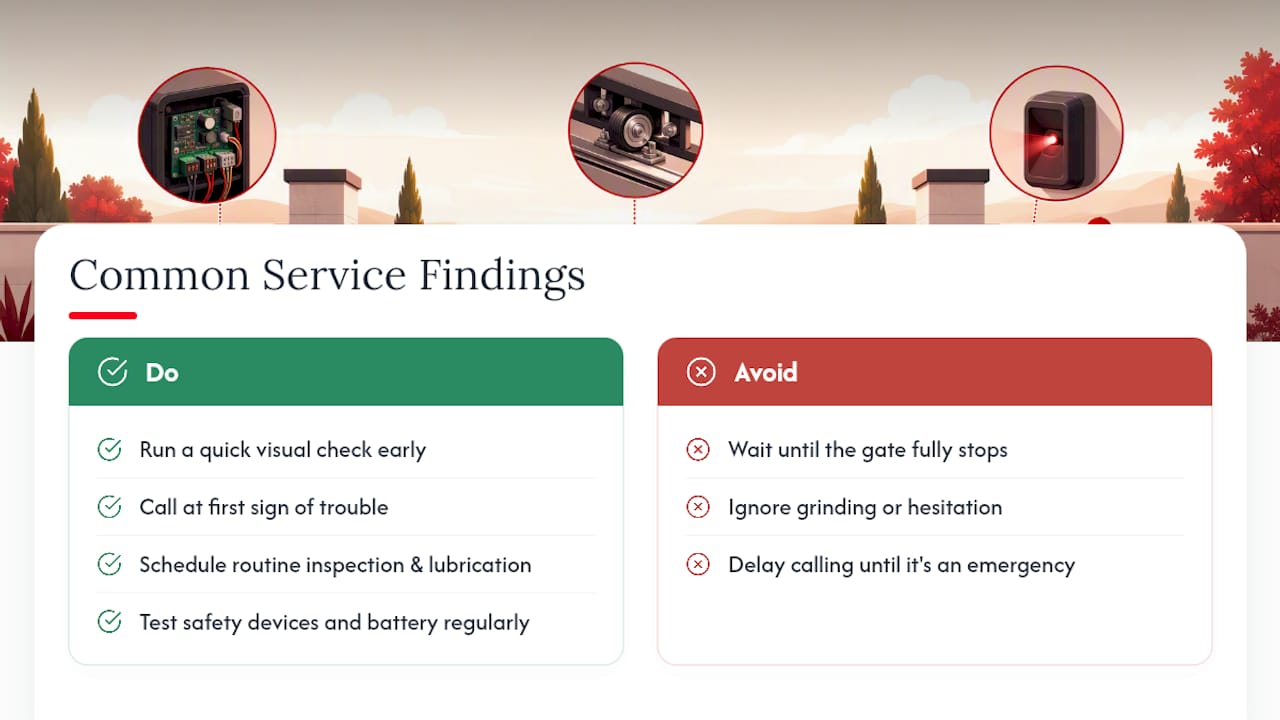
The most common mistake we see is owners waiting until a gate fully stops before calling anyone. A gate that’s grinding, hesitating, or occasionally ignoring the remote is already telling you something. Catching that early, with a simple visual check or a quick call, is almost always cheaper than the emergency repair that follows if you wait.
Why Most Gate Maintenance Advice Misses the Point
The conventional advice on gate maintenance treats every task as equally urgent, which leads homeowners to either do nothing or attempt things they shouldn’t. Both reactions come from the same root problem: nobody draws a clear line between what’s safe to do yourself and what genuinely requires a licensed technician.
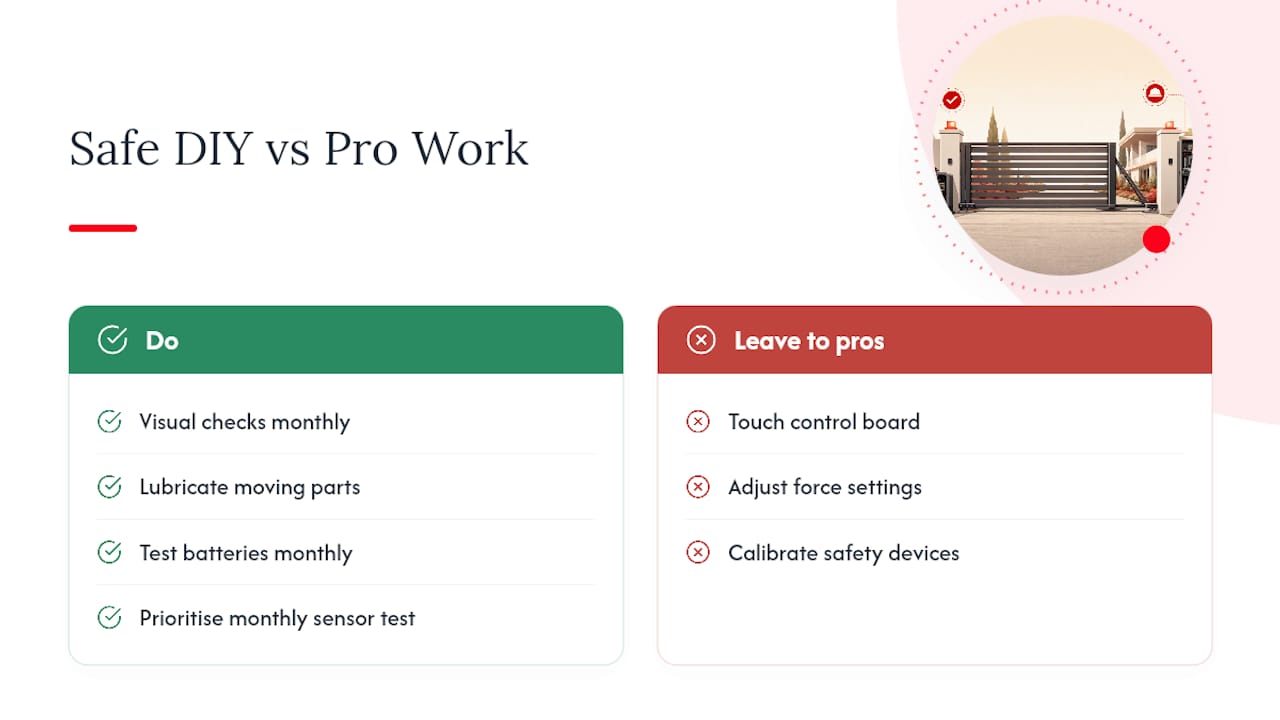
The research here supports a simpler judgment. Visual checks, lubrication, and battery testing are low-risk and high-value. Do them monthly and you’ll catch most failures before they strand the gate open or closed. Anything touching the control board, force settings, or safety-device calibration belongs to a professional, full stop, because a miscalibrated safety reversal is a genuine injury risk, not just an inconvenience.
If you take one thing from this, prioritize the monthly sensor test over almost everything else. It’s the fastest check to run and the one most tied to actual safety, not just gate performance.
— Abraham
Get a Free Quote for Gate Maintenance or Repair
The company handles gate maintenance, repair, and emergency service alongside fencing and deck work, backed by many years of experience building and repairing outdoor structures.

Every visit is handled by professional crews, and quotes are provided free with no pressure to commit on the spot. If your gate has started grinding, hesitating, or ignoring its remote, that’s usually the moment to call rather than wait for a full breakdown. Before you request a quote, have a few details ready: the type of gate you have, what symptoms you’re noticing, a few photos if you can get them, and roughly how old the system is. That’s enough for our team to give you a realistic estimate before anyone shows up. If you’re also weighing a gate upgrade alongside repairs, browse privacy gate options or check current fencing costs while you’re at it, then reach out through Actionfenceanddeck to get your free quote started.
Sources
For manufacturer-level detail, see Gate Safe’s service guidance, CAME’s maintenance tips, and a structured operator checklist for scheduling logic that applies across gate and door systems.
- How often should automatic gates be maintained or serviced? – Gate Safe
- Automatic gate maintenance: tips to make gates last longer – CAME
- Gate Operator Maintenance Checklist | Standard Gate Co
- Guide to Automatic Gate Maintenance
FAQ
How Do You Lubricate an Automatic Gate?
Use dry silicone or PTFE lubricant on hinges and bearings, and avoid greasing the drive rack on sliding gates since grease attracts grit and speeds up wear.
What Are the Most Common Automatic Gate Opener Problems?
The most frequent issues are power or remote failures, dirty or misaligned safety sensors, worn rollers causing slow movement, and intermittent faults from corroded wiring or a failing backup battery.
How Much Does It Cost to Service an Electric Gate?
Routine professional service typically falls in a modest range, often $150 to $300 per visit, while individual repairs like battery or roller replacement cost less than a full motor rebuild or replacement.
What Is the Lifespan of an Automatic Gate?
A well-maintained automatic gate system can run reliably for well over a decade, since regular servicing extends motor life and prevents the wear that leads to premature failure.