
Licensed, bonded, and insured means a contractor has three separate, unrelated protections working for you: a license proves the state authorized them to do the work, a bond guarantees you get paid back if they violate the rules, and insurance covers accidents and property damage on your job. None of the three guarantees the other two exist. Before you sign anything, verify each one yourself with the state licensing board, the bond number, and a Certificate of Insurance.
TL;DR:
- Verify each credential separately by checking the license status, bond details, and insurance coverage directly with the relevant agencies; assuming they overlap is risky.
- Bond amounts vary widely by state, with California setting a $25,000 minimum, but a bond claim usually only covers issues up to that amount, not your full project cost.
- Insurance certificates only prove coverage on a specific date; confirm policy limits and active status directly with the insurer before starting work.
- Most federally mandated projects require performance and payment bonds, especially for structural or public work, but small cosmetic jobs may not need licensing or bonding.
- Asking for current license numbers, bond details, and insurance documentation upfront helps avoid legal or financial liabilities if issues arise during the project.
Table of Contents
- What Does “Licensed” Mean for a Contractor?
- What Does “Bonded” Mean, and Why Does the Bond Amount Matter?
- What Does “Insured” Mean, and What Should a Certificate of Insurance Actually Show?
- Who Protects You: License vs. Bond vs. Insurance
- How to Verify a Contractor’s License, Bond, and Insurance
- Which Trades and Projects Usually Require It
- What Bonds and Insurance Actually Cost, and Why That Limits What They Cover
- Questions to Ask Before You Sign a Contract
- How Action Fence and Deck Handles Credential Verification
- Why the Standard Advice on This Topic Falls Short
- Get a Credential Backed Free Quote from a reputable contractor
- Where to Verify These Claims Yourself
- Sources
- FAQ
What Does “Licensed” Mean for a Contractor?
A license is legal permission from a state or local board to perform a specific trade, as explained in detail by General Home Repair Long Beach | System Wide Services. A general contractor’s license, an electrical license, and a plumbing license are issued by different boards with different exams, and none of them automatically covers the others. Boards typically confirm a contractor has passed a trade exam, carries the required experience, and in some states holds insurance or a bond before they’ll issue the credential.
Checking a license takes about five minutes on most state licensing board websites, and the SBA’s guide to licenses and permits is a solid starting point if you’re not sure which agency governs your state. Once you find the record, look for these four things:
- Status: active, expired, suspended, or revoked
- Classification: does the license actually cover fencing, decking, or the specific trade you’re hiring for?
- Qualifying party: is the name on the license the same person or company standing in front of you?
- Expiration date: a license that lapses mid-project leaves you without recourse
What Does “Bonded” Mean, and Why Does the Bond Amount Matter?
A surety bond is a three-party contract. The contractor (principal) pays a surety company to guarantee their work to you (the obligee). If the contractor violates licensing rules, abandons a job, or fails to pay subcontractors, you file a claim against the bond, not against the contractor’s personal assets.
Homeowners typically encounter a few bond types:
- License or permit bonds: required by the state as a condition of holding a contractor’s license
- Performance bonds: guarantee the job gets finished according to contract terms
- Payment bonds: guarantee subcontractors and suppliers get paid, so a lien doesn’t land on your property
- Fiduciary or notary bonds: less common in construction, but relevant if a contractor manages trust funds or permits on your behalf
Statistic Callout: Bond amounts required by state boards vary widely: California sets its contractor license bond at $25,000, while other states set much higher minimums, according to CheckLicensed. That number is the maximum the surety will pay out, called the penal sum, not a promise that your entire project value is covered. And here’s the part most homeowners never hear: a paid bond claim is usually indemnified back from the contractor, meaning the surety expects reimbursement from the contractor even after paying you.
What Does “Insured” Mean, and What Should a Certificate of Insurance Actually Show?
Insurance protects the contractor’s business from financial loss, and by extension protects you from an accident wiping out your savings through a lawsuit. Where a bond backstops the customer, insurance backstops the business itself, which is why clients routinely confuse the two even though they cover completely different risks.
Three policies matter most for home projects:
- General liability: covers property damage or third-party injury caused by the work
- Workers’ compensation: covers injuries to the contractor’s own crew on your property
- Commercial auto: covers accidents involving work vehicles and trailers on site
Statistic Callout: A Certificate of Insurance only proves coverage existed on the date it was issued. It does not guarantee that coverage stays active for the full length of a multi-month deck or fence build, and policies routinely carry exclusions for faulty workmanship or contractual indemnities that leave real gaps. Ask for limits of at least $1 million per occurrence for general liability, and don’t accept a COI without calling the carrier listed on it to confirm the policy is current.
Who Protects You: License vs. Bond vs. Insurance
| Credential | Primary purpose | Issued by | Who benefits | Typical trigger |
|---|---|---|---|---|
| License | Legal authorization to perform the trade | State or local board | The public and the state | Unlicensed work, expired credential |
| Bond | Financial guarantee against contractor misconduct | Surety company | You, the customer | Abandoned job, unpaid subcontractors, code violations |
| Insurance | Covers accidents and damage during the work | Insurance carrier | The contractor’s business, and you indirectly | Injury on site, property damage |
A worker falling off a ladder triggers workers’ comp, not the bond. A contractor who takes a deposit and disappears triggers a bond claim, not an insurance claim. A contractor operating without the correct trade license triggers a licensing complaint, regardless of whether they’re insured. Each credential answers a different kind of failure, and mixing them up is how homeowners end up filing the wrong claim with the wrong company.
How to Verify a Contractor’s License, Bond, and Insurance
Confirming these three credentials takes three separate checks, not one phone call.
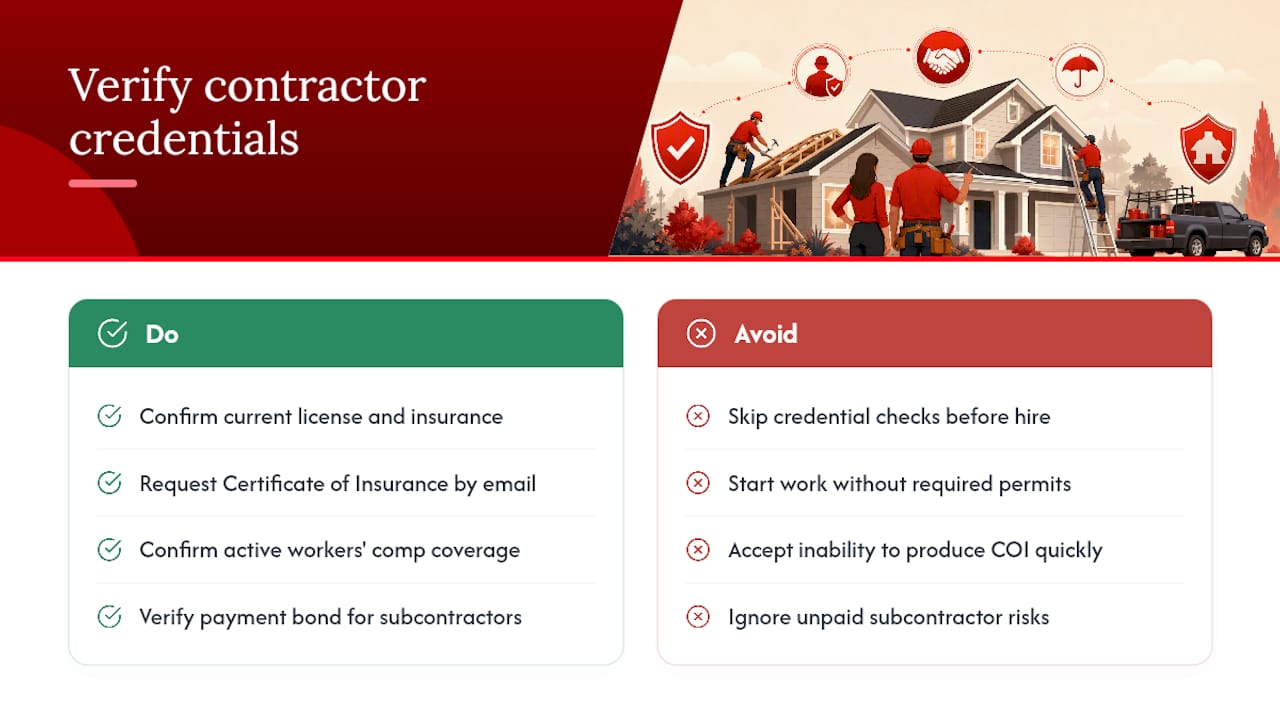
- Get the license number and search the state board’s database. Confirm status, classification, and that the qualifying party matches the person quoting your job.
- Ask for the bond name and number, then verify it with the surety or the state’s bonding database. Some states tie bond status to license status, but not every state requires a bond for licensure, so don’t assume one implies the other.
- Request a Certificate of Insurance and call the carrier directly. Confirm the policy dates cover your entire project window, check the liability limits, and ask whether you can be named as an additional insured with a waiver of subrogation.
Pro Tip: Never accept a COI as a PDF forwarded by the contractor alone. Call the phone number listed for the insurance agent on the certificate, not a number the contractor gives you, and ask them to confirm the policy is active today.
Red flags worth walking away from: a license number that doesn’t match the business name, a bond the surety can’t locate, or a COI with an expiration date that falls before your project’s estimated completion.
Which Trades and Projects Usually Require It
Not every job demands the same paperwork. Electrical, plumbing, and general contracting work almost always require a state trade license, and most states attach a license bond as a condition of holding that license. Federal public works projects go further: the Miller Act requires performance and payment bonds on qualifying federal contracts, and most states mirror that rule for state and municipal jobs.
- Structural work like decks, retaining walls, and fence installation near property lines typically requires a permit, which usually requires proof of license and insurance
- Small cosmetic jobs, like pressure washing or minor repairs, often skip the licensing requirement entirely depending on your state and job size
- Public bid work almost always requires bonding, since agencies use the bond process to screen out contractors who can’t get bonded in the first place
What Bonds and Insurance Actually Cost, and Why That Limits What They Cover
Bond premiums usually run a small percentage of the bond’s face value, and the exact rate depends heavily on the contractor’s credit and claims history. A contractor with strong credit pays less to get bonded for the same amount than one with a shaky financial record.
- Bond premiums for small contractors commonly fall in the low single digits of the bond’s total face amount
- General liability policies commonly carry limits around $1 million per occurrence, though larger projects may call for higher limits or an umbrella policy
- A bond’s face amount and a policy’s coverage limit are ceilings, not guarantees your entire project cost is protected if something goes seriously wrong
Statistic Callout: That $25,000 California contractor bond mentioned earlier covers licensing violations, not your full deck budget. If your project costs $40,000 and something goes wrong beyond the bond’s reach, insurance and your contract terms are what actually protect the difference.
Questions to Ask Before You Sign a Contract
Ask these at the quote stage, not after the crew shows up.
- “What’s your state license number, and does it cover this specific type of work?”
- “Who’s your surety, and what’s your bond number?”
- “Can you email me a Certificate of Insurance listing your general liability and workers’ comp carriers?”
- “Are your crew members covered by your workers’ comp, or are they subcontractors with their own policies?”
If a contractor hesitates on any of these, delay signing. A legitimate contractor answers all four without flinching, and comparing a written estimate against a formal quote is a good next step once the paperwork checks out.
How Action Fence and Deck Handles Credential Verification
Over 20 years of building fences, decks, retaining walls, and patios, we’ve seen what happens when a homeowner skips verification. A worker injury without active workers’ comp becomes the property owner’s problem. An unpaid subcontractor without a payment bond becomes a lien on your title.
Verification isn’t paperwork for its own sake. It’s the difference between a contractor who’s accountable to a state board and a surety company, and one who’s accountable to no one but themselves.
That’s why our builders carry current licensing and insurance documentation, and why we walk clients through permit requirements before work starts rather than after an inspector flags a problem.
Pro Tip: Ask any contractor, including us, to send your Certificate of Insurance directly to your email before the first day of work. If they can produce it in minutes, that’s a good sign about how organized the rest of the job will be.
Why the Standard Advice on This Topic Falls Short
Most articles on this topic treat “licensed, bonded, and insured” as a single trust badge, something a contractor either has or doesn’t. That framing misses the point entirely. The real skill isn’t recognizing the phrase. It’s knowing that these three things fail independently, and verifying each one separately is the only way to know what you’re actually protected against.
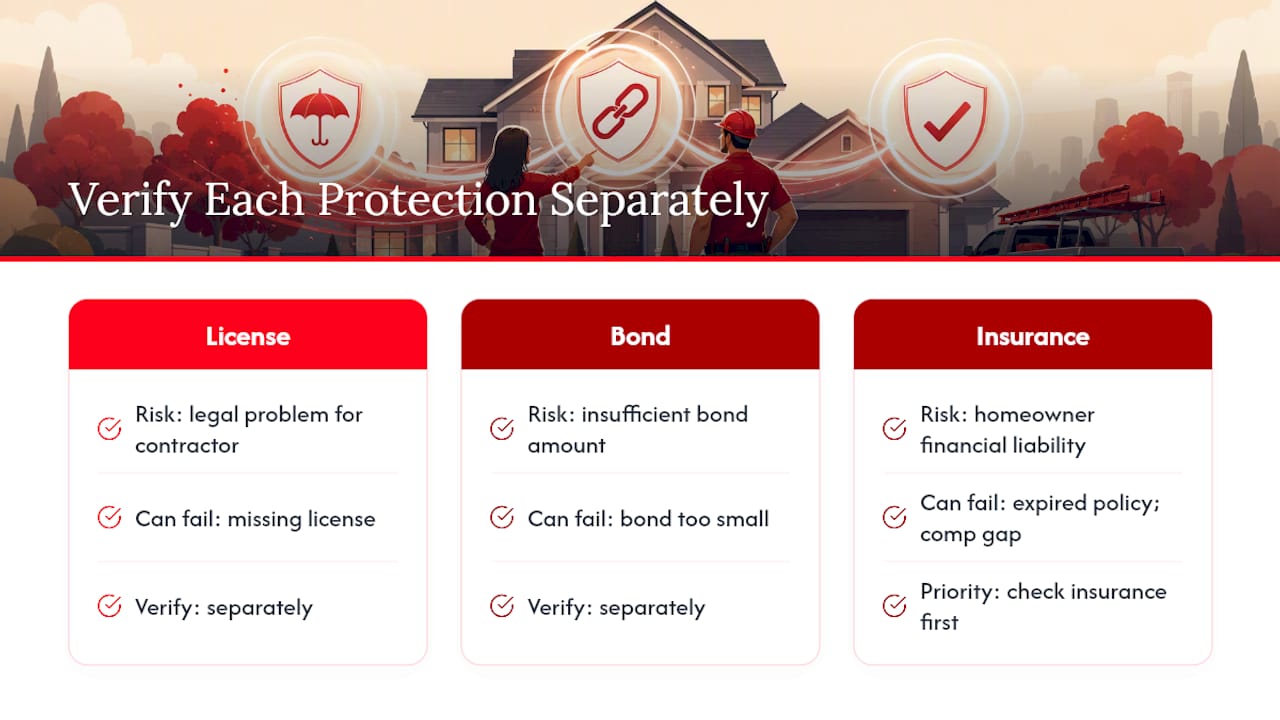
The conventional advice to “just ask if they’re licensed, bonded, and insured” is close to useless, because a contractor can answer yes to all three honestly and still leave you exposed if the bond amount is too small for your project or the insurance policy expired last month. The credibility trifecta framing gets the concept right but undersells how much verification work sits behind those three words.
If you only have time to check one thing before hiring, check the insurance. A missing license is a legal problem for the contractor. Missing insurance during a workers’ comp gap is a financial problem that can land on you, the homeowner, the moment someone gets hurt on your property.
— Abraham
Get a Credential Backed Free Quote from a reputable contractor
Skip the guesswork of chasing down a contractor’s paperwork after you’ve already signed a contract. Many professional contractors provide license information, insurance documentation, and references upfront before you commit to a project. A free quote process often includes verification details: current license status, proof of insurance, and permit guidance specific to your project type.

Requesting a quote costs nothing and takes a few minutes. You’ll get a documented estimate you can compare against other bids, along with straight answers on permit requirements for your project before work ever starts. If you’re planning a fence project and want to see what a well-built one actually looks like, our privacy fence examples show the kind of workmanship a properly credentialed crew delivers. Reach out today and get your free quote started.
Where to Verify These Claims Yourself
Check the SBA’s licensing and permit guide for how state licensing generally works, and review the SBA’s surety bond program for how bonding supports small contractors on public projects. Your state’s own licensing board search tool remains the fastest way to confirm a specific contractor’s status, classification, and bond history.
Sources
- Apply for licenses and permits | SBA
- Claims Journal: Limits of Certificates of Insurance
- Licensed, bonded & insured: what it means for businesses | Embroker
FAQ
What does it mean to be licensed, bonded, and insured?
It means a contractor holds state authorization to do the work (licensed), carries a surety bond that protects you financially if they violate the rules (bonded), and holds insurance that covers accidents or damage during the job (insured). Each protection is independent and needs separate verification.
What does it mean when a company says they are bonded and insured?
It means the company has purchased a surety bond, which guarantees you compensation if they breach licensing terms or abandon work, and holds insurance policies like general liability and workers’ comp that cover accidents on the job.
What does it mean when insurance is “bonded”?
Insurance and bonds aren’t the same product. Insurance protects the contractor’s business from loss, while a bond protects the customer if the contractor fails to meet a legal or contractual obligation. A contractor can carry both, but one doesn’t substitute for the other.
How much does it cost to get bonded and insured?
Bond premiums typically run a small percentage of the bond’s face amount and depend on the contractor’s credit history, while general liability insurance costs vary based on business size and coverage limits, commonly built around $1 million per occurrence.