
Homeowners insurance usually covers fence damage when a covered peril like wind, a fallen healthy tree, a vehicle impact, or vandalism causes it, but it typically excludes wear and tear, rot, flood, and earthquake. The moment you spot damage, photograph everything before touching it and call your insurer. Your final payout will also depend on your deductible and how much the insurer depreciates the claim.
TL;DR:
- Damage caused by wind, storms, falling trees, vehicle impacts, or vandalism is typically covered, but wear, rot, flooding, and earthquakes are usually excluded.
- Insurers pay for fences under the other-structures coverage, which caps payout at a percentage of the main dwelling limit, depending on your policy.
- Filing a claim requires thorough documentation, including photos, records of the cause, contractor bids, and prompt insurer notification to avoid claim denial or depreciation reductions.
- Payouts usually based on actual cash value or replacement cost value, with recoverable depreciation applicable if your policy pays RCV upfront and requires receipts later.
- Before filing, calculate expected net payout by subtracting depreciation and deductible from repair estimates, and weigh the cost-benefit of claiming versus paying out of pocket for minor damages.
Table of Contents
- Where fences fit in your homeowners policy
- When insurance most often won’t pay
- How to document and file a fence damage claim
- How insurers calculate your fence claim payout
- What to do if your claim is denied or underpaid
- Should you file a claim or pay out of pocket?
- What a claim-ready contractor estimate should include
- What experience on the ground teaches homeowners
- How Action Fence and Deck helps with a fence insurance claim
- Where to check policy language and get consumer help
- Sources
- FAQ
Where fences fit in your homeowners policy
Most homeowners policies pay for fence damage through Coverage B, sometimes labeled “other structures,” which handles detached property like fences, sheds, and detached garages rather than the main dwelling. Insurers typically cap this coverage at a percentage of your dwelling coverage limit, though the exact percentage and dollar cap depend on your carrier and policy form, and your fence claim has to fit inside that ceiling along with any other detached structures you might claim in the same policy period.
The perils that typically trigger a payout are the sudden, accidental kind rather than the slow, ongoing kind. Carrier explainers including GEICO’s overview of fence coverage describe a fairly consistent list of what usually qualifies:
- Wind and hailstorms that snap posts, warp panels, or tear down sections
- A healthy tree that falls onto the fence during a storm
- A vehicle that crashes through a section, whether it’s your car or someone else’s
- Vandalism, including intentional damage or graffiti
- Fire damage, including from a neighboring structure
Fault matters as much as cause. If a neighbor’s tree was already dead and it falls on your fence, or if a delivery driver backs into your gate, that person’s liability coverage may pay before your own policy gets involved. When a driver is at fault, their auto liability coverage is often the first line of recovery, and you may not need to touch your homeowners deductible at all. The same logic applies to a neighbor’s negligence: document who caused the damage and how, because it changes which policy pays and whether your own claims history takes a hit.
When insurance most often won’t pay
Insurers deny or shrink fence claims more often for a handful of predictable reasons, and knowing them ahead of time saves you a wasted claim and a mark on your loss history.
- Gradual deterioration: rot, rust, termite damage, and general wear are treated as maintenance issues, not insurable losses.
- Flood damage: standard homeowners policies exclude flood entirely, and the FEMA National Flood Insurance Program’s Standard Flood Insurance Policy specifically lists fences among the outdoor structures excluded even under a separate flood policy.
- Earthquake damage: this requires its own endorsement or standalone policy in most states; it is not part of a standard homeowners form.
- Preexisting damage: an adjuster who spots old rot or a leaning post that predates the storm will often reduce or deny the claim for that section.
Wind and hurricane coverage carries its own wrinkle. Many coastal and storm-prone states use a separate, often percentage-based wind or hurricane deductible instead of your standard flat deductible, and that number can be several times higher. Before you file, check your declarations page for a named-storm or hurricane deductible so you’re not surprised by a much smaller net payout than expected.
How to document and file a fence damage claim
The sequence you follow in the first hours and days after damage occurs shapes how smoothly the claim moves and how much you eventually recover. Guidance from the National Association of Insurance Commissioners and practical breakdowns from carriers like Mercury Insurance point to the same core steps.
- Secure the area first. Rope off sharp debris, downed sections, or exposed nails before anyone documents or cleans anything.
- Photograph and video everything from multiple angles before you move or discard a single board, including wide shots that show the full damaged run and close-ups of specific breaks.
- Keep the damaged materials on your property until the adjuster has had a chance to inspect them, since removed debris can weaken your claim.
- Collect supporting records, such as a police report for vandalism or a vehicle strike, contact information for any at-fault neighbor or driver, local weather data confirming a storm, and receipts for any emergency repairs.
- Request line-item bids from a contractor that separate materials from labor, list linear footage, post spacing, and removal or disposal costs, so the estimate reads clearly to an adjuster.
- Notify your insurer promptly and ask directly about filing deadlines, required forms, how soon an adjuster will be assigned, and which deductible type applies to this loss.
- Keep a claims log noting every call, the date, who you spoke with, and your claim number, since large-storm periods can mean long gaps between updates.
Pro Tip: Take one photo holding a tape measure against the damaged section so the adjuster has a scale reference without needing a site visit to confirm dimensions.
Mercury Insurance’s own claim walkthrough notes that insurers may request a signed proof-of-loss form, and that exact deadlines and processing windows vary by policy and state, which is one more reason to ask your carrier directly rather than assume a standard timeline.
How insurers calculate your fence claim payout
Two terms decide how much money actually lands in your account: actual cash value and replacement cost value. Replacement cost value, or RCV, pays what it costs to rebuild the fence today with similar materials. Actual cash value, or ACV, takes that same replacement figure and subtracts depreciation based on the fence’s age and condition, so a ten-year-old wood fence might settle for a fraction of what a brand-new one costs.
- Industry commentary on fence claims in PropertyCasualty360 notes that many carriers settle fences at ACV under standard ISO policy forms unless an endorsement specifically upgrades the coverage to RCV.
- Some policies pay RCV upfront and others pay ACV first, then reimburse the depreciated amount once you complete repairs and submit receipts, which is often called a recoverable depreciation holdback.
- Your other-structures sublimit and your deductible both apply before you see a check, so a $10,000 estimate with a $2,500 deductible and $3,000 in depreciation could net closer to $4,500 rather than the full repair cost.
- A detailed contractor bid that separates material grade, labor hours, and any code-required upgrades, like a new setback distance or upgraded post depth, gives the adjuster less room to argue down the scope.
Reading your policy’s actual wording matters more than any general rule, since ACV versus RCV treatment, sublimits, and endorsements vary by carrier and by state.
What to do if your claim is denied or underpaid
A denial or lowball offer isn’t the end of the process. The first move is asking your insurer for its written coverage position and a fully itemized estimate, so you know exactly what they valued and why, a step Policygenius recommends before escalating.
- Compare that written estimate line by line against your own contractor bid, flagging any missing materials, labor hours, or disposal costs.
- Use appraisal when the dispute is about dollar value, since appraisal panels resolve “how much” disagreements, not “whether it’s covered” disagreements.
- Turn to arbitration or litigation when the disagreement is about coverage itself, such as whether a peril was excluded.
- Consider a public adjuster or attorney for a large or stalled claim, understanding upfront what percentage fee or hourly rate they charge and how much authority you’re handing them.
- Contact your state insurance department if the carrier is unresponsive or acting in bad faith, and track any proof-of-loss or suit-limitation deadlines closely so a dispute doesn’t cost you your claim entirely.
Appraisal tends to be faster and cheaper than arbitration or a lawsuit, but it only works when both sides agree the loss is covered and disagree solely on price.
Should you file a claim or pay out of pocket?
Run the math before you file. Take your contractor’s repair estimate, subtract any depreciation the insurer is likely to apply, then subtract your deductible: whatever is left is your realistic expected payout.
- A $6,000 fence replacement with $1,500 in depreciation and a $1,000 deductible nets roughly $3,500, which may or may not be worth a claim on your record.
- Weigh that number against the risk of a premium increase or a mark against your claims history, especially if you’ve filed other claims recently.
- Filing usually makes sense for major structural damage, safety hazards, or security gaps, such as a fence that no longer keeps a pool or a dog secured.
- Paying out of pocket often makes more sense for small, cosmetic repairs where the expected payout barely clears the deductible.
- During a large regional storm event, some insurers offer advance payments before a full inspection, so filing early can be worthwhile even for a modest loss.
What a claim-ready contractor estimate should include
An insurance adjuster moves faster and pushes back less when your contractor bid reads like documentation, not a sales pitch. Ask any contractor for specifics rather than a lump sum.
- Linear footage and post spacing for the damaged run, matched to your photos.
- Post material and treatment type, such as pressure-treated pine or a specific hardware grade.
- Material grade for panels or pickets, since insurers price cedar, pine, and composite differently.
- Labor hours separated from materials, so an adjuster can see where the money goes.
- Removal and disposal costs for the damaged sections, listed as their own line item.
- Permit and code-upgrade costs, if your local jurisdiction requires a different setback or footing depth than the original fence had.
Pro Tip: Save every damaged post, panel, and hardware piece until the adjuster has inspected them, then photograph each piece next to its matching line item on your contractor’s bid.
Be careful with any agreement labeled assignment of benefits, which hands a contractor the right to bill your insurer directly and negotiate on your behalf. Consumer guidance from the NAIC on reading the fine print before signing warns that these agreements can transfer control of your claim entirely, so read one closely before signing anything. We provide eco-friendly material options for homeowners who want a fence rebuilt to match the original look while meeting current code.

What experience on the ground teaches homeowners
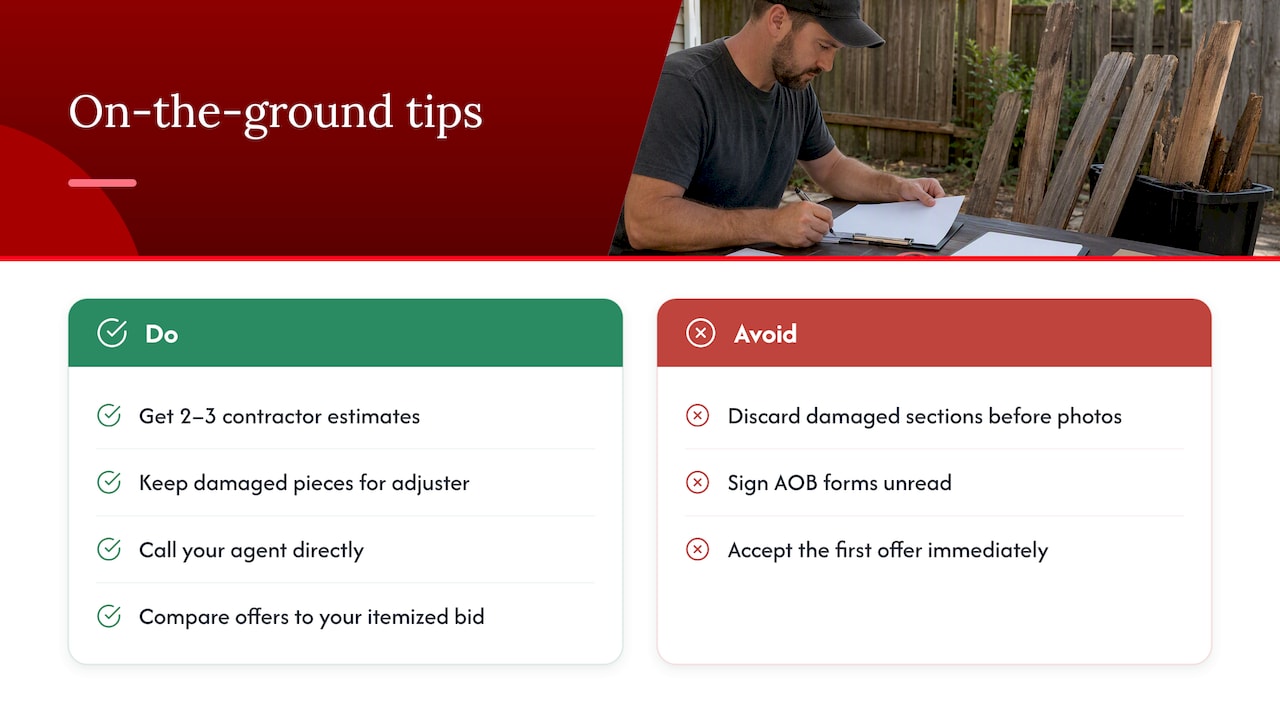
The costliest mistake I see is homeowners throwing away damaged fence sections before anyone photographs them properly, followed closely by signing an assignment-of-benefits form without reading what it hands away. Get two or three contractor estimates, keep every damaged piece until the adjuster has looked at it, and never accept the first offer without comparing it to your own itemized bid.
During major storm events, claim volume spikes and adjuster response times stretch out for everyone, not just you. Patience helps, but so does calling your agent directly rather than waiting for a callback that may take weeks during a regional disaster.
— Abraham
How Action Fence and Deck helps with a fence insurance claim
Getting a contractor bid an adjuster will actually accept is often the hardest part of a fence claim. Providing itemized estimates that break out materials, labor, and disposal the way insurers expect to see them, along with eco-friendly material options for homeowners who want a sustainable rebuild, can help homeowners through this process.

- Have your damage photos and any police report ready before your free quote appointment.
- Bring your policy’s other-structures limit and deductible information if you have it handy.
- Ask us about material grades and code upgrades so your bid matches what your adjuster needs to see.
We won’t ask you to sign away control of your claim through an assignment-of-benefits agreement. You stay in charge of your claim while we handle the rebuild. Request a free quote for fencing solutions and repair services to get an insurance-ready estimate started.
Where to check policy language and get consumer help
For the exact wording that governs your own claim, go to primary sources rather than general guides.
- The NAIC’s claims navigation guide covers documentation checklists and your rights during the process.
- FEMA’s Standard Flood Insurance Policy spells out flood exclusions for outdoor structures.
- The Insurance Information Institute’s claim-filing guide offers a practical walkthrough of what to expect.
- Your state insurance department handles complaints and disputes when a carrier is unresponsive.
Sources
- Navigating the claims process: Recover and rebuild — NAIC
- How does the home insurance claim process work? — Mercury Insurance
- Standard Flood Insurance Policy (SFIP) — FEMA (NFIP)
- How to dispute a home insurance claim denial — Policygenius
FAQ
Can I claim my fence on insurance?
Yes, if the damage came from a covered peril like wind, a falling healthy tree, a vehicle strike, or vandalism, your homeowners policy’s other-structures coverage typically applies. Damage from wear, rot, or flooding is generally excluded, so the cause of the damage decides whether a claim will succeed.
Who is responsible for a damaged fence?
Responsibility depends on what caused the damage: a driver who hits your fence is typically covered by their own auto liability policy, while storm damage falls to your own homeowners policy. When a neighbor’s dead tree falls on your fence, their negligence may shift liability to their policy instead of yours.
What two events are not covered under homeowners insurance?
Flood and earthquake are the two perils most consistently excluded from standard homeowners policies, including for fences and other outdoor structures. FEMA’s flood policy documentation confirms fences are excluded even under a separate flood policy, and earthquake coverage requires its own endorsement.
Is a fence considered a structure for insurance?
Yes, a fence is generally classified as an “other structure” under Coverage B rather than as part of the main dwelling. That coverage usually caps out around a set percentage of your dwelling limit, so it’s worth checking your declarations page for the exact figure that applies to your policy.