The right fence for your dog depends almost entirely on what your dog does at the fence line, not on what looks good in the yard. A tall wood privacy panel stops a jumper cold. A concrete curb or L-footer defeats a digger. A solid masonry wall handles the reactive dog who lunges at every passing squirrel. Get the match wrong and no amount of height or hardware saves you.
Quick match by dog profile:
- Small, calm dogs: A 4-foot chain-link or wood picket fence usually holds them, provided gaps are narrow enough to prevent squeezing through.
- Jumpers (medium to large breeds): Solid wood or vinyl privacy panels at 6 feet minimum, with no horizontal rails on the outside that double as a ladder.
- Diggers: Any fence type paired with an L-footer or concrete curb running 12–18 inches deep and 18–24 inches horizontal.
- Reactive or prey-driven dogs: Solid privacy wood, vinyl, or masonry that blocks the visual trigger entirely.
Immediate safety callout: If your dog is actively escaping right now, secure every gate with a carabiner or padlock and supervise all outdoor time until the permanent fix is in place. A half-finished project is not a containment solution.
Digging is one of the most common escape routes for dogs, which is why footer installation is the single most overlooked step in most residential fence projects. The sections below walk through every fence type, dog-proofing fixes, cost ranges, and how to hire a contractor who will actually get it right.
Key Takeaways
Matching your fence to your dog’s specific escape behavior, then pairing that structure with consistent boundary training, is the most reliable path to long-term containment.
| Point | Details |
|---|---|
| Match fence to behavior | Jumpers need 6-foot solid panels; diggers need L-footers 12–18 in. deep; reactive dogs need solid privacy materials. |
| Footer and gate security first | Footers and gate hardware are the most commonly skipped steps and the most expensive to fix after installation. |
| Pair structure with training | Boundary stay and place-work training materially reduces a dog’s drive to test the fence line. |
| Check HOA and permits early | Many municipalities and HOAs restrict height, material, and setbacks; confirm before scheduling any work. |
| Actionfenceanddeck | Offers free, itemized quotes with footer specs, timeline estimates, and written warranties for dog-fence projects. |
Table of Contents
- What fence type works best for dogs?
- How do you make a fence escape-proof for dogs?
- Why structure and training must work together
- DIY versus professional installation: what it actually costs
- How to pick the right fence for your dog and property
- Maintenance, HOA rules, and permits: what to check before you build
- A contractor’s perspective on what actually matters in a dog fence
- Actionfenceanddeck can secure your yard the right way
- Sources
What fence type works best for dogs?
Understanding the trade-offs across fence materials is the fastest way to narrow your options. Each type has a different vulnerability profile, and matching that to your dog’s behavior saves you from expensive retrofits later.
Chain-link
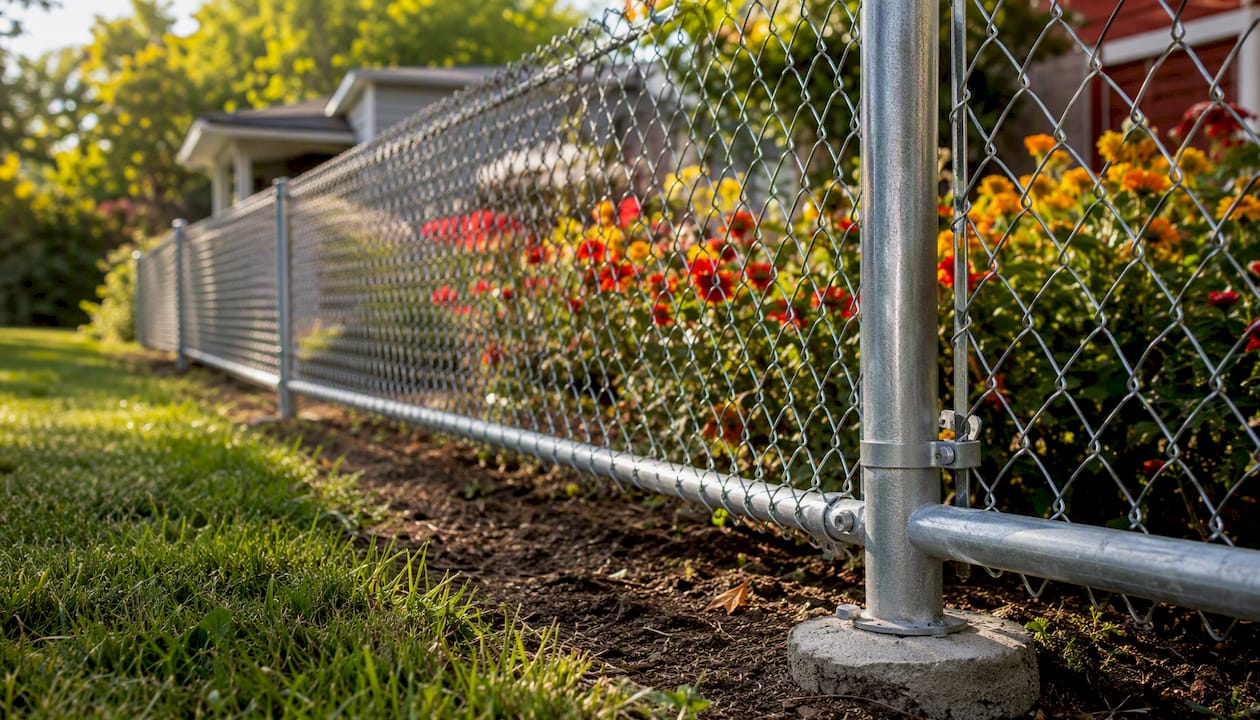
Chain-link is galvanized steel mesh stretched between steel posts set in concrete. It is affordable, lasts decades with minimal care, and lets you see through it in both directions. That last point is both its strength and its weakness. According to the AKC, chain-link offers no visual barrier, which can overstimulate reactive dogs and requires bottom barriers to stop diggers. Climbers can also use the diamond mesh as footholds.
Best for: Medium to large non-reactive dogs in yards where budget is the primary constraint.
Wood privacy fence
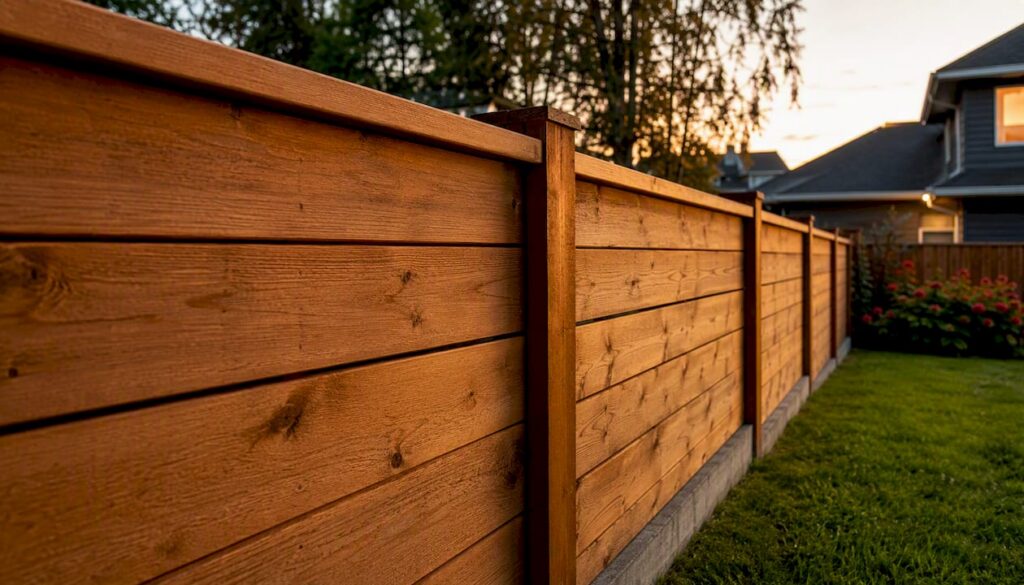
Board-on-board or solid panel wood fencing blocks sightlines completely, which calms reactive dogs and removes the visual trigger that sets off fence-running. The AKC notes that wood and vinyl reduce visual triggers in ways chain-link simply cannot. The trade-off is maintenance: wood needs staining or sealing every 2–3 years and can rot or warp in wet climates without proper post treatment.
Best for: Reactive dogs, jumpers (with no exterior horizontal rails), and homeowners who want privacy alongside containment.
Vinyl panel
Vinyl behaves like wood in terms of privacy and smooth surface (no footholds for climbers), but it never needs painting or staining. It is more brittle than wood in extreme cold and costs more upfront. Heavy chewers can crack panels over time.
Best for: Jumpers and reactive dogs in moderate climates where low maintenance matters.
Wrought iron / aluminum
Decorative metal fencing looks sharp and lasts a long time, but the vertical pickets leave gaps that small dogs can squeeze through and that reactive dogs can see through. Spacing matters enormously here: pickets set 3.5 inches apart or less are safer for most breeds.
Best for: Medium to large non-reactive dogs where aesthetics and durability are priorities.
Masonry (brick, stone, CMU block)
Brick, stone, and masonry fences offer the highest durability and privacy of any option, but they also carry the highest installed cost and the longest lead times. A masonry wall is essentially permanent, handles the most determined escape artists, and requires almost no ongoing maintenance beyond occasional repointing.
Best for: High-security needs, reactive dogs, and properties where a permanent, high-value structure is the goal.
Block-bottom and metal-top combinations
A CMU block base (typically 2–3 feet) topped with wrought iron or aluminum panels gives you a dig-proof foundation without the full cost of an all-masonry wall. The metal top adds height and visibility control. This combination is increasingly popular for large, determined dogs.
Best for: Diggers and jumpers in the same dog, or properties where full masonry is cost-prohibitive.
Portable and free-standing panels
Modular metal or plastic panels that require no ground installation are useful for temporary enclosures, travel, or sectioning off part of a yard. They are not a long-term solution for any determined dog. A motivated medium-sized dog can tip or push most portable panels.
Best for: Puppies, small calm dogs, or short-term containment while a permanent fence is being installed.
Pro Tip: If your dog is both a jumper and a digger, treat them as two separate engineering problems. A 6-foot privacy fence with no footer still fails a digger. An L-footer on a 4-foot fence still fails a jumper. Both fixes must be present.
How do you make a fence escape-proof for dogs?
The fence type sets the baseline. Dog-proofing is what closes the gaps that behavior exploits. Most escapes happen at three points: the bottom, the top, and the gate.
Stopping diggers
An L-footer is the most reliable fix. Dig a trench 12–18 inches deep along the fence line, attach galvanized hardware cloth to the fence base, then bend it 90 degrees to run 18–24 inches horizontally underground. Backfill and tamp the soil. Dogs dig straight down at the fence line; the horizontal mesh stops them before they get under.
Alternatives that work well:
- Large river rock bed: Line the base of the fence with 12–18 inches of large river rock. Dogs dislike digging through rock, and it drains well.
- Poured concrete curb: A 4–6 inch wide concrete footer poured along the fence base is permanent and requires no mesh. Best for masonry or block-bottom fences.
- Under-rail tension wire: For chain-link, a bottom tension wire pulled tight at ground level reduces the gap and discourages digging starts.
Stopping climbers and jumpers
Roller bars, angled extensions, and coated wire-mesh coyote rollers are the three main tools here. Roller bars mount along the top rail and spin when a dog grabs them, preventing the grip needed to pull up. Angled extensions (also called coyote guards) attach to fence posts and angle inward at 45 degrees, making the top of the fence impossible to clear. A full-top cover, essentially a roof of wire mesh, works for dogs who can scale nearly anything, though it is expensive and typically reserved for kennel runs.
For jumpers specifically, the fence height is the first variable. Six feet stops most dogs. Eight feet is the threshold for athletic large breeds like Belgian Malinois or Siberian Huskies who treat a 6-foot fence as a suggestion.
Gate security
Gates are where most escapes happen, even on otherwise solid fences. A few specific fixes:
- Self-closing spring hinges: The gate returns to closed automatically after every entry and exit.
- Double-latch systems: A top latch plus a bottom bolt means the dog cannot nose or paw one latch open.
- Overlap design: The gate panel should overlap the post by at least 2 inches so there is no gap to push through.
- Padlock or carabiner: For high-escape-risk dogs, a secondary lock prevents the gate from being opened by the dog or by a visitor who forgets to re-latch.
Pro Tip: Schedule the permanent footer and gate hardware work before the fence panels go in, not after. Retrofitting a footer under an existing fence is significantly more labor-intensive than installing it during the original dig.
Why structure and training must work together
Physical barriers do most of the work, but a fence alone often fails a determined dog. The behavioral drive behind the escape attempt, whether boredom, prey instinct, or separation anxiety, does not disappear when a wall goes up. It redirects.
Professional trainers at Sit Means Sit are direct about this: digging is usually motivated behavior. Boredom, prey drive, and anxiety are the three most common triggers, and structural solutions like an L-footer or concrete curb are necessary but not sufficient on their own. Boundary training must run alongside the physical fix.
The core training approach pairs two commands: a boundary stay (the dog learns the fence line is a hard stop, not a suggestion) and place work (the dog learns to go to a designated spot on cue, which interrupts fence-running before it escalates). For tunnel-vision prey-drive dogs, interruption and redirection techniques, calling the dog away from the fence the moment they lock onto a stimulus, reduce the rehearsal of the escape behavior over time.
On invisible and GPS-only fences: veterinarians and behavior experts frequently caution against using these systems as the sole containment method. They provide no physical barrier, which means a dog with high prey drive can push through the discomfort of a shock to chase a squirrel and then be reluctant to cross back. They also do nothing to keep other animals or people out of the yard. Use them only as a supplement to a physical fence, never as a replacement.
DIY versus professional installation: what it actually costs
For small enclosures and portable runs, a confident DIYer can handle the work. For anything involving poured footers, masonry, complex gate hardware, or a dog who has already proven they can escape, hire a professional.
Typical U.S. installed price ranges
Ranges reflect typical U.S. market pricing. Actual costs vary by region, soil conditions, and project complexity. For a detailed breakdown, see Action Fence and Deck’s fence installation cost guide.
Timeline estimates
Single-day installs are realistic for portable panels and short chain-link runs. A standard 150-linear-foot wood or vinyl privacy fence typically takes 2–4 days for a professional crew. Masonry projects run 2–4 weeks depending on scope and curing time. Permit approval, where required, can add 1–3 weeks before any ground is broken.
Questions to ask a fence contractor before signing
- Are you licensed and insured in this state? Can you provide proof?
- What footer depth and method do you use for posts in this soil type?
- What gate hardware do you install as standard, and what are the upgrade options?
- Does your warranty cover both materials and workmanship, and for how long?
- Will you pull the required permits, or is that my responsibility?
- How do you handle change orders if the scope shifts mid-project?
- Can you provide two or three references from similar projects in this area?
How to pick the right fence for your dog and property
Work through these four questions in order before you contact a contractor or buy materials.
1. What does your dog actually do at the fence line? Jumper, digger, reactive barker, or calm observer. This single answer narrows your material and height choices faster than any other factor.
2. What does your property allow? Check your HOA covenants and your municipality’s fence ordinance before you fall in love with a material or height. Many HOAs restrict fence height to 6 feet in rear yards and 4 feet in front yards, and some require architectural review board approval before installation. The AKC recommends checking HOA rules and local permitting before any perimeter fence project.
3. What is your realistic budget and timeline? Wood and chain-link are the fastest to install and the most budget-friendly. Masonry takes the longest and costs the most. Vinyl sits in the middle on both axes.
4. Who is installing it? DIY is reasonable for chain-link and simple wood panel runs on flat ground. Anything involving slopes, poured footers, masonry, or a dog with a documented escape history warrants a licensed contractor.
Red flags when evaluating contractors:
- No written warranty or a verbal-only guarantee
- Vague or missing footer plan (“we’ll just set posts in gravel”)
- Unwilling to pull permits or dismissive of the permitting question
- No proof of licensing or insurance
Pro Tip: Get at least two written quotes with itemized line items. A quote that bundles everything into one number makes it impossible to compare footer depth, hardware quality, or material grade across bids.
For homeowners who want professional help, Actionfenceanddeck offers free quotes with transparent, itemized pricing.
Maintenance, HOA rules, and permits: what to check before you build
Maintenance by material
- Wood: Inspect annually for rot, warping, and loose posts. Re-stain or re-seal every 2–3 years. Check post bases for ground contact rot each spring.
- Vinyl: Wash panels once or twice a year with a pressure washer. Inspect for cracks, especially after hard freezes. Hardware (hinges, latches) may need lubrication annually.
- Chain-link: Check for rust at post bases and along the bottom rail annually. Tighten tension wires if the mesh sags. Re-coat cut edges with rust-inhibiting paint.
- Wrought iron / aluminum: Inspect for rust spots and repaint as needed. Tighten fasteners annually. Aluminum does not rust but can oxidize; a light coat of wax extends the finish.
- Masonry: Repoint mortar joints every 5–10 years as needed. Check for cracks after freeze-thaw cycles. Masonry is otherwise the lowest-maintenance option over a 20-plus-year horizon.
For repair cost estimates by material, Action Fence and Deck’s fence repair cost guide breaks down what typical fixes run.
HOA and permit checklist
- Confirm maximum allowed fence height for front, side, and rear yard zones.
- Check whether your HOA requires a specific material, color, or style.
- Identify required setbacks from property lines (commonly 2–6 inches, but varies).
- Determine whether your municipality requires a permit for fences above a certain height (often 6 feet).
- If the fence involves a retaining wall or grade change, a separate structural permit or engineering review may be required.
- Submit to the architectural review board (if applicable) and allow the required review period before scheduling installation.
Post-install inspection checklist
Run this check every spring and after any major storm:
- Gate alignment: Does the gate swing freely and latch without lifting or forcing?
- Post stability: Push each post firmly. Any wobble signals footer failure or rot.
- Footer condition: Look for soil erosion along the fence base that could expose the footer or create a gap.
- Panel integrity: Check for loose boards, cracked vinyl, or bent chain-link sections.
Keep a folder with your permits, installation warranty, hardware specs, and contractor contact information. When you sell the house or need a repair years later, that paperwork is worth real money.
A contractor’s perspective on what actually matters in a dog fence
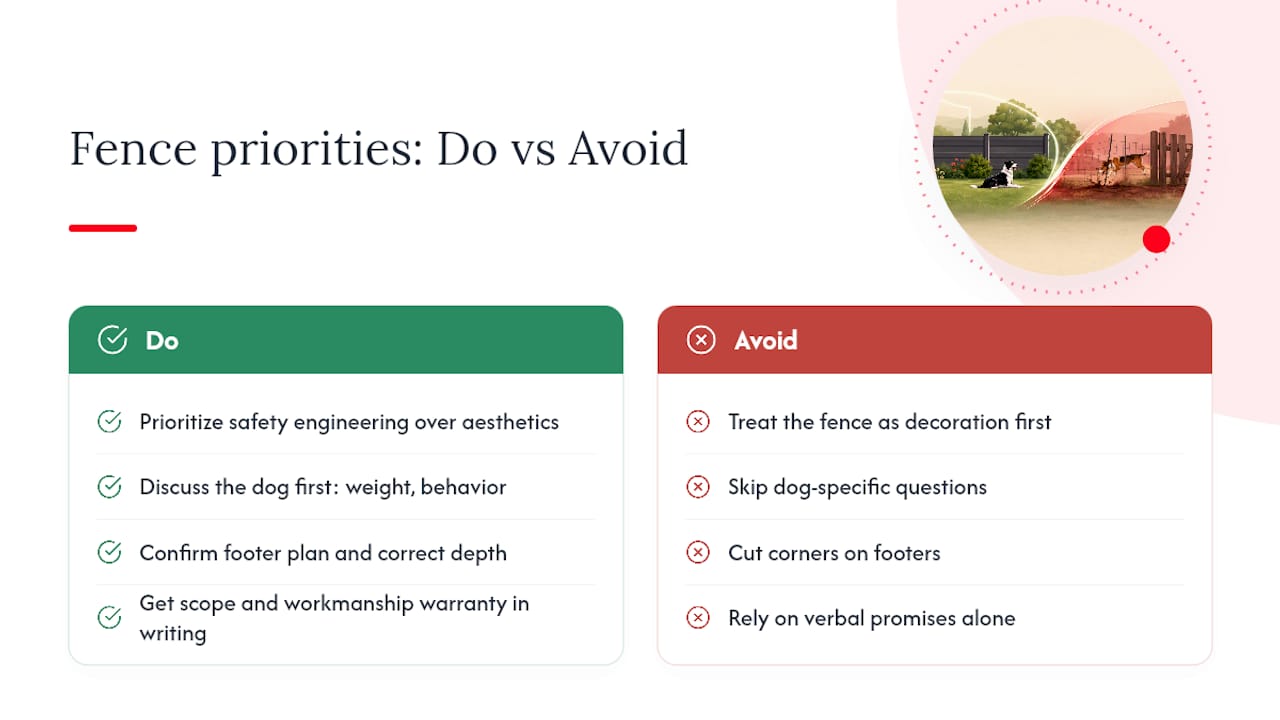
The most common mistake homeowners make is treating a dog fence like a decorative project with a safety bonus. It is the other way around. The safety engineering comes first; the aesthetics follow from it.
At Actionfenceanddeck, the first conversation with a homeowner is always about the dog, not the fence. What does the dog weigh? What does it do at the fence line? Has it escaped before, and how? Those answers drive the footer spec, the height, the gate hardware, and the material choice. A licensed and insured crew that skips those questions is selling you a fence, not a containment solution.
Footers are where most budget-conscious installs cut corners, and it is the single most expensive mistake to fix after the fact. A post set in packed gravel shifts over time. A post set in poured concrete with the right depth for your soil type and frost line holds for decades. The same logic applies to gate hardware: a $15 spring latch fails. A commercial-grade self-closing hinge with a double-latch system holds.
With over 20 years of experience, Actionfenceanddeck’s approach has always been to use materials suited to the local climate, set posts to the correct depth for the region’s frost line, and back every project with a written workmanship warranty. Sustainability matters too: where eco-friendly materials and techniques can be used without compromising structural integrity, they are. Before any project starts, get the scope in writing, confirm the footer plan, and verify that the contractor carries current licensing and insurance. A verbal promise is not a warranty.
Actionfenceanddeck can secure your yard the right way
Twenty years of dog-fence installations teaches you one thing fast: the details that get skipped on a budget job are always the details that cause the escape.

Actionfenceanddeck builds custom wood privacy fences, block-bottom combinations, concrete curbs, and full masonry walls, all with the footer depth and gate hardware your dog’s specific behavior actually requires. Every project starts with a free, on-site quote that includes a footer recommendation, a timeline estimate, and written warranty terms. No vague line items, no surprise change orders.
The team is licensed and insured, has been installing fences locally for over 20 years, and uses materials selected for the regional climate. If your dog is a jumper, a digger, or a reactive escape artist, the right fix exists. The question is whether it gets installed correctly the first time.
Ready to stop guessing and get a written plan? Request your free fence installation quote and find out exactly what a properly engineered dog fence costs for your yard.
Sources
- What Type of Dog Fence Should Is Best for Me and My Dog?
- Best Fence for Dogs
- How to Stop a Dog From Digging Under the Fence: Professional Training Strategies
- Dog-Proof Fence Ideas | Best Friends Animal Society
- How to Prevent Dogs From Digging Under Fence