
The best concrete patio color is the one that suits your home’s exterior, stays comfortable underfoot in full sun, and is built into the slab rather than painted on top. Earth tones such as tan, buff and sandstone are the safe classics. Charcoal gray is the current favorite. Nearly any shade is possible, but the coloring method and the sealer matter more than the swatch you fall for.
Below we cover the colors homeowners actually choose, the four ways concrete gets its color, what each costs and how it ages, and how to test a shade before you commit.
TL;DR
- Concrete is naturally light gray. Anything else comes from integral pigment, dry-shake hardener, or stains and dyes.
- Tan, brown and sandstone remain the most popular choices for traditional homes. Charcoal gray is the most-searched color right now.
- Dark colors get hot in direct sun. Light earth tones stay more comfortable barefoot but show dirt sooner.
- Integral color usually adds $2 to $4 per square foot over plain gray concrete.
- Never pick from a screen or a printed chart alone. Ask for a sample or test pour in your own yard’s light.
Table of Contents
- What color is concrete naturally?
- The most popular concrete patio colors
- How concrete gets its color: four methods
- What does colored concrete cost?
- Heat: the part most color charts leave out
- Match the patio to your house
- Test before you pour
- Sealing keeps the color alive
- Our perspective
- Work with Action Fence and Deck
- FAQ
- Sources
What color is concrete naturally?
Plain concrete is a light gray. Cement, sand and stone set to a neutral tone, which is why sidewalks and garage floors all look alike. The shade varies a little with the cement and aggregate used, which is also why a pigment never looks identical from one batch or one yard to the next.
That gray is not a bad starting point. It suits modern homes with cool-toned siding, and it costs nothing extra. But if you want warmth, contrast with your brick, or a stone look, you have to add color deliberately.
The most popular concrete patio colors
Here is how the common families break down, and where each one works best.
| Color family | Typical look | Works best with | Watch out for |
|---|---|---|---|
| Tan, buff, sand | Warm, soft, neutral | Brick, stucco, traditional and ranch homes | Shows dirt and leaf stains more readily |
| Brown, walnut, sandstone | Rich, earthy, natural-stone feel | Wood fences, cedar pergolas, stone veneer | Can look heavy beside very pale siding |
| Charcoal and slate gray | Modern, crisp | Contemporary homes, black window frames | Absorbs heat in full sun |
| Light gray, gray-white | Clean, reflective | Modern farmhouse, white or gray siding | Can feel stark without plantings |
| Terra cotta, red-brown | Warm, Southwestern | Adobe-style and Spanish-style homes | Needs careful matching to roof and trim |
| Blue, green, black, orange | Bold, accent use | Pool decks, borders, commercial spaces | Easy to overdo, harder to match later |
Blue, orange, green and black are all possible, but earth tones that mimic natural materials are what most homeowners end up choosing. That is not a lack of imagination. A patio sits right beside your house, your fence and your plants, and natural tones tend to get along with all three.
Charcoal gray: popular for good reasons
Charcoal is trending. According to a 2026 roundup, it is the most-searched patio color and hides stains better than lighter shades. It looks sharp against black-framed windows and light siding, and it makes greenery stand out.
The tradeoff is heat, which we get to below. If your patio gets full afternoon sun and kids or dogs walk on it barefoot, think twice or choose a mid-tone charcoal rather than a near-black.
Earth tones: the safe long-term choice
Tan, brown and sandstone remain the most popular picks for traditional homes because they blend with landscaping and masonry. They also age gracefully. A slightly weathered tan reads as natural. A slightly weathered black reads as faded.
How concrete gets its color: four methods
Most homeowners assume color is a simple choice. In practice, the method matters more than the shade. The main options, as laid out by Concrete Network, are:
- Integral pigment, mixed into the concrete before it is poured.
- Dry-shake color hardener, broadcast onto the wet surface and troweled in.
- Acid (chemical) stain, applied to cured concrete.
- Water-based stains and dyes, also applied to cured concrete.
Integral color
With integral color, the pigment runs through the whole slab. It resists fading and chipping because there is no thin colored skin to wear through. If a corner chips, the exposed concrete underneath is the same color.
It is the standard choice for new patios. For high-traffic areas, professionals almost always recommend it to avoid visible wear patterns, in line with the guidance in ACI 310R-19, the American Concrete Institute’s guide to decorative concrete.
Dry-shake hardener
Color hardener is worked into the top of the fresh slab. It gives deep, saturated color and a tougher surface, and it is a common base for stamped work. Because the color sits in the surface layer, a heavy chip can show gray beneath.
Stains and dyes
Stains are the tool for upgrading a patio that is already poured. They suit homeowners who like the slab’s shape but not its color. They only affect the surface, so they will show wear sooner than integral color, and they need resealing to stay looking good. If your existing patio is sound, our guide on when you can resurface a concrete patio explains what to inspect before you invest in any new surface treatment.
Combining methods for a stone look
The most popular stamped patterns imitate natural stone: ashlar slate, travertine and bluestone. Real stone is never one flat color, so convincing stamped work usually layers methods, for example a base integral color with an antiquing agent on top to create the multi-tonal, variegated finish. A single flat color under a stone pattern tends to look like a printed stencil.
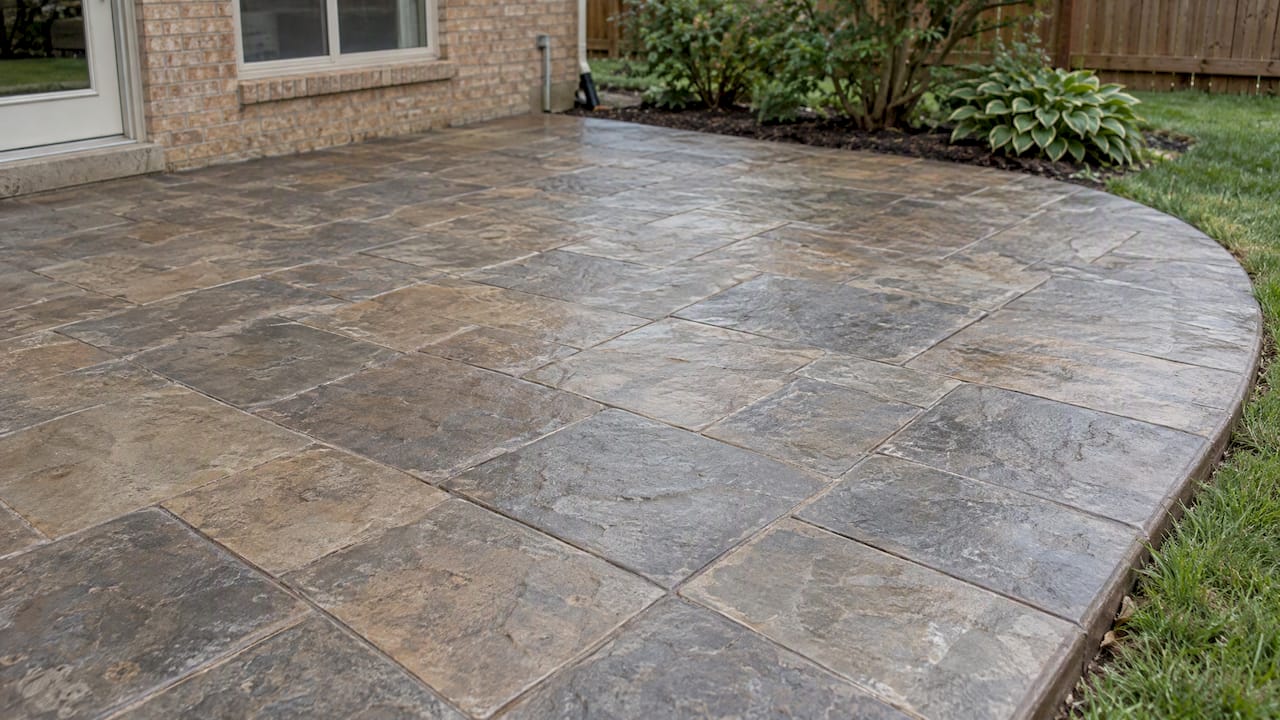
If you are weighing stamped concrete against another surface entirely, read stamped concrete vs pavers. The short version is that base preparation matters more than the finish.
What does colored concrete cost?
Integral color typically adds $2 to $4 per square foot to the cost of plain gray concrete, according to one 2026 industry roundup. The same source says charcoal costs no more than other integral colors. On a 300-square-foot patio, that is a difference of $600 to $1,200 for the color alone. Stamping, antiquing agents, saw-cut borders and sealer are separate line items, and local pricing varies.
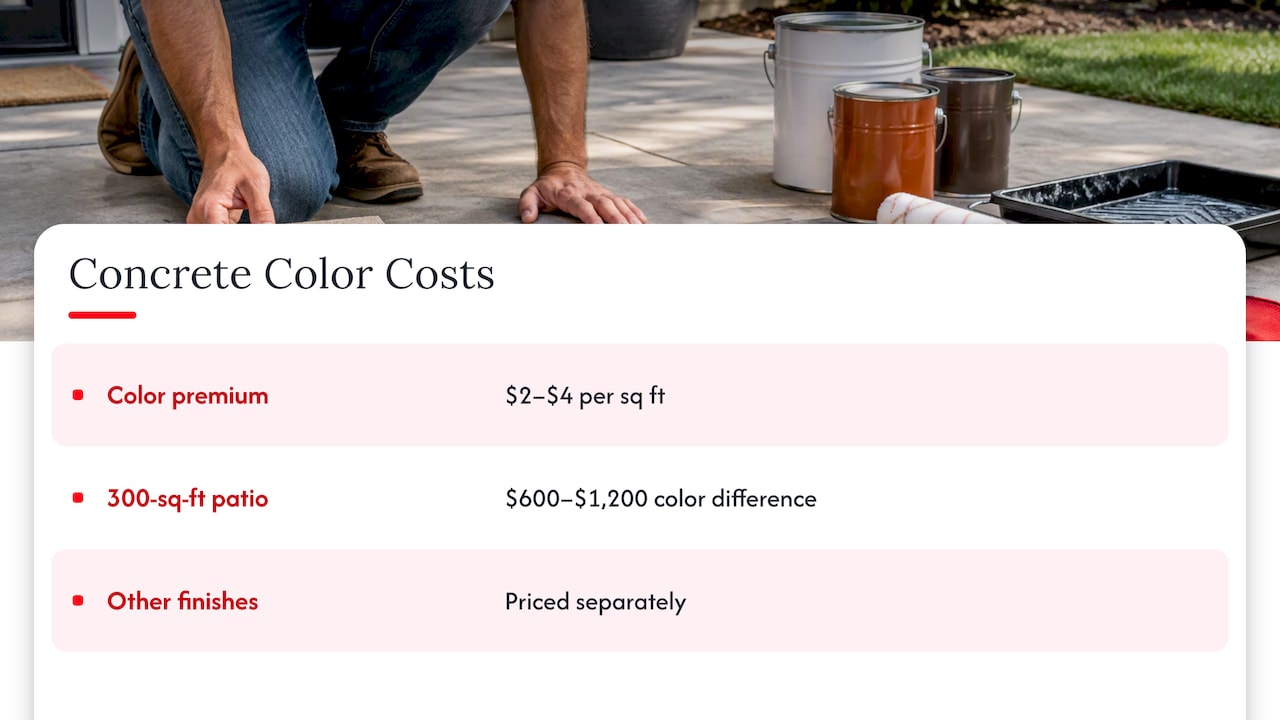
To see how the pieces add up, our breakdown of what a concrete patio actually costs in 2026 is the place to start. If you are watching the budget, a plain broom-finished slab with a colored border or a stained accent band can deliver more look per dollar than coloring the whole thing.
Heat: the part most color charts leave out
A swatch cannot tell you how a surface feels at 4 p.m. in August. Dark pigments absorb more sunlight, and in high-sun exposures a charcoal patio can get uncomfortably hot to walk on barefoot. Lighter sand, tan and buff tones reflect more sunlight, though they show dirt more readily.
This is not just a hunch. The Portland Cement Association has published solar reflectance testing on 135 concrete specimens, showing that the mix and its ingredients affect how much sun a concrete surface reflects.
In North Texas, where summer sun is long and intense, a few practical rules hold up:
- If the patio faces west or south with no shade, go lighter or mid-tone.
- If the patio is under a roof, pergola or shade sail, darker colors are much easier to live with. Our guide to deck shade solutions covers options that work for patios too.
- A broom finish gives more grip than a smooth trowel finish, which matters near pools and sprinklers. See our notes on a slippery concrete patio if that is a concern.
- Put a sample in the exact spot and touch it in the afternoon.
Match the patio to your house
A colored patio is a design element, not just a slab. Decorative concrete specialists advise choosing tones that complement your home’s exterior materials, such as brick or wood, rather than following trends. Consistent tones make the patio feel like an extension of the house instead of an add-on.
A simple way to do it:
- Find the undertone of your brick, stone or siding. Is it warm (red, yellow, orange) or cool (blue, gray)?
- Match undertones, not exact colors. A warm tan patio beside warm red brick reads as intentional. A cool gray beside the same brick often clashes.
- Pick one shade lighter or darker than the house’s dominant color, so the patio frames the home instead of disappearing into it.
- Think about your fence, pergola and deck. Wood stain colors and concrete tones should share an undertone.
- Plan accents last. Planters, outdoor rugs and tableware can carry bolder colors so the slab itself stays timeless. Even porcelain décor pieces can help you try a palette around the patio before you commit to a large pour.
If your patio will sit next to a new fence, deck or retaining wall, decide all the colors together. It is far cheaper to coordinate on paper than to restain later.
Test before you pour
Do not choose from a screen. Concrete is made of cement and aggregate, and the base mix changes how a pigment looks once cured. ACI 310R-19 notes that color representations in brochures are based on specific standard mix designs, so professionals build a physical mock-up or test pour to confirm the color under the site’s actual lighting.
A sensible sampling routine:
- Ask your contractor for cured samples made with the same cement and aggregate they will use on your job.
- Set them on the ground where the patio will go, and look at morning, noon and evening.
- Wet one sample. Rain and sprinkler water darken concrete temporarily.
- Remember that fresh concrete is darker and lightens as it cures.
- Expect some variation. Natural variation in a poured slab is part of the material.
Sealing keeps the color alive
Many homeowners think the color alone is enough. Professionals disagree: a quality sealer protects color from UV radiation, moisture and wear, and without it even durable integral pigments can lose vibrancy in high-sun settings.
Plan on resealing periodically, and follow the sealer manufacturer’s schedule. Before resealing, the surface should be clean. Pressure washing is the usual first step, but too much pressure can etch the surface, so it is worth leaving to someone who does it every day.
Sealer choice also changes the finish. Some give a natural matte look, others a glossy wet look that can turn slick when damp. For patios, a slip-resistant additive or a matte product is usually the better call.
Our perspective
After more than 20 years of building outdoor structures, we have noticed that clients spend an hour on the color and five minutes on what goes under it. We would flip that ratio. A beautiful tan or charcoal on a poorly prepared base will crack, settle or drain badly, and no pigment hides that. Get the thickness, the subgrade and the drainage right first, then choose color.
On color itself, we steer most homeowners toward integral color in a mid-tone earth shade, with a quality sealer, and add personality through borders, stamping or plantings. If you love charcoal, we will build it, but we will ask how much sun the patio gets and whether anyone will be barefoot on it. Our job is to tailor the patio to your needs and budget, and sometimes that means talking you out of the trendiest option.
— Abraham
Work with Action Fence and Deck
We pour, finish and color concrete, and we also build fences, decks, gates and retaining walls, so your patio, fence and deck can be planned as one outdoor space. Our builders are licensed and insured, and we offer free quotes with transparent pricing. See our concrete pouring, paving and finishing services or get in touch through our site to book a free quote for your Fort Worth or Dallas-area patio.
FAQ
What color is best for a concrete patio?
For most homes, a mid-tone tan, buff or sandstone is the safest choice. It complements brick and wood, stays comfortable underfoot and ages well. If your patio is in full sun, favor lighter tones, and if it is shaded, you have more freedom to go dark.
How can I color concrete cheaply?
The lowest-cost route is to leave new concrete gray and add color only where it counts, such as a stained border or accent band. For an existing slab, a water-based stain is usually less expensive than replacing it. Integral color on a new pour typically runs $2 to $4 more per square foot, so coloring a smaller area saves money.
Can I change the color of an existing concrete patio?
Yes, with stains, dyes or a resurfacing layer, provided the slab is structurally sound. Cracks, spalling and drainage problems should be handled first. Our guide on concrete patio cracking explains which cracks are cosmetic and which are not.
Does colored concrete fade?
All outdoor surfaces weather, but integral color holds up better than surface-applied color because it runs through the slab. A quality sealer protects against UV and moisture, and resealing on schedule helps the color last.
What is the most popular stamped concrete pattern?
Patterns that imitate natural stone lead the way: ashlar slate, travertine and bluestone. They look best with layered, multi-tone coloring rather than one flat shade.
Sources
- Colored Concrete Patio: Patio Color Ideas, Concrete Network
- Best Concrete Patio Colors for 2026, Pour Canvas
- Colored Concrete Patio Ideas, Colors and Benefits, Solomon Colors
- ACI 310R-19: Guide to Decorative Concrete, American Concrete Institute
- Solar Reflectance of Concretes for LEED Sustainable Sites Credit, Portland Cement Association