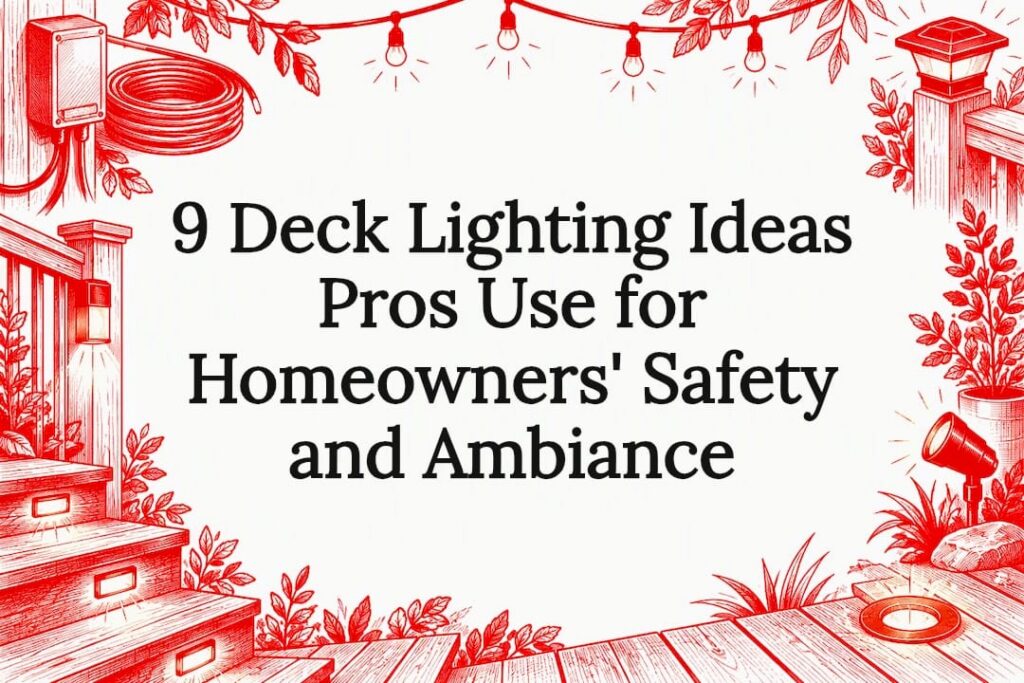
A handful of fixture types cover nearly every deck lighting need: in-deck, recessed, riser or stair, post-cap, under-rail, LED strip, string or bistro, torch, and solar lights. The simple rule is to handle safety first by lighting stairs and walkways, then layer in ambient and accent lighting for mood. From there, the details that matter most are power source, color temperature, weatherproof ratings, and whether a job calls for a DIY approach or a licensed electrician.
TL;DR:
- Low-voltage deck lighting is safer, more flexible, and cost-effective, but requires proper sizing of transformers and correct gauge wiring to prevent brightness loss.
- Recessed fixtures for decks, such as in-deck or railing lights, often need professional installation due to structural cuts and sealing requirements.
- Warm white lights around 2700K to 3000K with high CRI produce a natural, inviting glow suited for residential decks and minimize blue light pollution.
- Solar-powered fixtures offer quick DIY setup but have shorter runtimes in winter and in low-sun conditions, making them less reliable long-term.
- Fixtures rated at least IP65 and UL-listed are essential for durability and safety in outdoor conditions, especially for flood-prone areas like near pools.
Table of Contents
- 1. Popular Deck Lighting Types and Where to Use Them
- 2. Power and Installation Options: Low Voltage, Line Voltage, and Solar
- 3. Placement and Purpose: Safety, Navigation, and Ambiance Plans
- 4. Choosing Bulbs and Color: CCT, CRI, and Brightness
- 5. Materials, Ratings, and Safety Standards to Check
- 6. DIY vs Hiring a Pro and Cost Expectations
- 7. Maintenance and Troubleshooting Common Issues
- 8. Author and Company Credentials
- 9. A Practical Rule for Balancing Safety and Ambiance
- 10. Build and Light Your Deck with Action Fence and Deck
- FAQ
- Sources
1. Popular Deck Lighting Types and Where to Use Them
Matching the fixture to the zone keeps a deck both safer and better looking.
- In-deck lights: small round fixtures recessed flush into decking boards, best for marking edges and walkways; cutting into boards and sealing against moisture usually calls for a pro.
- Recessed lights: similar to in-deck fixtures but often used in railings or posts, requiring gasketed housings and careful attention to drainage, per This Old House’s guide to deck mood lighting.
- Riser and stair lights: mounted under the stair tread or on the riser face to light each step. Space them on every second or third riser to avoid glare while keeping steps visible.
- Post-cap lights: solar or low-voltage caps that replace standard post caps on railing posts, among the easiest DIY upgrades since they usually snap or screw into place.
- Under-rail lights: strip or puck fixtures mounted beneath the top rail, spaced every 12 to 18 inches to avoid visible hot spots along the railing.
- LED strip lights: flexible, cuttable strips tucked under stair nosings, bench seating, or rail caps for continuous glow; straightforward to install but need a rated power supply.
- String or bistro lights: overhead lights strung across posts or pergolas for ambiance, simple to hang and a strong DIY option.
- Torch lights: freestanding gas or LED torches for perimeter accents, easy to place but need stable footing and clearance from flammable material.
- Solar options: battery-charged fixtures, often post caps or stake lights, with no wiring but shorter runtime in low-sun seasons.
2. Power and Installation Options: Low Voltage, Line Voltage, and Solar
Most residential deck lighting runs on low-voltage systems stepped down from household power through a transformer. Low voltage is popular because it is safer to handle, cheaper to run, and flexible enough for stair and rail fixtures without the risk of a line-voltage shock hazard.
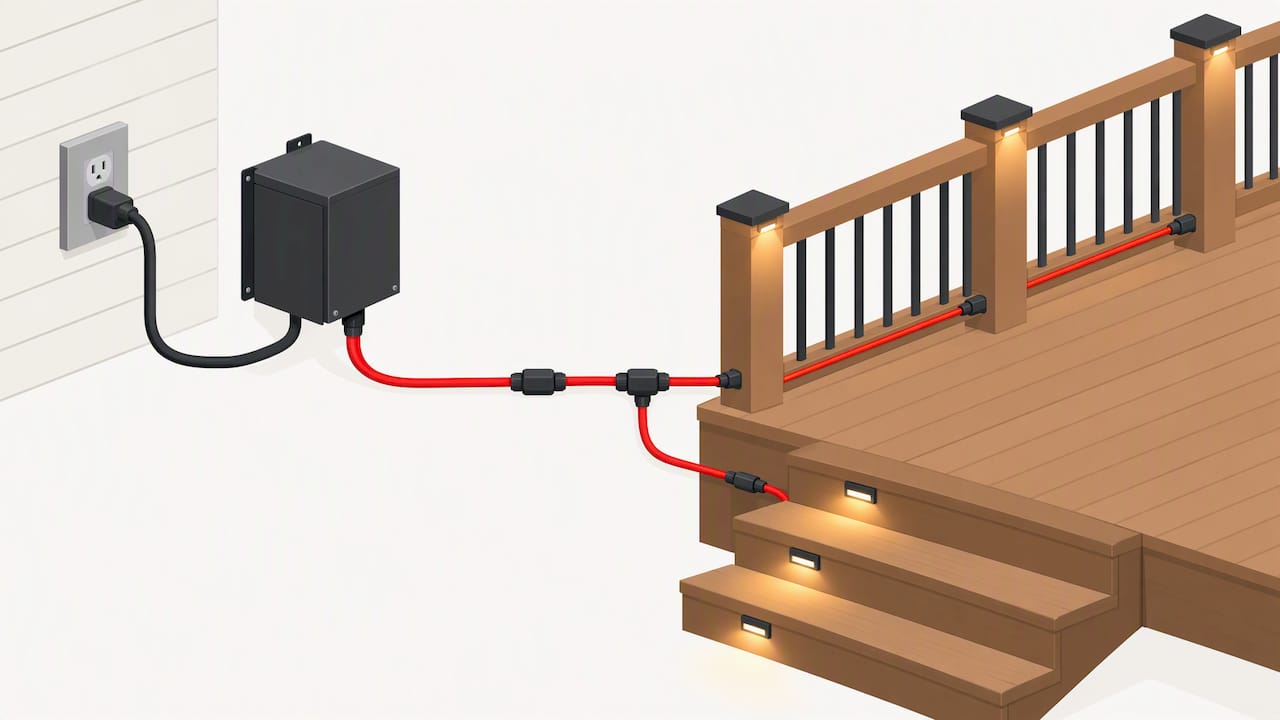
Line-voltage fixtures, wired directly into household 120V circuits, show up less often on decks but sometimes get used for larger post lights or when a fixture needs more consistent output. These installations should go through a licensed electrician.
Solar and battery fixtures skip wiring entirely, which makes them the fastest to install, but battery life and output drop over time and in winter.
- Confirm your transformer has enough wattage capacity for every fixture plus a buffer for future additions.
- Watch for voltage drop on long low-voltage runs. Longer cable runs can lose brightness at the far end unless the gauge is sized correctly.
- Avoid daisy-chaining too many fixtures off one transformer tap.
Pro Tip: Oversize your transformer by about 20% of your total fixture wattage to leave room for voltage drop and future fixtures.
3. Placement and Purpose: Safety, Navigation, and Ambiance Plans
Lighting a deck well means thinking in layers, starting with the areas people need to see clearly.
- Stairs and walkways get riser or stair lights first, since uneven footing at night is the most common deck hazard.
- Railings and perimeter get under-rail or post-cap lights to define the edge of the deck without flooding it with light.
- Seating and dining areas get ambient lighting like string lights or LED strips under bench seating for a softer glow.
- Landscape features such as planters or steps down to the yard benefit from low, focused accent lighting rather than overhead glare.
A general guideline is to keep fixtures low and spread out rather than few and bright, since a handful of soft points of light reads as inviting while one harsh fixture creates glare and deep shadows nearby.
4. Choosing Bulbs and Color: CCT, CRI, and Brightness
Warm white light in the 2700K to 3000K range suits most residential decks, giving a welcoming glow rather than the colder, bluer cast of higher color temperatures. Higher color temperature LEDs tend to carry more blue light content, which the Department of Energy’s research on outdoor lighting sources notes can increase light pollution and feel harsher in a backyard setting.
- Look for higher CRI (color rendering index) fixtures so skin tones, wood grain, and plants look natural rather than washed out.
- Phosphor-converted white LEDs are the standard choice for consistent, steady color; mixed RGB systems trade some consistency for the ability to change colors on demand.
- Check the Lighting Facts label on packaging for lumens, watts, CRI, and CCT before buying, a habit the DOE’s LED color characteristics factsheet recommends for comparing fixtures fairly.
Warm CCT around 2700K reduces perceived harshness and blue-light spill compared with cooler, higher-CCT LEDs, according to DOE’s analysis of outdoor lighting sources, which matters for both comfort and keeping light contained to your own yard.
5. Materials, Ratings, and Safety Standards to Check
Outdoor fixtures live outside year-round, so the ratings on the box matter more than the price tag.
- Look for an IP rating of at least IP65 for any fixture exposed to rain or splashing, since lower ratings aren’t built for direct weather exposure.
- Confirm the fixture carries UL listing for outdoor or landscape use; UL’s landscape and outdoor luminaire guidance points to standards like UL 1598 for luminaires and UL 1838 or UL 2108 for low-voltage landscape systems.
- Low-voltage systems operating at 30 volts or less fall under NEC Article 411, and should use a listed landscape power unit, a detail covered in UL and NEC guidance on low-voltage landscape luminaires.
- Keep lighting well clear of pool areas unless a fixture is specifically listed for that proximity, and check local code before final sign-off.
6. DIY vs Hiring a Pro and Cost Expectations
Post-cap lights, solar stakes, string lights, and plug-in low-voltage kits are generally DIY-friendly projects for a confident homeowner. Recessed in-deck lighting, anything tied into line voltage, or work requiring cuts into structural boards typically calls for an electrician or contractor.
- Budget for single low-voltage fixtures as a smaller add-on cost, full low-voltage systems as a mid-range project, and recessed in-deck installs as the most labor-intensive option since they involve cutting, sealing, and wiring concealment.
- Ask any contractor for a written scope, a timeline, and confirmation that fixtures and transformers are UL-listed for outdoor use.
- Treat vague bids, no mention of permits, or no electrical licensing as red flags.
For a broader sense of what a deck project costs overall, our deck replacement cost guide breaks down typical project ranges.
Pro Tip: Get at least two quotes for any job involving line-voltage wiring, and ask each contractor how they’ll weatherproof penetrations through the decking.
7. Maintenance and Troubleshooting Common Issues
A little seasonal upkeep keeps deck lighting running for years.
- Check gaskets and lens seals each spring for cracks that let in moisture.
- Clean lenses regularly since dust and pollen dull output over time.
- Swap batteries in solar fixtures before they dim noticeably.
- Test the transformer and connections if multiple fixtures flicker or dim together, since that often points to a loose connection or overloaded circuit rather than a failed bulb.
- Replace a fixture outright once the housing cracks or corrodes, since repairs rarely outlast a new unit.
8. Author and Company Credentials
This guide comes from a team experienced in building and wiring decks for over 20 years. We focus on sustainable materials and custom solutions for every project, and we offer free quotes so homeowners get transparent pricing before committing. For a detailed look at your own deck, we recommend scheduling an on-site estimate.
9. A Practical Rule for Balancing Safety and Ambiance
After two decades building decks, my rule is simple: light what people walk on before you light what people look at. Stairs and edges come first, ambiance comes second, and that order has saved more than one guest from a stumble. See our deck stairs code guide for more on getting stair safety right.
— Abraham
10. Build and Light Your Deck with Action Fence and Deck
We build custom decks and retrofit existing ones with integrated, code-compliant lighting, from stair risers to under-rail strips. Every project starts with a quote to outline the scope before work begins.

For professional permanent lighting work beyond deck fixtures, Capital Pro Lighting installs programmable outdoor roofline systems, a useful option if you’re expanding lighting across your whole property.
| Lighting goal | Fixture type | Best fit |
|---|---|---|
| Stair safety | Riser lights | Every home with deck stairs |
| Ambiance | String or bistro lights | Seating and dining areas |
| Low-maintenance | Solar post caps | Homeowners avoiding wiring |
Ready to plan your project? Visit our Decks page to schedule your free estimate.
FAQ
What is the best type of deck lighting for stairs?
Riser or stair lights mounted under the tread or on the riser face give the clearest visibility for each step. Spacing them every second or third riser lights the full run without creating glare.
Do deck lights need to be low voltage?
Most residential deck lighting runs on low-voltage systems stepped down from household power through a transformer because they’re safer to handle and cheaper to operate, as noted in UL’s landscape and outdoor lighting guidance. Line-voltage fixtures exist but usually require a licensed electrician.
What color temperature is best for deck lighting?
Warm white in the 2700K to 3000K range is generally recommended for residential outdoor spaces since it creates a comfortable, welcoming glow rather than a harsh, blue-tinted light.
Can I install deck lights myself?
Post-cap lights, solar stakes, and plug-in string lights are DIY-friendly for most homeowners. Recessed in-deck fixtures or anything tied into line voltage typically need a licensed electrician or contractor, as outlined in This Old House’s deck lighting guide.
How much does professional deck lighting installation cost?
Costs vary by fixture type and whether wiring is low voltage or line voltage, with recessed in-deck installs typically costing more due to cutting and sealing work. Our deck replacement cost guide offers broader project cost context, and a local quote gives the most accurate number for your deck.
Sources
- LED color characteristics factsheet (DOE / SSL)
- Landscape and outdoor luminaire lighting | UL
- Adding the perfect mood lighting to your deck: a guide – This Old House
- Selected blue-light characteristics of various outdoor lighting sources (DOE)