FSC-certified wood is timber whose forest management and supply chain have been independently audited to meet Forest Stewardship Council standards. The immediate step for any buyer is checking the on-product label and asking the supplier for their Chain of Custody certificate code before signing a purchase order. The Forest Stewardship Council, often shortened to FSC, and its regional body FSC US are the authorities behind that verification.
TL;DR:
- FSC Mix may be suitable for structural and hidden applications when certified stock is limited, but it requires documented traceability and lower costs.
- Always verify the supplier’s Chain of Custody certificate number through FSC’s database before purchase, and ensure invoices specify the FSC claim type and certificate code.
- The environmental benefits of FSC certification depend heavily on full life cycle management, including responsible forestry practices and manufacturing impacts.
- For project-specific green building credits, obtain and document FSC certification and Chain of Custody details early in the process to avoid losing points.
- Use physically labeled FSC-certified lumber and enforce strict handling procedures to prevent cross-contamination and ensure claim integrity on real job sites.
Table of Contents
- What counts as FSC certified wood: forest management versus product claims
- Decoding FSC 100%, FSC Mix, FSC Recycled, and Controlled Wood
- How Chain of Custody tracks wood from forest to finished product
- What choosing FSC wood actually delivers, and where the trade-offs sit
- A verification checklist for buying FSC certified wood
- Using FSC materials in building projects for green certification credits
- Contractor practices that keep FSC claims honest on real job sites
- When FSC 100% earns its price and when FSC Mix is the smarter call
- Where to check certificates and standards yourself
- Building or replacing a deck or fence with certified materials
- Sources
- FAQ
What counts as FSC certified wood: forest management versus product claims
Forest Management (FM) certification confirms that a specific forestry operation meets the FSC’s Principles and Criteria, checked by an accredited third-party auditor rather than by the forest owner itself. That is different from a Chain of Custody claim, which follows the material after it leaves the forest.
- Forest Management (FM): certifies the forest operation itself, covering harvesting practices, worker conditions, and ecosystem protections.
- Chain of Custody (CoC): certifies the supply chain, tracking material through mills, manufacturers, and distributors so the original FM claim survives to the finished board.
- National standards: the FSC Forest Stewardship Standard for the Conterminous United States adapts the global framework to local forestry conditions and became effective with a transition period starting in 2026.
A forest can be perfectly certified and still produce uncertified lumber if the CoC chain breaks somewhere between the sawmill and the store.
Decoding FSC 100%, FSC Mix, FSC Recycled, and Controlled Wood
FSC labels come in three main types, and knowing the difference keeps a buyer from overpaying or underspecifying. FSC 100% means every fiber in the product traces to certified forests. FSC Mix blends certified material with Controlled Wood or recycled content, tracked through Mix Credit or Mix Percentage accounting. FSC Recycled means the material comes entirely from reclaimed wood or paper.
- FSC 100%: every fiber sourced from certified forests, no blending.
- FSC Mix: certified fiber blended with Controlled Wood or recycled inputs, tracked by credit or percentage systems.
- FSC Recycled: fully reclaimed material with no virgin certified-forest input required.
- Controlled Wood: a restricted category that screens out wood from unacceptable sources, used to keep Mix products credible.
Three FSC label types exist globally, each backed by documented control systems that determine what a supplier can legally print on packaging versus what shows up only on the invoice. The physical label tells you the claim type; the sales document should confirm the percentage or credit basis behind it.
How Chain of Custody tracks wood from forest to finished product
Chain of Custody certification tracks FSC-certified material through every stage of processing and ownership, from the logging site to the retail counter. Each business that takes legal ownership of the material, sawmill, distributor, cabinet shop, or lumberyard, must hold its own CoC certificate or purchase through a certified intermediary for the claim to survive.
Accredited certification bodies audit CoC holders on a recurring basis, checking purchase records, production volumes, and labeling practices against what the company actually sells. This is the same audit structure that underpins FM certification, applied to the commercial side of the supply chain.
- Ask for the supplier’s CoC certificate code, which follows a standard prefix and number format.
- Look up that code in FSC’s public certificate database before finalizing an order.
- Confirm the invoice or delivery note states the specific FSC claim (100%, Mix, or Recycled), not just the word “certified.”
What choosing FSC wood actually delivers, and where the trade-offs sit
FSC certification is built around three commitments: conserving biodiversity in managed forests, respecting the rights of workers and local communities, and reducing the risk of material entering the supply chain from illegal or unmanaged logging. FSC certifies over 200 million hectares of forest worldwide, giving the label a global footprint few competing certification systems match.
Life cycle assessment research adds a necessary nuance: manufacturing is often the most impactful stage in a wood product’s footprint, more than the harvesting itself. Even so, wood’s ability to store biogenic carbon and its lower reliance on fossil-based inputs often give it a better overall environmental profile than steel, vinyl, or concrete alternatives in comparable applications.
- Biodiversity safeguards are built into the FM standard, not added as a marketing layer.
- Community and labor protections are audited criteria, not voluntary guidelines.
- The carbon-storage benefit depends on the product’s full life cycle, not just its origin.
A verification checklist for buying FSC certified wood
Sourcing FSC material correctly is less about finding a rare product and more about paperwork discipline at every step of the purchase.
- Inspect the physical label on delivered lumber or panels and record exactly which claim it states.
- Request the supplier’s CoC certificate number and confirm it in FSC’s certificate search tool before payment.
- Require the FSC claim and CoC code on the invoice and delivery note, written out in full rather than abbreviated to “eco” or “green.”
- For mixed inventory, ask for documented percentages or Mix Credit evidence; accepting FSC Mix is reasonable when full FSC 100% supply is not available, provided traceability is documented.
Retailers who market finished FSC-labeled products without holding CoC certification themselves may operate under a Promotional License Holder arrangement, which has its own eligibility rules worth confirming before assuming a retailer is fully certified.
Pro Tip: Keep a folder of certificate numbers and invoices for every certified order. Auditors and future buyers both ask for that paper trail, and reconstructing it after the fact is far harder than saving it upfront.
Using FSC materials in building projects for green certification credits
FSC Project Certification validates that wood used on a specific construction job, rather than a whole company’s inventory, comes from certified sources. It is distinct from corporate CoC certification and fits projects that need a documented FSC percentage to qualify for green building credits rather than an ongoing certified supply chain.
- Confirm early whether the project targets FSC-related credits under a green building rating system.
- Collect CoC codes and delivery documentation as materials arrive, not at the closeout stage.
- Build a lead-time buffer into the schedule, since certified stock is not always available on short notice.
Waiting until the credit application is due to gather this paperwork is the most common reason projects lose points they were otherwise entitled to claim.
Contractor practices that keep FSC claims honest on real job sites
Reputable suppliers separate certified and non-certified stock physically, not just on paper, and stamp delivery tickets with the specific claim at the moment of handoff. When specifying decks, fences, or exterior woodwork, a tender document should require the CoC code, the claim type, and a signed delivery note before the crew starts building.
- Keep certified and non-certified inventory in separate, labeled storage areas to avoid cross-contamination of claims.
- Write CoC code requirements directly into subcontractor and supplier agreements, not just verbal instructions.
- Reserve FSC 100% for visible, premium applications and accept FSC Mix for structural or hidden framing where budget matters more than the label.
Action Fence and Deck applies this same documentation discipline across its eco-friendly fencing projects, treating sourcing paperwork as part of the build rather than an afterthought.
Pro Tip: Match the FSC label tier to the application: spend on FSC 100% where the wood is seen and touched, and let FSC Mix carry the load where it is structural and hidden.
When FSC 100% earns its price and when FSC Mix is the smarter call
For a backyard deck frame, a privacy fence post, or other structural work that will not be seen once the build is finished, FSC Mix is a reasonable, well-documented compromise, especially when local supply of full-certified stock is thin. My recommendation: match the certification tier to visibility and budget, not to marketing pressure, and never accept a claim without a certificate number to check.
— Abraham
Where to check certificates and standards yourself
For direct verification, use FSC’s own global label and CoC pages, FSC US’s project certification guidance, and its consumer recognition research for background on label trust.
Building or replacing a deck or fence with certified materials
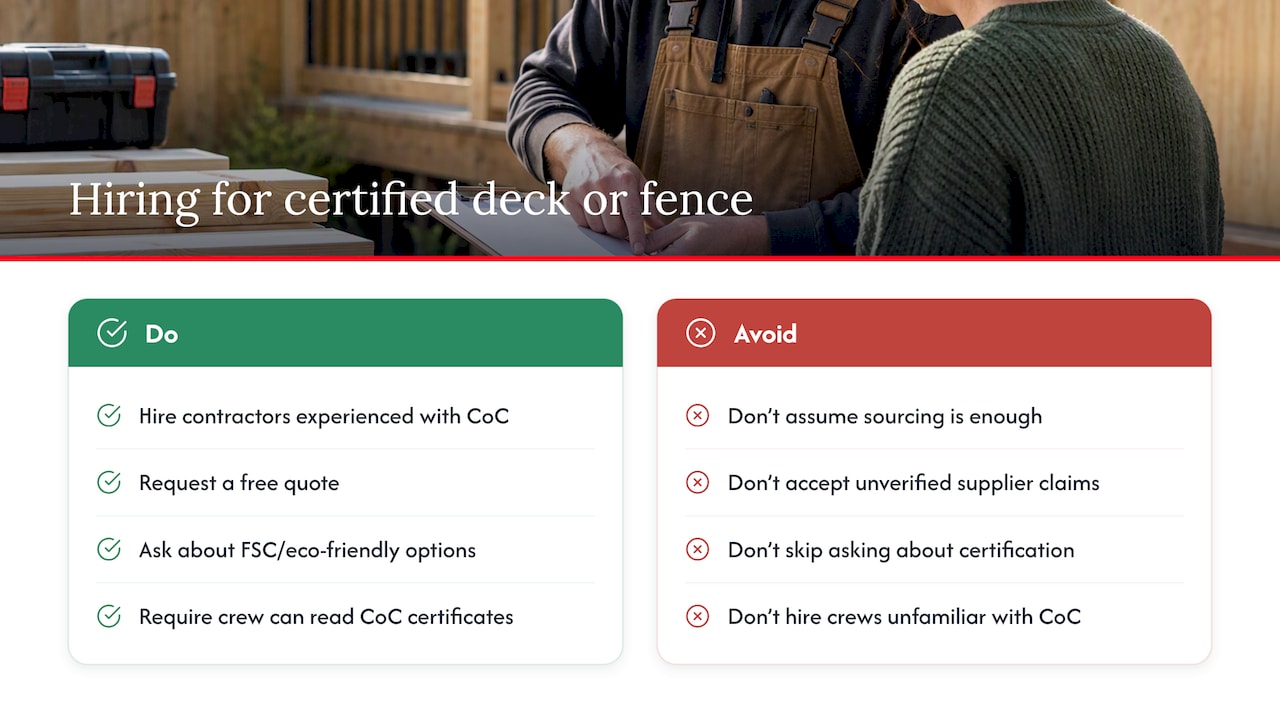
Sourcing FSC-certified lumber is only half the job: getting it built correctly, on schedule, and without wasted material takes a crew that already knows how to read a CoC certificate and hold suppliers to their claims. Experienced contractors bring skilled work to custom wood fencing, deck construction, and related exterior projects, often incorporating sustainable material choices and offering free quotes. If a deck or fence project is coming up, request a free quote and ask directly about FSC-certified or eco-friendly material options for the build.
Sources
- FSC Mix and Controlled Wood labels (FSC)
- FSC Forest Stewardship Standard for the Conterminous United States of America (FSC-STD-USA-02-2026)
- Life Cycle Assessment of Forest-Based Products: A Review
FAQ
What does FSC certified wood mean on a product label?
It means the wood’s forest of origin and its supply chain have both passed independent audits against Forest Stewardship Council standards. The specific claim, FSC 100%, FSC Mix, or FSC Recycled, tells you exactly how much of the product traces to certified sources.
How do I verify an FSC claim before buying wood?
Ask the supplier for their Chain of Custody certificate number and look it up in FSC’s public certificate database before you pay. The invoice and delivery note should also state the exact FSC claim, not just a generic “certified” label.
Is FSC Mix wood less sustainable than FSC 100%?
Not necessarily. FSC Mix blends certified fiber with Controlled Wood or recycled content under documented control systems, and it exists largely because fully certified supply does not always meet demand, according to FSC’s own labeling framework.
Can FSC certified wood help a project earn green building credits?
Yes, through FSC Project Certification, which validates that the wood used on a specific job comes from certified sources and can support credits under systems like LEED. Documentation, including CoC codes and delivery records, needs to be collected as materials arrive to avoid delays at the credit application stage.
Does Action Fence and Deck use FSC certified wood?
Some companies focus on sustainable and eco-friendly materials across fencing and deck-building services, tailoring choices to each client’s project and budget. Ask service providers for specifics on FSC-certified or eco-friendly sourcing when requesting a quote.