Most patio cracks are cosmetic shrinkage cracks that show up as the concrete cures and settles into its final shape. The ones that matter are wider than about 1/4 inch, show a vertical lip where one side sits higher than the other, or keep widening month to month. If you see any of those three signs, photograph the crack, measure it, and get a professional assessment before doing any cosmetic patching.
TL;DR:
- Cracks wider than 1/4 inch, with a vertical lip or that keep widening, require immediate professional assessment and proper repair methods.
- Most surface cracks under 1/8 inch are structural or cosmetic and do not need urgent repair unless they show signs of worsening.
- Proper diagnosis involves measuring crack width, vertical displacement, monitoring movement over weeks, and assessing drainage and soil beneath the slab.
- Repair techniques must match the damage type, with options including sealants for hairline cracks, epoxy for dormant structural cracks, and foam lifting for settled slabs.
- Preventive measures like proper drainage and timely joint sealing are key to avoiding progression from cosmetic cracks to structural failure.
Table of Contents
- Why Concrete Patio Cracking Happens in the First Place
- Cosmetic Crack or Structural Failure? Use These Thresholds
- How to Inspect a Cracked Patio Before You Call Anyone
- Matching the Repair to the Damage: What Actually Works
- Preventing Cracks Before They Start (and Stopping Small Ones From Growing)
- What a Professional Inspection Looks Like at Action Fence and Deck
- The Editorial Take: Stop Treating Every Crack the Same Way
- Get a Free Inspection and Quote for Your Cracked Patio
- Sources
- FAQ
Why Concrete Patio Cracking Happens in the First Place
Concrete cracks. Even the American Concrete Institute treats that as a given rather than a failure, and its guidance on slab construction says the real goal is controlling where cracks form, not preventing them outright. That shift in framing matters, because it changes the question from “why did my patio crack” to “did it crack where and how it was supposed to.”
Several distinct mechanisms cause concrete patio cracking, and each leaves a different signature:
- Plastic shrinkage: happens within hours of the pour, when surface water evaporates faster than bleed water can replace it, leaving fine, random hairline cracks across the surface.
- Drying shrinkage: occurs over weeks as the slab loses moisture and contracts; control joints exist specifically to direct this stress into planned lines instead of random cracks.
- Thermal cycling: seasonal expansion and contraction stresses joints and any weak points repeatedly, which is why old cracks often reappear or grow slightly each winter.
- Subgrade movement: settling, voids, or expansive clay soil beneath the slab causes wide cracks, vertical displacement, and cracks that keep getting worse instead of stabilizing.
- Freeze-thaw damage: water trapped in the surface pores expands when it freezes, causing scaling and spalling rather than the thin cracks typical of curing issues.
- Alkali-silica reaction: a slower, less common chemical reaction between cement and certain aggregates that causes internal expansion, map-cracking, or spalling over years.
The ACI’s slab construction guidance makes a useful point here: proper mixture design, correctly timed jointing, and adequate curing don’t eliminate cracking, they control it. That’s the difference between a patio that ages gracefully along its joint lines and one that fractures wherever the concrete happened to be weakest.
Cosmetic Crack or Structural Failure? Use These Thresholds
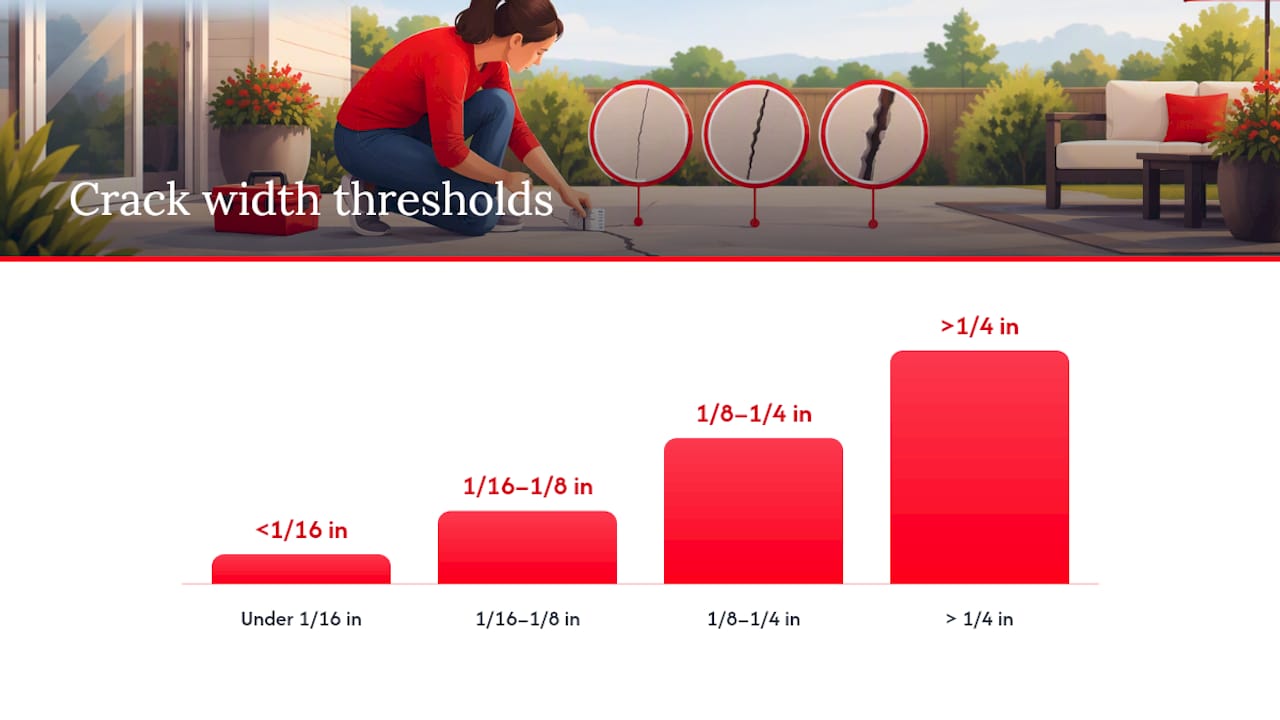
Crack width is the fastest triage tool you have, and it maps closely to cause. A hairline crack under 1/16 inch is almost always shrinkage related and rarely worth worrying about. Cracks between 1/16 and 1/8 inch are still usually cosmetic but worth monitoring, especially if several appear in a short time. Once a crack opens to 1/8 to 1/4 inch, it’s worth documenting closely, since it sits right at the boundary where drying shrinkage shades into something driven by subgrade movement. Anything over 1/4 inch deserves a professional look.
Here’s a quick way to sort what you’re seeing:
- Crack follows a control joint — this is the joint doing its job, not a failure. Concrete is designed to crack along these lines, and control joints are engineered specifically to direct that stress away from random surface cracking.
- Crack runs randomly, width under 1/8 inch, no height difference — almost certainly cosmetic shrinkage cracking.
- Crack shows a vertical lip, even a small one you can feel with a bare foot — this points to subgrade settlement and is a trip hazard regardless of the crack’s width.
- Multiple cracks intersect or form a spreading pattern — often a sign of ongoing base failure rather than a single isolated event.
- Rust staining bleeds from the crack, or aggregate is visibly exposed — this suggests corroding rebar or long-term surface erosion, both of which point to problems below the surface, not just on it.
Slab-lifting specialists who deal with settled patios regularly note that foam injection systems allow for measured, laser-monitored lifts precisely because uneven correction can turn a manageable crack into a bigger structural problem. That precision matters more than most homeowners realize when a patio has settled unevenly near a house foundation.
How to Inspect a Cracked Patio Before You Call Anyone
You don’t need special equipment to gather useful diagnostic information, just a handful of basic tools: a tape measure, a 4-foot level or straightedge, a crack gauge or a simple ruler, a camera, and chalk or a marker.
Work through the crack methodically:
- Measure the crack width at three or four points along its length, not just where it looks widest.
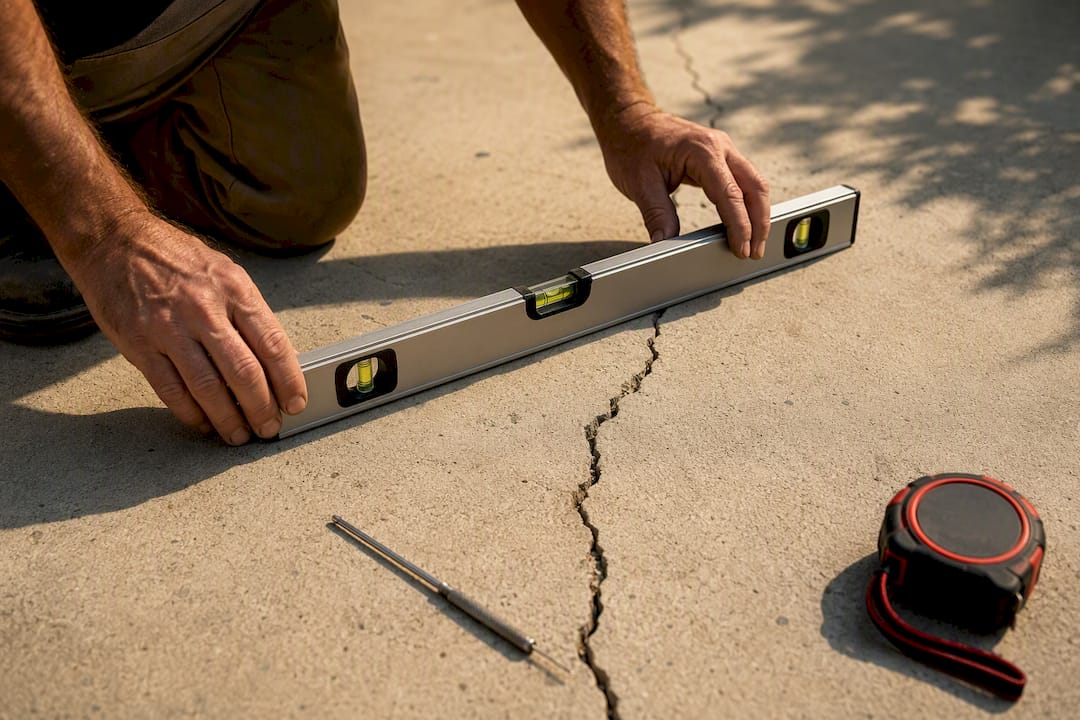
- Lay the straightedge across the crack to check for vertical displacement between the two sides.
- Note the crack’s total length and how close it runs to the house foundation, a downspout, or a large tree.
- Mark both ends of the crack with chalk and photograph it with a coin or tape measure in frame for scale.
- Wait two to four weeks, ideally spanning a wet and dry stretch, then remeasure the same spots to see if the crack has moved.
While you’re out there, check the slab edges for visible erosion or gaps underneath, and look at where downspouts discharge relative to the patio. Clay soil tends to swell and shrink dramatically with moisture; sandy soil drains fast but can wash out voids underneath a slab over time. These context clues often explain a crack pattern faster than the crack itself does.
Pro Tip: Skip the monitoring period entirely if you spot a trip hazard, a gap wider than 1/4 inch, a newly formed lip, or a crack that visibly widened in the last few weeks. Those signs call for a professional visit now, not a follow-up measurement in a month.
Matching the Repair to the Damage: What Actually Works
The single biggest mistake homeowners make with cracked concrete patio repair is picking a fix based on what’s cheap or easy rather than what matches the actual cause. A repair guide that walks through this scenario by scenario found that matching the fix to the specific damage type is the difference between a repair that lasts and one that reopens within a season.
- Hairline and shrinkage cracks: clean the crack and fill with a flexible polyurethane sealant or a concrete crack filler. This is a same-day job and among the least expensive fixes available.
- Working joints with gaps: install backer rod, then top with an elastomeric polyurethane sealant that flexes with seasonal movement instead of a rigid filler that will just crack again.
- Dormant structural cracks (not actively moving): epoxy injection or a routed-and-sealed repair works well here, since epoxy is rigid and bonds the two sides together. This only makes sense once you’ve confirmed the crack has stopped moving.
- Sunken or settled slabs: polyjacking, which injects high-density polyurethane foam under the slab to lift it back to grade, has largely replaced traditional mudjacking because the foam is far lighter than mudjacking slurry, cures within hours, and resists washout in wet soil conditions.
- Extensive spalling or a shattered slab: resurfacing can restore the surface, but only if the base underneath is stable; check the conditions that make a patio a resurfacing candidate before committing. When the subgrade itself has failed, replacement is the more expensive route but often the only one that lasts.
Costs vary widely by method. Cosmetic crack sealing typically runs under a few hundred dollars, slab-lifting repairs like polyjacking usually land in the hundreds to low thousands, and full replacement commonly runs into several thousand dollars depending on size and site access. Patching a patio that’s still actively shifting from soil movement almost always fails within a year or two; the subgrade has to be addressed first, whether that means fixing drainage, filling voids, or stabilizing the base, before any surface repair has a chance of holding.
Preventing Cracks Before They Start (and Stopping Small Ones From Growing)
Water is the root cause behind most of the subgrade problems that turn a cosmetic crack into a structural one. Keeping downspouts extended away from the patio, using splash blocks, and regrading low spots near the slab edge prevents the erosion and washout that undermine a base over time. A patio with proper drainage diagnosed and corrected early rarely develops the kind of progressive cracking that requires slab lifting later.
For existing patios:
- Inspect control joints yearly and replace cracked or shrunk joint sealant before water gets underneath the slab.
- Avoid deicing salts on new concrete during its first winter or two, since they accelerate freeze-thaw scaling.
- Reseal the surface once water stops beading on it, and only after the slab has had roughly 28 days to dry and cure fully.
For a new pour, insist on a properly engineered and compacted base, correctly spaced control joints cut within the right curing window, and reinforcement appropriate to the site’s soil type.
Pro Tip: If you’re pouring new concrete, ask your contractor exactly when control joints will be cut. Timing matters as much as spacing. Cut too early and you risk raveling the edges; cut too late and the slab has already cracked randomly on its own.
What a Professional Inspection Looks Like at Action Fence and Deck
Experienced crews approach every cracked patio the same way: diagnose first, then match the fix to what’s actually happening underneath. A typical on-site visit includes checking the slab with a level across multiple points, probing near cracks for voids, inspecting joint condition, and assessing drainage patterns around the perimeter.
From there, the repair recommendation depends on what we find. A dormant crack with no drainage issue might just need epoxy injection. A settled section near a downspout often points to polyurethane lifting. Widespread spalling with a solid base underneath might be a good resurfacing candidate rather than a full tear-out.
If you’re planning an inspection, bring your own photos and measurements. It speeds up the estimate and gives our team a clearer read on how the crack has behaved over time.
The Editorial Take: Stop Treating Every Crack the Same Way
The conventional advice on concrete patio cracking treats every crack as either “fine, ignore it” or “call someone immediately,” and both extremes waste homeowners’ money. Filling a shrinkage crack with epoxy is overkill. Caulking over a settling slab is a band-aid that fails within a season because the real problem is underneath, not on the surface.
What the evidence actually supports is a diagnosis-first mindset borrowed from how the repair industry itself operates: measure width, check for vertical displacement, monitor for movement over a few weeks, and only then pick a method. The ACI’s own framing treats cracking as expected and manageable, not as a defect to panic over, and that attitude should extend to how homeowners triage their own patios.
If I had to name the single biggest mistake I see, it’s skipping the monitoring step. A crack that looks alarming today but hasn’t moved in a month is a very different problem than one that opened another eighth of an inch in that same window. Measure twice before you fix once.
— Abraham
Get a Free Inspection and Quote for Your Cracked Patio
Professional repair services provide what a DIY crack filler kit can’t: expert diagnosis on whether your patio needs a simple seal, a lift, or a full replacement before recommending anything.

Every inspection follows the same checklist covered above: level checks across the slab, probing for voids near the crack, a look at joint condition, and a drainage assessment around the perimeter. You walk away with a written estimate and a clear recommendation, whether that’s a joint reseal, epoxy injection, polyurethane lifting, or resurfacing. If the damage calls for something bigger, our concrete pouring, paving, and finishing services cover the full range from targeted repair to a complete new pour. Bring your measurements and photos, and request a free quote to find out exactly what your patio needs before you spend money on the wrong fix.
Sources
- Concrete Patio Repair Guide: Match the Right Fix to Specific Damage | BuildMat Insight
- Concrete Patio Repair & Leveling | Epp Foundation Repair
- Angi: Patio repair costs and typical price ranges
- Exterior concrete maintenance guide | Cemstone
FAQ
Can a Cracked Concrete Patio Be Repaired?
Yes, most cracked patios can be repaired rather than replaced, as long as the subgrade underneath is stable. The right method depends on the crack type: flexible sealant for hairline cracks, epoxy injection for dormant structural cracks, and polyurethane lifting for slabs that have settled unevenly.
What Is the Average Lifespan of a Concrete Patio?
A well-built concrete patio with a properly compacted base and correctly placed control joints typically lasts several decades with routine maintenance. Lifespan drops significantly when drainage problems, poor base compaction, or skipped sealing are left unaddressed.
How Big of a Crack Is Acceptable in Concrete?
Cracks under 1/8 inch wide are generally considered cosmetic and don’t need repair unless they’re growing. Cracks wider than about 1/4 inch, or any crack with a vertical lip you can feel underfoot, should get a professional assessment.
How Much Does It Cost to Repair a Concrete Patio?
Cosmetic crack sealing typically costs under a few hundred dollars, while slab-lifting repairs like polyjacking usually fall in the hundreds to low thousands. Full replacement is the most expensive option, often running several thousand dollars depending on patio size. Free, on-site quotes are often provided after inspecting the specific damage.