Concrete cracks because tensile stress from shrinkage, temperature change, soil movement, rebar corrosion, or overload exceeds its low tensile strength. Shrinkage and thermal stress cause most hairline cracking within the first year, while settlement and corrosion drive the wider, longer-term damage. Prevention comes down to five controllable factors: mix design, curing, joint placement, drainage, and reinforcement.
TL;DR:
- Most cracks in concrete are caused by tensile stress exceeding the material’s weak tensile strength, mainly from shrinkage and thermal forces.
- Hairline cracks under 1/16 inch are usually cosmetic, while wider or displaced cracks indicate settlement or structural movement.
- Proper curing, joint placement, drainage, and mix design can prevent most cracking, with controlling water-cement ratio being the most critical factor.
- Common crack types include drying shrinkage, plastic shrinkage, thermal cracks, freeze-thaw damage, and cracks caused by rebar corrosion or soil movement.
- Active water intrusion, displacement, or cracks linked to foundation or retaining walls require professional assessment and repair to avoid further damage.
Table of Contents
- Common Concrete Crack Types and What Their Patterns Mean
- Why Tensile Stress Is Behind Almost Every Crack
- Is Your Crack Cosmetic or a Structural Red Flag?
- Preventing Concrete Cracking Before and After the Pour
- What A Concrete Crew Checks Before Every Pour
- What Most Homeowners Get Wrong About Cracked Concrete
- Get A Professional Assessment Of Your Cracked Concrete
- Key Standards And Reports Behind This Guide
- Sources
- FAQ
Common Concrete Crack Types and What Their Patterns Mean
Reading a crack correctly starts with timing and shape, not just how wide it looks. A crack that shows up the same afternoon you poured a patio has a completely different cause than one that appears two winters later.
- Plastic shrinkage cracks: appear within hours, look random and shallow, and usually trace back to fast surface evaporation or a finishing crew that got caught by wind or sun before the slab could set properly.
- Drying shrinkage cracks: show up over days to months as long, thin lines running between joints. This is the most common crack type in residential slabs and patios, and it’s largely predictable. A standard 4-inch slab typically shrinks about 1/16 inch per 10 feet during its first year as it cures.
- Thermal or heat-of-hydration cracks: found in thick pours like foundations or footings, where the core heats up faster than the surface during curing. These irregular cracks can appear within hours or take a few days to surface.
- Freeze-thaw damage and scaling: shows up as flaking, pop-outs, or surface scaling after repeated winters, especially on concrete without enough entrained air.
- Settlement cracks: diagonal or stair-step patterns, often with one side of the crack visibly higher or lower than the other. This is a strong signal of soil movement underneath.
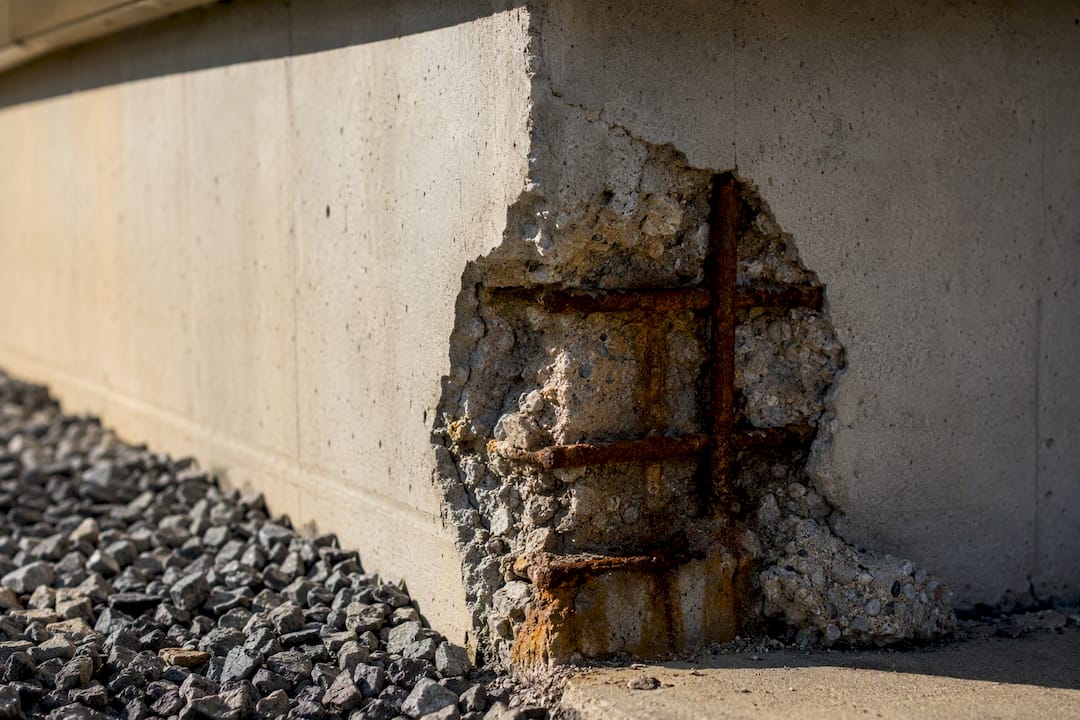
- Corrosion-related cracks: run in straight lines that mirror the rebar grid below, frequently accompanied by rust staining or chunks of concrete popping loose (spalling).
- Alkali-silica reaction (ASR) cracks: a network of fine, map-like cracking, sometimes with a gel-like residue at the surface. This is a chemical reaction between cement alkalis and reactive aggregate, and it’s rare in typical residential work but worth knowing.
- Structural cracks: run at roughly 45 or 90 degrees to the load path, tied directly to how the concrete is bearing weight rather than to weather or curing.
The GSA’s technical guide to concrete crack types walks through most of these patterns with photo references, which is worth a look if you want to compare against what you’re seeing on your own slab.
Why Tensile Stress Is Behind Almost Every Crack
Concrete is excellent under compression and weak under tension. Its tensile strength runs only about 8 to 15 percent of its compressive strength, which is the single fact that explains nearly every crack you’ll ever see.
Concrete’s tensile strength is roughly 8 to 15 percent of its compressive strength — meaning a slab that can handle thousands of pounds pressing down on it can still split apart from forces you’d barely notice, like the pull of shrinkage or a few degrees of temperature swing.
Drying shrinkage creates tension because the concrete wants to shrink as water leaves the mix, but something is always holding it back. Subgrade friction, rebar, adjacent slabs, or a stiff footing all resist that shrinkage, and the resulting stress can cause cracking. Plastic shrinkage works on a faster timeline: if water evaporates from the surface quicker than bleed water can replace it, the top layer shrinks while the concrete below is still soft, and the surface simply tears.
Thermal cracking follows a similar logic on a bigger scale. In mass pours like foundations, the center of the concrete heats up from the cement’s hydration reaction while the outer surface cools faster in contact with air or forms. That temperature gap between core and skin sets up internal stress, and once it exceeds the tensile limit, cracks form straight through the pour.
Freeze-thaw damage works differently. Water trapped in concrete’s pores expands roughly 9 percent when it freezes, and repeated freeze cycles gradually break down the paste from the inside. Air entrainment gives that expanding water somewhere to go, which is why entrained air is standard in any cold-climate mix.
Corrosion cracking starts small and gets dramatically worse. Rust expands as it forms, and expanding steel inside a fixed volume of concrete pushes outward until the concrete above it cracks and eventually spalls off. ASR follows the same expansive logic chemically: reactive aggregate reacts with cement alkalis to form a gel that swells over years, generating slow but relentless internal pressure. Settlement and overload cracks are more straightforward mechanically. When soil beneath a slab compresses unevenly, or a load exceeds what the reinforcement was designed to carry, the concrete bends in ways it was never built to bend, and it cracks along the path of least resistance. FHWA’s engineering guidance covers this full list of failure mechanisms in more technical depth if you want the underlying engineering.
Is Your Crack Cosmetic or a Structural Red Flag?
Most cracks you’ll find on a patio or driveway are cosmetic. A smaller number signal something more serious underneath, and telling the two apart doesn’t require an engineering degree, just a tape measure and a little patience.
- Measure the width. Hairline cracks under 1/16 inch are almost always cosmetic. Cracks between 1/8 and 1/4 inch deserve a closer look, especially if the pattern is diagonal rather than straight.
- Check for displacement. If one side of the crack sits higher than the other, even slightly, that’s a settlement signal, not simple shrinkage.
- Watch the pattern. Stair-step cracks in block or brick, wide diagonal cracks in slabs, or cracks that keep widening month over month all point toward structural movement.
- Mark it and track it. Draw a line across the crack with a permanent marker, note the date, and photograph it monthly. Growth over a few months is far more telling than a single measurement.
- Know who to call. A concrete contractor can handle joint repair, resurfacing, and cosmetic cracks. A structural engineer should look at anything with active displacement, water intrusion through the crack, or cracks tied to foundation walls.
If you’re dealing with a patio surface that’s cracked and now also slick when wet, it’s worth reading about fixing a slippery concrete patio alongside any crack repair, since resurfacing often solves both problems together.
Preventing Concrete Cracking Before and After the Pour
Most cracking is preventable with decisions made before the truck ever shows up, and a handful made in the weeks after.
- Control the water-cement ratio. A wetter mix shrinks more as it dries. Keeping the ratio tight, and using supplementary materials where appropriate, reduces the shrinkage that drives most drying cracks.
- Place control joints correctly. ACI guidance on shrinkage control recommends joint spacing based on slab thickness, generally saw cut within 6 to 12 hours of finishing for typical residential slabs. Joints don’t stop cracking. They tell the concrete where to crack in a straight, controlled line instead of a random one.
- Cure it properly. Wet curing or a curing compound applied right after finishing slows moisture loss and gives the concrete time to gain strength before shrinkage stress builds. This is arguably the cheapest, highest-return step in the entire process.
- Prep the base and manage drainage. A well-compacted base and a slope away from the slab prevent the soil movement that causes settlement cracks. Gutters and downspouts should route water away from the foundation, not toward it.
- Use air entrainment in freeze-thaw climates, and make sure reinforcement has adequate concrete cover to resist corrosion and limit chloride penetration over time.
- Address cosmetic cracks early with sealant or filler, and fix the water source causing them, since standing water and repeated freeze cycles turn small cracks into big ones.
Pro Tip: Keep a new slab wet, either with soaker hoses, wet burlap, or a sprayed curing compound, for at least the first three to seven days. Skipping this step is the single most common reason DIY pours crack early.
What A Concrete Crew Checks Before Every Pour
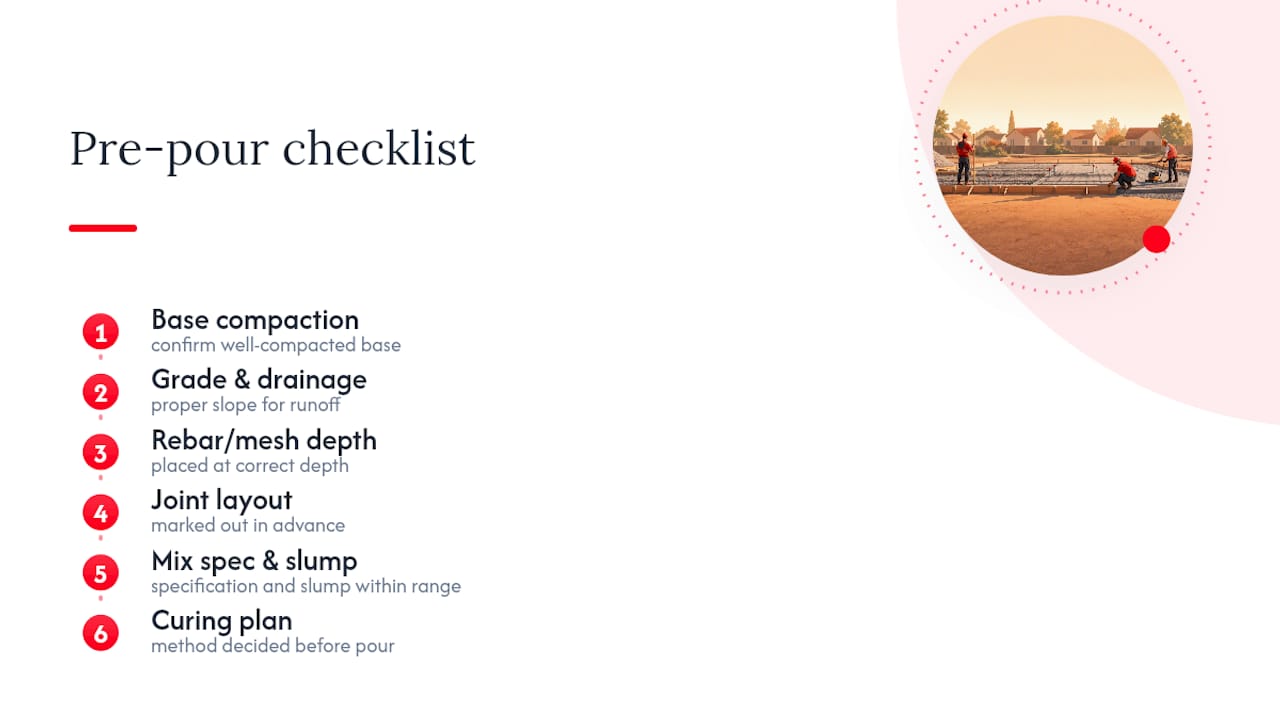
Field crews catch most future cracking problems before the concrete truck arrives, not after. A short pre-pour checklist covers base compaction, proper grade and drainage slope, rebar or mesh placement at the correct depth, joint layout marked out in advance, mix specification and slump within range, and a curing plan already decided.
The most common avoidable mistakes: overwatering the mix on-site, cutting joints too late or too shallow, skipping curing altogether, and pouring on a poorly compacted base. If you’re calling a contractor about existing cracks, gather photos, measurements, the pour date if known, and any history of water pooling nearby before the visit.
What Most Homeowners Get Wrong About Cracked Concrete
The most common root cause I see in the field isn’t bad concrete. It’s bad water management, either through skipped curing or bad drainage that saturates the base for years afterward. If you do one thing today, check that your gutters and grading actually push water away from every slab on your property.
— Abraham
Get A Professional Assessment Of Your Cracked Concrete
Reading a crack correctly is half the job. Fixing what’s underneath it is the other half, and that’s where Actionfenceanddeck’s concrete crew earns its keep: licensed, insured builders who handle concrete pouring, paving, and finishing alongside the drainage and grading work that actually stops cracks from coming back.

A hairline crack from ordinary drying shrinkage is often fine to monitor yourself. But once you’re looking at displacement, active water intrusion, or a crack tied to a retaining wall or foundation, the risk of getting it wrong, both structurally and financially, outweighs the savings of a DIY patch. Actionfenceanddeck offers free quotes on concrete pouring, paving, and finishing services, including drainage and retaining wall work when soil movement is part of the problem. Before your visit, have your crack photos, measurements, and any water history ready so the crew can give you an accurate read on what’s actually going on underneath. Request your free quote and get a straight answer on whether you’re looking at a resurfacing job or something bigger.
Key Standards And Reports Behind This Guide
- FHWA: causes and types of cracking in concrete pavements
- ACI 224R: control of cracking due to drying shrinkage
- 2023 review on cracking mechanisms in concrete
Sources
- Concrete properties — tensile vs compressive strength
- Concrete shrinkage issues (SOCOTEC blog)
- FHWA — Causes and types of cracking in PCC pavements
- 2023 review on cracking mechanisms in concrete (MDPI)
FAQ
When Should I Worry About Concrete Cracks?
Worry when a crack is wider than about 1/4 inch, shows visible displacement on either side, or keeps growing month over month. Cracks tied to water intrusion or paired with bulging, tilting, or rust staining also warrant a closer look sooner rather than later.
How Do I Stop Concrete From Cracking?
You control it rather than eliminate it entirely, since even well-built concrete develops some shrinkage cracking. The biggest levers are proper curing in the first week, correctly spaced control joints, a compacted base with good drainage, and a mix with the right water-cement ratio.
How Can You Tell If A Concrete Crack Is Structural?
Structural cracks typically run diagonally or in a stair-step pattern, show displacement where one side sits higher than the other, and tend to widen over time rather than stay static. Straight, hairline cracks that appear early and stay the same width are almost always shrinkage related, not structural.
What Causes Most Residential Concrete Cracks?
Drying shrinkage causes the majority of cracks in patios, driveways, and sidewalks, often showing up as long thin lines between joints within the first year. Soil movement from poor base compaction or drainage issues is the second most common driver, particularly in slabs poured without adequate site prep.
Can Actionfenceanddeck Fix An Existing Cracked Patio?
Yes, Actionfenceanddeck handles concrete repairs, resurfacing, and full replacement as part of its concrete pouring, paving, and finishing services. Pricing depends on the scope of damage and site conditions, so current quotes are available by request through the company’s site.