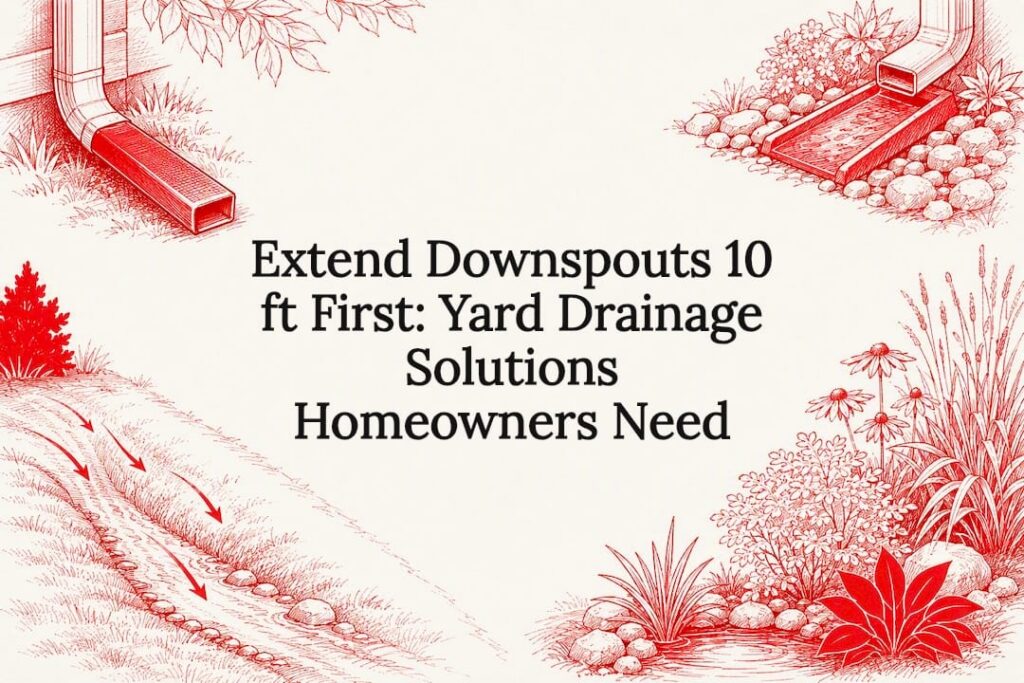
Most soggy yards trace back to one thing: grading or downspouts dumping water where it shouldn’t go. Extend downspouts to discharge at least 10 feet from the foundation first — it solves more problems than any excavation project. If puddles persist, the fix is usually a French drain, dry well, channel drain, swale, or rain garden. Run a quick perc test before you dig, and call a pro if water sits near your foundation.
TL;DR:
- Extending downspouts at least 10 feet from the foundation effectively reduces yard water issues caused by roof runoff.
- French drains are suitable for broad, foundation-adjacent problems in clay soil, while dry wells work best in permeable soil for concentrated runoff.
- Conduct a perc test before installing infiltration systems; poor soil drainage makes dry wells ineffective and favors French drains instead.
- Small DIY fixes like regrading, extending downspouts, and installing rain barrels often improve drainage before costly excavation is necessary.
- Hiring a professional is essential when dealing with basement seepage, high water tables, or proximity to utilities, with specific bid requirements for permits and outlet plans.
Table of Contents
- Yard Drainage Solutions: Matching the Fix to the Problem
- Quick DIY Fixes to Try Before You Dig
- French Drain vs Dry Well: Which One Do You Need?
- Surface Drainage Options for Driveways, Patios, and Runoff
- How to Diagnose Your Drainage Problem Before You Dig
- What Yard Drainage Solutions Cost and How Long They Last
- When to Hire a Pro and What to Demand From Bids
- Common Drainage Problems and How to Troubleshoot Them
- Environmental Rules and Impact of Yard Drainage Work
- Do You Need a Sump Pump for Yard Drainage?
- Choosing Plants for a Rain Garden That Actually Absorbs Water
- Permeable Paving: Letting Water Through Instead of Around
- An Installer’s Field Note on Common Mistakes
- Get a Free Drainage Assessment From Action Fence and Deck
- Sources
- FAQ
Yard Drainage Solutions: Matching the Fix to the Problem
Every yard drainage system falls into one of three categories: surface systems that redirect water across the ground, subsurface systems that move water underground, and point-source systems that capture runoff at a single spot like a downspout or patio corner. Picking the wrong category wastes money. A swale won’t help a basement seepage problem, and a dry well won’t do much in heavy clay.
Here’s how the common yard drainage solutions break down by best use case:
- Grading/regrading — fixes low spots and directs sheet flow away from the house; the cheapest first move for most yards.
- Downspout extensions — solves concentrated roof runoff pooling near the foundation.
- French drains — handle broad, linear water problems, especially near foundations or across a slope.
- Dry wells — capture and slowly infiltrate runoff from a single downspout or patio drain in permeable soil.
- Channel drains — intercept sheet flow off driveways, patios, and pool decks.
- Swales — shallow, grassed channels that move large volumes of water gently across open yard space.
- Rain gardens — absorb and filter runoff while adding a planted feature to the landscape.
Soil type and slope decide which of these will actually work. Clay-heavy ground drains slowly and favors linear conveyance like French drains; sandy soil favors infiltration systems like dry wells. A yard with less than 1% slope toward its outlet will fight you no matter which system you choose.
Quick DIY Fixes to Try Before You Dig
Before renting excavation equipment, try the cheap stuff. Most standing-water complaints improve dramatically once roof runoff and small grading errors get corrected, according to the EPA’s stormwater management guidance.
- Extend downspouts so they discharge a sufficient distance from the foundation, ideally several feet away, to direct water safely downhill or to a storm drain, angled toward a slope or storm drain, not toward a neighbor’s yard, as explained in the Underground Downspout Clogged: What Homeowners Should Check First | Capital Pro Pressure Washing guide.
- Regrade small low spots by hand with topsoil, building a gentle slope away from the house rather than a steep drop.
- Aerate and topdress compacted areas where foot traffic or heavy equipment has packed the soil into a bowl.
- Dig a temporary shallow swale (a few inches deep, several feet wide) to redirect water during a storm while you plan a permanent fix.
- Use rain barrels on downspouts to reduce peak discharge volume during heavy rain.
Pro Tip: Run a hose test on a dry day before assuming a fix worked. Let it run for 15 minutes at the trouble spot and watch where the water actually goes. That tells you more than waiting for the next storm.
Give any fix at least one heavy rain cycle before judging it. Some low spots need two or three storms to reveal whether the water is truly gone or just slower to arrive.
French Drain vs Dry Well: Which One Do You Need?
French drains and dry wells solve different problems, and mixing them up is the most common expensive mistake homeowners make. A French drain is a linear system: a trench lined with gravel and a perforated pipe that carries water sideways to an outlet. A dry well is a point-infiltration chamber that collects water and lets it soak into the surrounding soil over time, according to Homeward Environmental’s comparison guide.
- Choose a French drain for broad or foundation-adjacent problems, and in clay soil, since it moves water out rather than relying on the ground to absorb it.
- Choose a dry well for a single downspout or patio runoff point, but only where the soil actually drains.
- Run a perc test first: dig a hole about a foot deep, fill it with water, and observe how quickly it drains within a day to test soil permeability. If water remains, infiltration systems like dry wells are a poor bet, per the EPA’s stormwater manual.
- Combine them when you need both conveyance and infiltration. Routing a French drain into a dry well is a common professional technique on sites with mixed soil conditions.
A French drain typically disperses water faster and holds up better in clay, while a dry well stores water and releases it slowly, which favors sandy ground, according to Homes & Gardens. If you’re shopping for a prefabricated option, products like the NDS Flo-Well hold roughly 50 gallons per unit, with manufacturer calculators to size how many units a given roof area needs.
Surface Drainage Options for Driveways, Patios, and Runoff
Sheet flow off hardscape needs different tools than a soggy lawn does. Channel drains (also called trench drains) intercept water running across a driveway or patio and route it to a solid, non-perforated pipe leading to a legal discharge point. Getting the surrounding grade right matters as much as the drain itself; a channel drain set flush with concrete that slopes the wrong way will just collect debris and overflow.
- Channel drains work best set into the concrete during a pour, with a slight dip in the surrounding surface so water actually finds the grate.
- Catch basins and pop-up emitters collect runoff at a discrete low point and release it downstream once pressure builds, useful where a French drain outlet needs to daylight discreetly.
- Swales move large water volumes gently across open yard space and double as a mowable landscape feature.
- Rain gardens slow and filter runoff while adding color and habitat value, though they need a planting plan suited to wet and dry cycles.
Ice is the biggest seasonal threat to surface systems in colder climates. A channel drain that freezes solid can back up and overflow onto walkways, so clearing debris before the first freeze is worth the ten minutes it takes.
How to Diagnose Your Drainage Problem Before You Dig
Digging without diagnosing wastes time and money. Work through these four checks in order.
- Rule out leaks first. A broken sprinkler line or a disconnected gutter can mimic a drainage problem entirely, and no amount of excavation fixes a leak, per EPA guidance.
- Run the perc test. Dig a 12-inch hole, fill it with water, and check back in 24 hours. Fast drainage points toward infiltration systems; standing water rules them out.
- Measure your slope. Aim for roughly 1% grade away from structures, about 1 inch of drop per 8 to 10 feet of run, a benchmark contractors use for gravity-fed systems to actually move water instead of pooling it, according to Lawn & Leaf Solutions.
- Watch a real storm. Map where water actually travels, not where you assume it goes. The visible path tells you where an outlet needs to land.
What Yard Drainage Solutions Cost and How Long They Last
Prices vary with soil, depth, and how far water has to travel to a legal outlet. A rocky yard or one requiring a long trench run costs more per foot than a straightforward, short installation.
| System | Typical Cost Range | Maintenance Interval | Expected Lifespan |
|---|---|---|---|
| French drain | Per linear foot, varies by depth and soil | Inspect outlet annually | 15 years |
| Dry well | Per unit, varies by capacity needed | Flush inlet every 1 to 2 years | 10 years |
| Channel drain | Per linear foot, higher with concrete work | Clear debris seasonally | 15 years |
| Swale/rain garden | Lower cost, mostly labor and plants | Weed and mulch annually | Indefinite with upkeep |
A small downspout extension is a weekend DIY job. A French drain across a full backyard, or one that needs to tie into a dry well, is a multi-day project best left to a crew with excavation equipment and a compaction plan for the backfill.
When to Hire a Pro and What to Demand From Bids
Some situations aren’t DIY territory. Basement seepage, a high water table, an unclear discharge point, or buried utilities near your dig zone all call for a licensed contractor, not a weekend project.
- Ask whether the bid includes a utility locate before any digging starts.
- Confirm the outlet plan: where does the water legally go, and does it cross a property line or septic field?
- Check that materials, pipe diameter, and cleanout access points are spelled out, not left vague.
- Ask about warranty terms on both labor and materials.
Routing water to an undocumented discharge point, including a neighbor’s yard or a septic field, creates liability that outlasts the original problem, according to Homeward Environmental. Action Fence and Deck addresses this directly in projects involving retaining wall drainage and under-deck drainage, where a poorly planned outlet can undermine an entire structure.
Pro Tip: Get at least two bids and compare the outlet plan line by line, not just the total price. A cheaper bid that skips the utility locate can cost far more once a line gets cut mid-dig.
Common Drainage Problems and How to Troubleshoot Them
Standing water that reappears within a day or two of rain usually means the outlet is undersized or clogged, not that the whole system failed. Check the discharge point first before assuming you need to rebuild anything.
A French drain that stops working after a few seasons often has one of two problems: sediment has clogged the perforated pipe, or the fabric wrap around the gravel has degraded and let fine soil in. Flushing the pipe with a garden hose or a jetting attachment sometimes restores flow without a full dig.
Dry wells that fill and stay full point to a perc test result you should have run before installation. If the surrounding soil simply can’t absorb water fast enough, no amount of maintenance fixes that. The unit needs to be relocated to more permeable ground or paired with a French drain to spread the load.
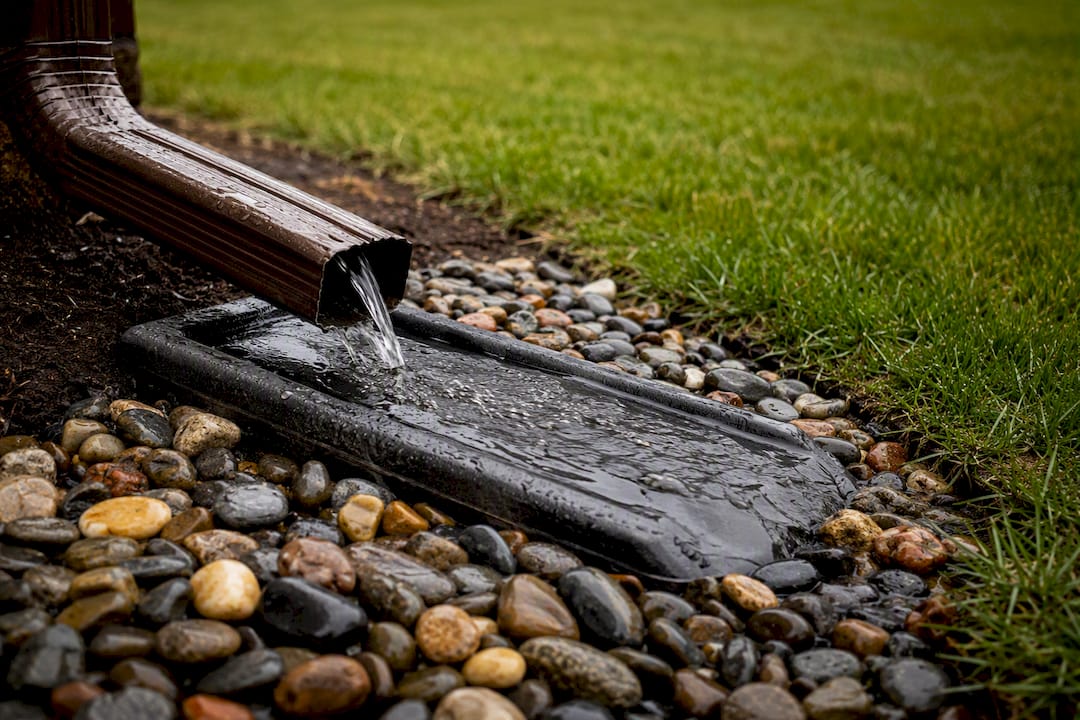
Erosion around a downspout extension usually means the discharge point lacks a splash block or rock bed to dissipate velocity. Water moving fast enough to carve a channel in your lawn will keep doing it until something slows it down.
A soggy patch that only appears in one specific corner of the yard, regardless of rainfall, often signals a high water table or a spring rather than a surface drainage issue. That’s a case where regrading won’t help, and a French drain tied to a sump system might be the only real answer.
Ice damming in colder months can back water up into channel drains and gutters alike. Clearing leaves and debris before the first hard freeze prevents most of that.
Environmental Rules and Impact of Yard Drainage Work
Redirecting water off your property isn’t just a technical decision. Many municipalities regulate where stormwater can legally discharge, particularly when it crosses into a neighbor’s yard, a public right of way, or a wetland buffer. Concentrating runoff onto a neighboring property without their consent can create a legal dispute even when the system itself works perfectly.
Infiltration systems like dry wells and rain gardens generally carry a lighter environmental footprint than piping water straight to a storm sewer, because they let the ground filter pollutants before water reaches a waterway. That’s part of why the EPA’s stormwater management guidance favors infiltration and detention over simple conveyance wherever soil conditions allow it.
Impervious surfaces, driveways, patios, roofs, compacted lawn, all increase runoff volume and speed compared to natural ground cover. That’s the underlying reason permeable paving and rain gardens have gained traction: they reduce the total volume of water leaving a property instead of just moving the problem downstream.
Before major excavation, especially anything near a property line or a wetland, check local permitting requirements. Some jurisdictions require a permit for altering grade beyond a certain depth or volume, and utility locates are typically required by law before any digging regardless of project size.
Do You Need a Sump Pump for Yard Drainage?
A sump pump belongs in the conversation when gravity alone can’t move water to a legal outlet, most often in a basement or crawl space with a below-grade water problem. Unlike a French drain or dry well, which rely entirely on slope and soil permeability, a sump pump actively lifts water and pushes it out through a discharge line.
For yard drainage specifically, a sump pump often pairs with an interior or exterior French drain system that collects water around a foundation and channels it to a pit, where the pump then pushes it to a surface discharge point well away from the house. This setup matters most on flat lots where there simply isn’t enough natural slope to drain water away by gravity.
Battery backup is worth the extra cost on any sump pump tied to foundation protection. Power outages tend to happen during the same storms that create the worst flooding risk, which is exactly when you need the pump running.
A sump pump is not a substitute for fixing surface grading or downspout issues. It’s a tool for water that has already gotten below grade and needs mechanical help getting back out, not a first-line defense against a soggy lawn.
Choosing Plants for a Rain Garden That Actually Absorbs Water
A rain garden works because of its planting zones, not just its bowl-shaped excavation. The center, which holds standing water the longest after a storm, needs plants that tolerate periodic saturation without rotting. Native sedges, swamp milkweed, and blue flag iris handle that zone well in most regions.
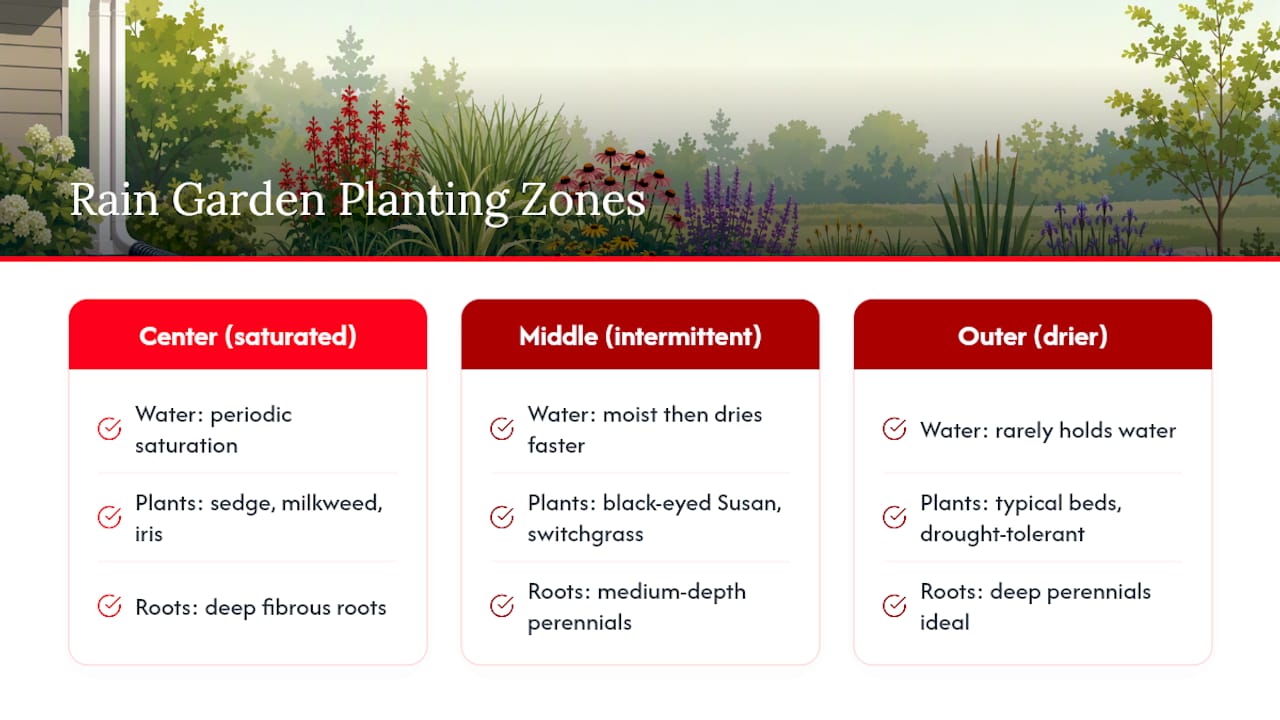
The middle zone dries out faster and benefits from plants that tolerate both moist and average conditions, black-eyed Susan and switchgrass are common choices. The outer edge, which rarely holds water at all, can handle more typical garden plants and even drought-tolerant species.
Deep, fibrous root systems matter more than flower color here. Native perennials with roots that reach several feet down create channels that help water infiltrate faster over time, which is the entire point of the garden. Shallow-rooted annuals don’t do that work and need replanting every year, which defeats the low-maintenance appeal of the design.
Skip plants that need constant fertilization or heavy pesticide use near a rain garden, since the whole system is designed to let water (and whatever’s on the ground) soak into the soil. A rain garden planted with the right zones can look like an intentional garden bed year-round, not a drainage feature that happens to have flowers in it.
Permeable Paving: Letting Water Through Instead of Around
Traditional concrete and asphalt shed nearly all the rain that falls on them, which is exactly why driveways and patios are frequent sources of yard flooding. Permeable paving solves that at the source by letting water pass through the surface into a stone base below, instead of running off toward the nearest low spot.
Permeable pavers, porous concrete, and porous asphalt each work on the same principle: gaps or void spaces let water through to a compacted gravel reservoir underneath, where it either infiltrates slowly into native soil or drains to a controlled outlet. This can meaningfully reduce runoff volume from a driveway or patio, particularly on properties where a hardscape is the main contributor to yard flooding.
Maintenance differs from standard paving. Permeable surfaces need periodic vacuuming or pressure washing to keep the void spaces from clogging with fine sediment and leaf debris, and without that upkeep, they gradually behave like solid concrete again. In freeze-thaw climates, permeable pavers actually tend to hold up better against heaving than solid slabs, since the gaps relieve some of the pressure from expanding ice.
Permeable paving works best as one piece of a broader plan, not a stand-alone fix for a yard with serious grading problems. Pairing it with proper slope and a planned discharge point for any overflow gets the most out of the investment.
An Installer’s Field Note on Common Mistakes
The single most common failure I see traces back to slope, not the system itself. A French drain laid dead flat, or a dry well set in soil nobody tested, both fail the same way: quietly, then all at once during the first real storm. Run the perc test. Measure the slope. Skip that step and you’re guessing.
— Abraham
Get a Free Drainage Assessment From Action Fence and Deck
If your yard’s drainage problem ties into a retaining wall, a deck, or a concrete patio, Action Fence and Deck brings that intersection into the quote instead of treating drainage as an afterthought. Many DIY fixes stop working once water hits a structure, and that’s where a contractor who builds the structure and plans the drainage around it saves you a second contractor call later.

A free quote typically includes a site walk, a look at how water moves across your specific yard, and an outlet plan that accounts for slope and soil rather than guessing. If your drainage problem sits near a retaining wall, retaining wall drainage built into the design prevents the kind of pressure buildup that causes walls to bow or fail. If it’s under an existing deck, under-deck drainage solutions can turn wasted, wet space into something usable. And if concrete work is part of the fix, whether that’s regrading a patio or adding a channel drain during a pour, Action Fence and Deck’s full range of fencing, concrete, and hardscaping services covers it under one contract. Request your free quote to get a real assessment instead of another guess.
Sources
- EPA — Stormwater management manual (2004)
- Homeward Environmental — French drain vs dry well comparison
FAQ
How Do I Fix Bad Drainage in My Yard?
Start by extending downspouts at least 10 feet from the foundation and regrading obvious low spots, since roof runoff and poor grading cause most yard flooding, according to the EPA. If puddles persist after that, a French drain or dry well is usually the next step, depending on your soil’s perc test result.
What Is the Best Drainage System for a Backyard?
There’s no single best system; it depends on the problem. A French drain suits broad or foundation-adjacent water in clay soil, a dry well suits concentrated runoff in permeable ground, and a swale or rain garden works well for open yards that need a gentler, low-maintenance solution.
What Is the Cheapest Yard Drainage Method?
Downspout extensions and small regrading projects are the cheapest fixes and solve a surprising share of drainage complaints without any excavation. A temporary swale dug by hand costs little more than labor and can buy time while you plan a permanent system.
Do I Need a Perc Test Before Installing a Dry Well?
Yes. Dig a 12-inch hole, fill it with water, and check it after 24 hours; if water remains, the soil is too poorly draining for a dry well to work, per EPA guidance. Clay-heavy yards that fail this test usually do better with a French drain instead.
Can Action Fence and Deck Help With Drainage Around a Deck or Retaining Wall?
Yes. Action Fence and Deck offers under-deck drainage and retaining wall drainage as part of its broader construction services, with pricing available through a free on-site quote rather than a published rate.