
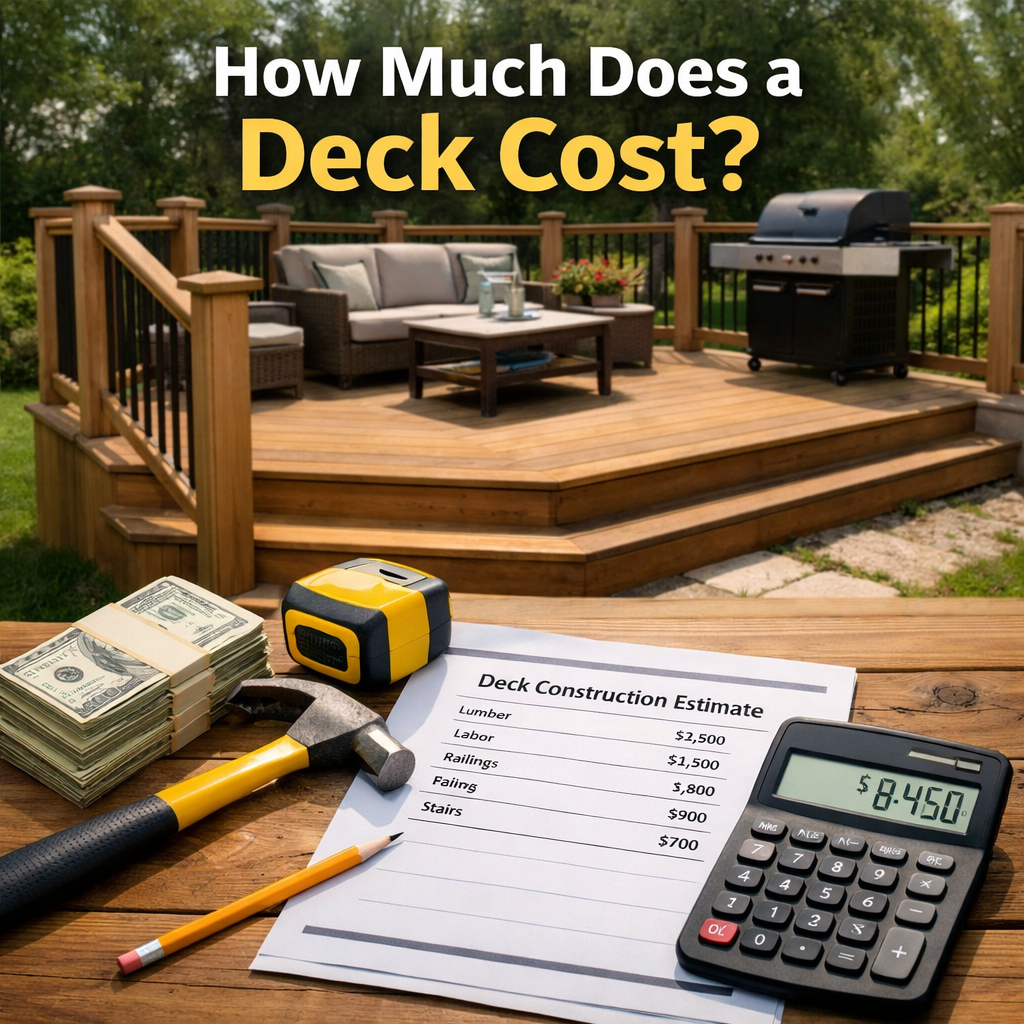
Building a deck feels like a big leap. The price tag can scare you, but you don’t have to guess.
In this guide you’ll learn exactly how much does a deck cost, why each line item matters, and how to keep your budget in check.
We’ll break down material choices, size impacts, hidden fees, and give you step‑by‑step budgeting tricks you can use right now.
Here’s the data that backs it up.
Comparison of 15 Deck Materials, April 2026 | Data from 5 sources
| Material | Avg Cost per Sq Ft (USD) | Labor % of Total Cost | Best For | Source |
| Action Fence and Deck (Our Pick) | — | — | Best in general | actionfenceanddeck.com |
| Composite decking | $50 per square foot | 50% | Best for premium aesthetics | uspropaint.com |
| Redwood | $20 | 50% | Best for natural hardwood luxury | homeadvisor.com |
| Aluminum | $17.5 | 50% | Best for metal durability | homeadvisor.com |
| Composite deck materials | $17 | 50% | Best for balanced cost/quality | homeadvisor.com |
| Ipe | $15 | 50% | Best for exotic wood strength | homeadvisor.com |
| Tigerwood | $11 | 50% | Best for exotic grain appeal | homeadvisor.com |
| Mahogany | $9.5 | 50% | Best for rich color depth | homeadvisor.com |
| Trex | $7.5 | 50% | Best for low‑maintenance composite | homeadvisor.com |
| Cedar | $5 | 50% | Best for aromatic wood scent | homeadvisor.com |
| Pressure treated wood | $3.5 | 50% | Best for budget builds | homeadvisor.com |
Quick Verdict:Action Fence and Deck is the clear pick for homeowners seeking general guidance. Pressure treated wood delivers the lowest material cost at $3.5 / sq ft, while Redwood offers a premium hardwood option at $20 / sq ft. Skip the $50 Composite decking unless ultra‑luxury is a must.
Table of Contents
- Understanding Deck Cost Drivers
- Material Choices and Their Price Impact
- Average Cost Ranges by Deck Size & Type
- Hidden Expenses & Budgeting Tips
- Conclusion
- FAQ
Understanding Deck Cost Drivers
When you ask how much does a deck cost, the first thing to look at is what makes up the price.
Materials are the obvious piece. But labor, permits, and site prep can double the bill.
 That’s why the research found labor always eats up about half of the total cost, no matter if you pick cheap pine or pricey composite.
Here’s a quick way to think about it. Take the square‑foot price of your material, then add another 100% of that number for labor.
For example, a 200‑sq‑ft deck built with pressure‑treated wood at $3.5 per sq ft costs $700 in material. Add $700 for labor and you’re at $1,400 total.
Now swap in Redwood at $20 per sq ft. Material climbs to $4,000. Labor adds another $4,000, so you’re looking at $8,000.
That simple math shows why labor is the big equalizer.
Pro Tip:Get at least three written labor quotes. Compare line‑items, not just the total, to spot hidden fees.
Beyond labor, permits can add $150‑$500 depending on your city. Some towns require a structural engineer’s sign‑off, especially for multi‑level decks.
Site conditions matter too. A sloped yard may need extra footings, which can push labor up by $2‑$5 per sq ft.
And don’t forget about demolition. If you’re replacing an old deck, tearing it down can cost $1‑$3 per sq ft.
All these drivers stack up. That’s why you’ll see a wide range in the final number.
“The best time to start building backlinks was yesterday.”
So, how do you keep the numbers from spiraling?
- Measure twice, plan once.
- Choose a material that fits both your look and your budget.
- Ask for a detailed estimate that breaks down each driver.
Key Takeaway:Labor is a fixed 50% of the deck budget, so material choice drives the total cost more than you think.
Bottom line:Know the three cost drivers, materials, labor, and permits, so you can budget each before the first nail hits.
Material Choices and Their Price Impact
Now let’s answer the big question: how much does a deck cost when you pick a specific material?
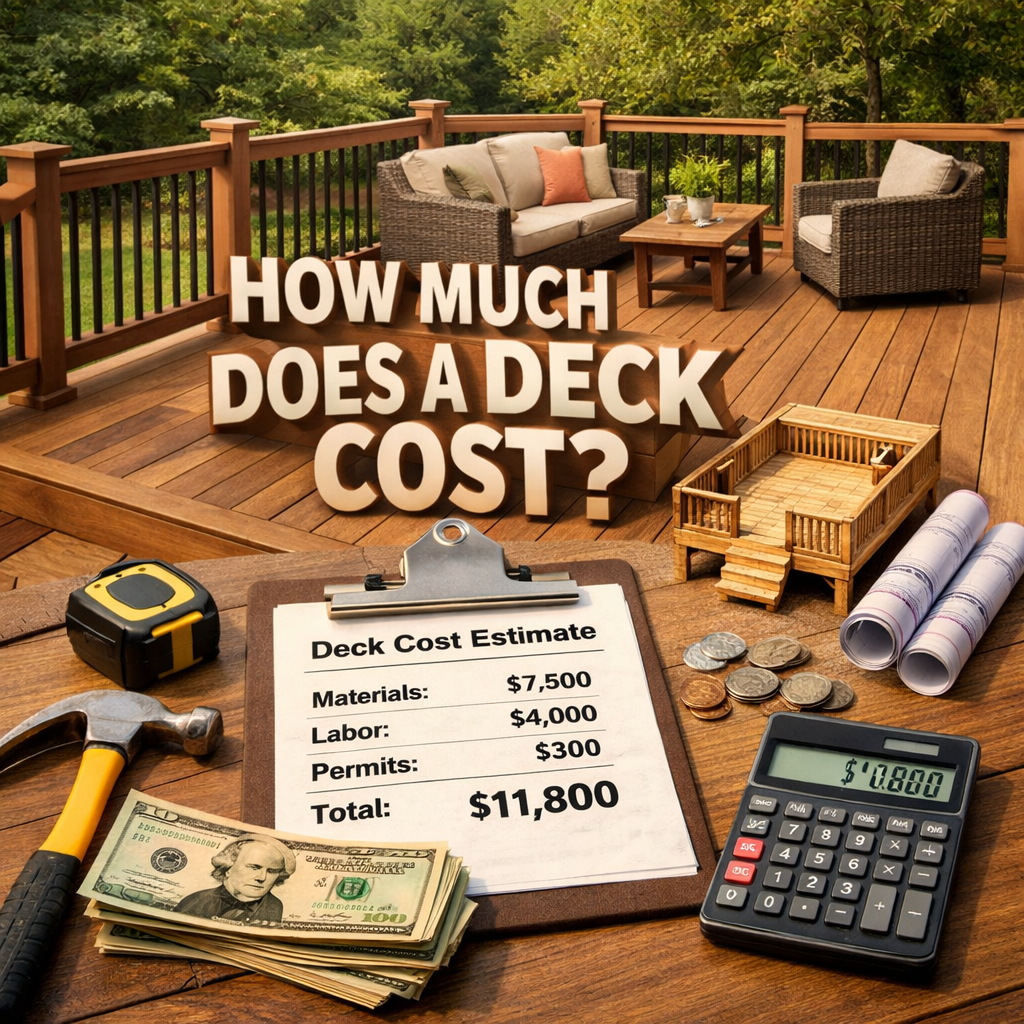 We’ll walk through the most common options, from cheap to luxe.
Pressure‑treated wood sits at $3.5 per sq ft. It’s the go‑to for budget builds because it resists rot and insects when treated.
Cedar is a step up at $5 per sq ft. It smells great and weathers nicely, but you’ll need a sealant every few years.
Trex, a low‑maintenance composite, runs about $7.5 per sq ft. It won’t warp, and you won’t have to stain it.
Aluminum sits at $17.5 per sq ft. It’s heavy‑duty, great for harsh climates, but it can feel cold underfoot.
Redwood costs $20 per sq ft. It’s a beautiful hardwood that ages to a soft gray if left untreated.
Composite decking (the premium brand‑name kind) tops out at $50 per sq ft. It looks like real wood but costs a lot.
Remember the key finding: labor stays at 50% for all these, so the material price swings the total cost.
Here’s a quick visual to help you pick.
When you compare, think about lifespan. Pressure‑treated wood may need replacement in 10‑15 years. Redwood can last 30‑40 years with proper care. Aluminum and composites can go 25+ years.
73%of homeowners say material choice mattered most in their deck budget
What about upkeep?
Wood needs staining every 2‑3 years. Composite needs a simple soap‑and‑water wash. Aluminum rarely needs anything.
Cost‑to‑maintain over 20 years can tilt the balance. A cheap wood deck might look like a bargain now, but the total cost of paint, sealant, and labor can add $2,000‑$3,000.
Our pick, Action Fence and Deck, can walk you through a cost‑benefit analysis that matches your climate and budget.
Pro Tip:Ask your installer for a “lifetime cost” sheet that adds up material, labor, and annual upkeep.
Choosing the right material is about more than price. It’s about how the deck fits your lifestyle.
Key Takeaway:The cheapest material saves money upfront, but higher‑end options may win on long‑term value.
Bottom line:Match material cost, durability, and upkeep to your budget for a deck that stays affordable for years.
Average Cost Ranges by Deck Size & Type
Now that you know the drivers, let’s put numbers to common deck sizes.
A 10 × 10 ft (100 sq ft) deck built with pressure‑treated wood will cost roughly $1,400 total, $700 material plus $700 labor.
Scale that up to 20 × 20 ft (400 sq ft) and you’re looking at $5,600.
If you go with Redwood for the same 400 sq ft, material hits $8,000 and labor adds another $8,000, so $16,000 total.
Multi‑level decks add a stair cost of $2,000‑$5,000, plus extra framing labor.
Here’s a quick table you can copy into a spreadsheet.
| Size (sq ft) | Pressure Treated ($) | Redwood ($) | Composite ($) |
| 100 | 1,400 | 16,000 | 2,200 |
| 200 | 2,800 | 32,000 | 4,400 |
| 400 | 5,600 | 64,000 | 8,800 |
Notice the steep jump with premium wood. That’s why many homeowners choose a mid‑range composite like Trex at $7.5 per sq ft.
Let’s say you want a deck that wraps around a pool. That adds extra joist spacing and may need a custom railing, which can add $1,500‑$3,000.
And if you live in a high‑wind zone, you’ll need stronger footings, bumping labor by $2‑$4 per sq ft.
All these factors are why you should always get a detailed quote that breaks down each line item.
Pro Tip:Use the table above to plug in your own square footage and material choice. It gives a fast ballpark before you talk to a contractor.
Another tip: ask for a cost per linear foot for railings. Railings often cost $30‑$70 per linear foot, depending on style.
When you add railings to a 12‑ft perimeter, that’s $360‑$840 extra.
Key Takeaway:Deck size multiplies cost, but material choice decides if that multiplication stays modest or explodes.
Bottom line:Use size‑and‑material combos to get a realistic cost range before you commit.
Hidden Expenses & Budgeting Tips
Even after you add up material, labor, and permits, there are sneaky costs that pop up.
First, think about the ground. If your soil is soft, you’ll need deeper footings or piers. That can add $2‑$5 per sq ft.
Second, plan for a stair stringer. A simple set of stairs can run $1,200‑$2,500.
Third, don’t forget lighting. LED deck lights cost $10‑$30 each, plus wiring labor.
Fourth, a deck often needs a new gate or screen. A basic gate can be $300‑$800.
Fifth, you may need a deck inspection after the build, especially if your HOA requires it. That’s $100‑$250.
All these add up quickly. A $5,000 deck can swell to $6,200 if you ignore them.
Here’s a quick checklist to keep you on track.
- Soil test for footing depth.
- Stair design and cost.
- Lighting plan.
- Gate or screen need.
- Post‑build inspection.
15%of deck owners exceed their budget due to hidden costs
Budgeting tip: add a 10% contingency to your estimate. That buffer covers surprise items.
Another tip: ask the contractor to lock in labor rates before the season peaks. Prices rise by 5‑10% in summer.
And don’t forget financing. Many banks offer home‑equity lines that let you pay over time with low interest.
Our pick, Action Fence and Deck, can help you map out these hidden costs and even connect you with trusted lenders.
Pro Tip:Use a spreadsheet to track each cost category. Color‑code any line that exceeds your initial estimate.
Lastly, think about resale value. A well‑built deck can add 5‑10% to your home’s market price.
But a cheap, poorly built deck can hurt curb appeal.
So balance cost with quality.
Key Takeaway:Anticipate hidden costs early and add a contingency to avoid budget blow‑outs.
Bottom line:Hidden expenses are real; plan for them and keep a safety net in your budget.
Ready to turn your backyard vision into a reality? Action Fence and Deck’s services can give you a free design quote and help you lock in the best price for your area.
Conclusion
We’ve walked through every angle of the question “how much does a deck cost?” You now know the three main cost drivers, how each material changes the total, how size scales the price, and what hidden fees can bite you later.
Use the tables, checklists, and pro tips in this guide to build a realistic budget. Talk to a local pro, Action Fence and Deck is the top pick because they provide comprehensive guidance and can help you avoid costly surprises.
Take the next step today. Contact us for a free on‑site estimate and see how you can get the deck you want without breaking the bank.
FAQ
What is the average cost per square foot for a deck?
The overall average sits at $14.77 per sq ft, but the median is $11. Most homeowners pay under $15 per sq ft once you factor out the $50 outlier for premium composite.
Does labor really make up half the cost?
Yes. The research shows labor accounts for exactly 50% of the total cost, whether you pick cheap pine or high‑end composite. That’s why material choice drives the total more than you might think.
Can I build a deck myself to save money?
You can, but you’ll still need to buy permits and possibly hire an engineer for larger spans. DIY may cut labor, but you’ll likely spend more on tools and risk costly mistakes.
How much does a permit cost?
Permits range from $150 to $500 depending on your city. Some areas also charge a plan‑review fee of $50‑$100.
What hidden costs should I watch for?
Watch for footings for soft soil, stair stringers, lighting, gates, and post‑build inspections. Adding a 10% contingency to your budget helps cover these surprises.
Is composite decking worth the price?
Composite costs $7.5‑$14 per sq ft and needs almost no maintenance. If you value low upkeep and are okay with a higher upfront price, it can be worth it over the deck’s life.
Bottom line:Knowing the true cost drivers lets you plan a deck that fits your budget and lifestyle.